Torque and Force question -- Multipe forces acting on an object

Click For Summary
SUMMARY

The discussion centers on the analysis of torque and force acting on an object with multiple forces. Participants emphasize the importance of understanding the vector sum of forces, particularly distinguishing between parallel and antiparallel forces. The conversation highlights the need for clarity in problem statements to avoid contradictions in force and torque balance equations. A consistent approach in applying these equations is crucial for accurate results.

PREREQUISITES
  • Understanding of vector forces and their resultant calculations
  • Knowledge of torque and its relation to force
  • Familiarity with equilibrium conditions in mechanics
  • Ability to interpret and analyze problem statements in physics
NEXT STEPS
  • Study the principles of vector addition in physics
  • Learn about torque calculations and their applications
  • Research equilibrium conditions for systems with multiple forces
  • Examine case studies involving parallel and antiparallel forces
USEFUL FOR

Students and professionals in physics, mechanical engineering, and anyone involved in analyzing forces and torques in mechanical systems.
shivam2571
Messages
1
Reaction score
0
Homework Statement
The resultant of two unlike parallel forces is10N and acts at a distance of 35cm and 45cm from them. The forces are:
Relevant Equations
F1.d1=F2.d2 (d is perpendicular distance of Axis of rotation to line of action)
F1-F2=10 (since forces are unlike and parallel)
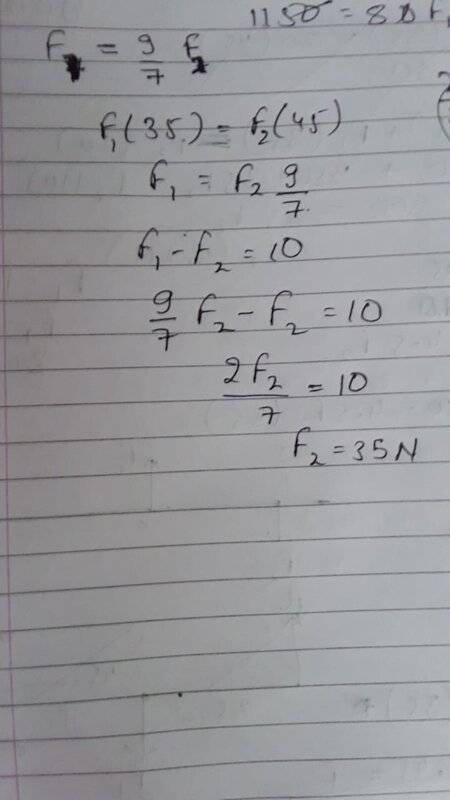
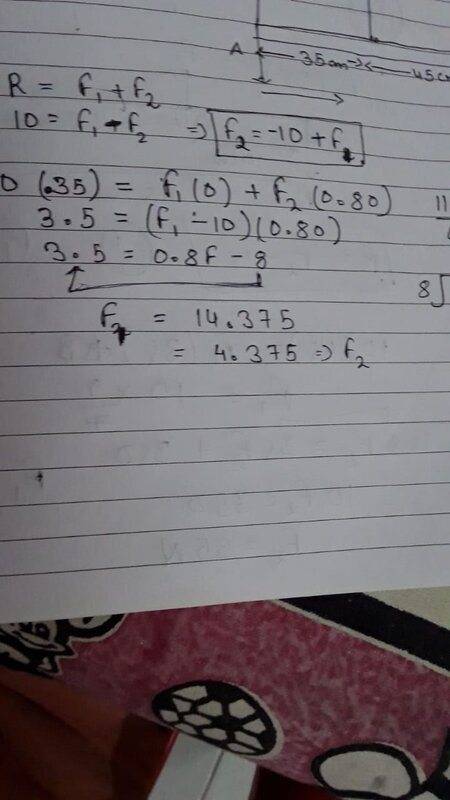
I have attempted and got 2 different solution
1:
1st.jpg

2:
2nd.jpg
 
Last edited by a moderator:
Physics news on Phys.org
Welcome! :cool:
What about the moments?
Is there equilibrium of moments in the system?
 
There seems to be a contradiction in what you posted. The resultant is the vector sum of two forces. If the forces are parallel, the resultant is the sum of the magnitudes. You use the difference of the magnitudes to denote the resultant. That to be correct if the forces are antiparallel, i.e. point in opposite directions. Which is it, parallel or antiparallel?

Better yet, please post the problem statement exactly as was given to you.
 
kuruman said:
There seems to be a contradiction in what you posted. The resultant is the vector sum of two forces. If the forces are parallel, the resultant is the sum of the magnitudes. You use the difference of the magnitudes to denote the resultant. That to be correct if the forces are antiparallel, i.e. point in opposite directions. Which is it, parallel or antiparallel?

Better yet, please post the problem statement exactly as was given to you.
I think the OP is using "unlike" to mean opposite directions.
 
shivam2571 said:
I have attempted and got 2 different solution
1:

2:
In your second solution, your force balance equation assumes the resultant acts in the same direction as as F1, but your torque balance equation assumes it acts in the same direction as F2.
The diagram places the resultant between the two forces. If that were so, taking moments about a point in its line could not produce zero. Had you been consistent in your two equations, I expect you would have got a negative value for one of the forces.
 
haruspex said:
I think the OP is using "unlike" to mean opposite directions.
I took to mean unequal but I can see the interpretation with a hyphen as in unlike-parallel. In any case without a clear statement of the problem as given to OP, one can only guess what it could be. It looks like quite a bit has been lost in translation.
 

Similar threads

Replies
30
Views
4K
Replies
43
Views
2K
  • · Replies 12 ·
Replies
12
Views
1K
  • · Replies 8 ·
Replies
8
Views
2K
  • · Replies 25 ·
Replies
25
Views
2K
Replies
12
Views
1K
  • · Replies 11 ·
Replies
11
Views
2K
Replies
6
Views
2K
  • · Replies 5 ·
Replies
5
Views
2K
Replies
6
Views
2K