Torque calculation of solar tracker

Click For Summary

Discussion Overview

The discussion revolves around calculating the torque required for a solar tracking system. Participants explore various aspects of torque calculation, including the influence of the center of gravity, moment of inertia, and external forces such as wind. The conversation encompasses theoretical considerations and practical implications for design.

Discussion Character

  • Technical explanation
  • Debate/contested
  • Mathematical reasoning

Main Points Raised

  • One participant expresses confusion about calculating torque, specifically questioning whether to use the radius of the shaft or the cylindrical base for calculations.
  • Another participant clarifies that the radius should relate to the horizontal displacement of the center of gravity, while the force is the weight of the structure.
  • A different viewpoint emphasizes the need to consider the torque required to accelerate the assembly and suggests using the mass moment of inertia and angular acceleration for calculations.
  • Some participants argue that the required rotation speed and acceleration to follow the sun may be negligible, but the motor must overcome the torque due to the weight of the structure.
  • Concerns are raised about the inertia of the structure and the need to account for various resistances to rotation, including friction and wind forces.
  • Participants discuss the importance of calculating the moment of inertia about the desired rotational axis and the potential need to use the parallel axis theorem when the center of mass does not align with the axis of rotation.
  • One participant provides a specific calculation example involving torque requirements based on mass and distance to the axis of rotation.
  • There is a suggestion to consider the impact of wind forces on the structure, indicating that these forces may significantly influence the torque requirements.

Areas of Agreement / Disagreement

Participants express differing views on the significance of various factors in torque calculations, including the relevance of acceleration, weight, and external forces. The discussion remains unresolved, with multiple competing perspectives on how to approach the calculations.

Contextual Notes

Participants mention the need for specific calculations and considerations that depend on the design parameters of the solar tracker, including the center of gravity and the effects of wind. There are unresolved aspects regarding the exact moment of inertia to use and how to account for different forces acting on the system.

vtaela
Messages
25
Reaction score
0
hi

i am currently designing a solar tracking system. i am confused at the point of calculating the torque required to rotate the solar tracker. i have a shaft in the cylinder which is rotating with 4RPM.

i know that Power= Toque* angular velocity or 2*pi*RPM* Torque

where Torque is= Force* radius

radius= should i take the radius of the shaft? ( please see the picture)
Force= how can i calculate the force?
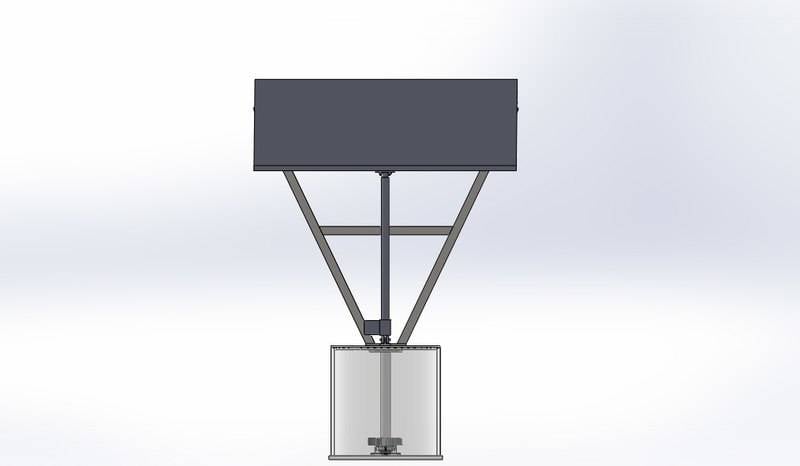
progress assembly.JPG


i know its stupid but i am confused and i need to continue with this

thank you
 
Engineering news on Phys.org
For gravity, radius is the horizontal displacement of the center of gravity of the system relative to your axis. And force is just the weight of the structure.
 
could you please be more specific? in my case do i take the radius of the shaft or the radius of the cylindrical base attached to the shaft?

thank you
 
I think my post is as specific as possible. Do you know the concept of the center of gravity?
Can you determine the position of your center of gravity?
 
Ummmm...no. Wrong approach.

You want torque required to turn the assembly. More specifically, you want the torque required to accelerate that assembly to a desired rotational speed in a desired time. That is

T = Jα

Torque = (Mass Moment of Inertia of the Assembly about the shaft) X ( angular acceleration)

...and angular acceleration is approximated by ΔAngularVelocity / ΔTime .

But this is not sufficient. You must size the driver/motor/gearing for maximum peak torque. That includes rotational inertial torque plus every other resistance to rotation that you can dream up (friction, stiction, wind, gravity, cobwebs, yadda yadda yadda). You need to analyze it for slowing down to a stop & holding it steady also. Then awww, what the heck, double that and use that to size your driver/motor/gearing.

If this assembly is designed with a CAD system of any useful power, then you can use the CAD system to calculate the MMI about the shaft. It can be done manually, but it would sure be tedious.

The only instance of using "radius" for this type of analysis was if you have a Radius of Gyration of the assembly...but that's too darn much trouble to fool with.
 
The required rotation speed and acceleration to follow the sun is negligible, but the motor has to overcome the torque due to the weight of the structure.
 
Mass properties of progress assembly ( Assembly Configuration - Default )

Output coordinate System: -- default --

The center of mass and the moments of inertia are output in the coordinate system of progress assembly
Mass = 50454.14 grams

Volume = 30048791.17 cubic millimeters

Surface area = 5588654.59 square millimeters

Center of mass: ( millimeters )
X = -45.25
Y = 58.44
Z = 527.49

Principal axes of inertia and principal moments of inertia: ( grams * square millimeters )
Taken at the center of mass.
Ix = (-0.01, -0.00, 1.00) Px = 3565295302.31
Iy = (0.51, -0.86, -0.00) Py = 16485736325.98
Iz = (0.86, 0.51, 0.01) Pz = 17926686404.42

Moments of inertia: ( grams * square millimeters )
Taken at the center of mass and aligned with the output coordinate system.
Lxx = 17554525288.05 Lxy = -630256839.06 Lxz = -72393884.81
Lyx = -630256839.06 Lyy = 16857393767.64 Lyz = -44632156.42
Lzx = -72393884.81 Lzy = -44632156.42 Lzz = 3565798977.02

Moments of inertia: ( grams * square millimeters )
Taken at the output coordinate system.
Ixx = 31765453901.78 Ixy = -763673439.14 Ixz = -1276546609.18
Iyx = -763673439.14 Iyy = 30999270315.94 Iyz = 1510802666.01
Izx = -1276546609.18 Izy = 1510802666.01 Izz = 3841422169.88


i got the above results from solid works. i am lost.. moment of inertia should i use?

thank you
 
The required rotation speed and acceleration to follow the sun is negligible, but the motor has to overcome the torque due to the weight of the structure.
Perhaps not. It's a simple calculation to be sure, and a disastrous project if it is not negligible. If one must accelerate a massive object to even a slow speed, significant torque must be applied to get it moving from zero speed. Once the mass is in motion, then the torque requirement will be reduced. Only if the motor must overcome gravity effects of the "weight" and therefore must counteract an induced torque T=WgL. Otherwise it's **inertia**. The wide dimension of this panel structure will produce a significant inertia due to the distributed masses away from the axis of rotation.

Regarding whether your SolidWorks-calculated inertia is Ix, Iy, Izz, or anything else: You must get the Mass Moment of Inertia of the mass **about the desired rotational axis**.

This is probably NOT the CAD model coordinate system axes that are given by the values you listed. So you must read the SW help file and (what? don't remember exactly) either have it calculate about a new reference geometry Axis or new reference geometry Coordinate System that you assign at the correct location to give you the answers you need.
 
It's a simple calculation to be sure
So why didn't you do it?

The system just has to complete one cycle per day. Let's assume it accelerates from rest to ##\omega=\frac{\pi}{24hours}## in 1 second (quite quick!). For a point-mass m with distance d to the axis, this requires a torque of ##md^2\frac{\pi}{86400s^2}##. Required static torque due to its angle relative to the vertical position is ##md\sin(\alpha)g##.

Assuming d<100m (we don't want to rotate a skyscraper, right?), static torque is larger for ##\alpha>0.00037##. For d=100m, this is a deflection of just 4cm at the top. I am sure the system is designed to operate with angles some orders of magnitude larger. It is easy to extend this analysis to arbitrary shapes, the conclusion stays valid as long as the structure does not exceed 100m (or 1000m, if you remove one 0 from the angle...).
 
  • #10
thank you very much both of you
 
  • #11
Acceleration torque is moment of inertia about rotational axis times the angular acceleration.

but Should we factor ------- Weight of payload X Distance between motor axis and CG of payload as well ??

And add both of them?
 
  • #12
mfb said:
The required rotation speed and acceleration to follow the sun is negligible, but the motor has to overcome the torque due to the weight of the structure.

It also has to overcome wind force on the structures (panels I presume). Worst case wind force is likely an order of magnitude higher than those other forces.

You need a design wind speed. You also need to rapidly move the panels to the feather position if winds exceed design speed. Alternatively, you would need a clutch to decouple the drive system and design the aerodynamics of the structure to self feather like a wind vane does.
 
  • #13
anilks said:
Acceleration torque is moment of inertia about rotational axis times the angular acceleration.

but Should we factor ------- Weight of payload X Distance between motor axis and CG of payload as well ??

And add both of them?

You must use the parallel axis theorem to find the proper moment of inertia (including payload) when the center of mass does not coincide with the axis of rotation:
1d0a8cfeb36821096b25a1df551318e5.png
 
  • #14
anilks said:
Acceleration torque is moment of inertia about rotational axis times the angular acceleration.

but Should we factor ------- Weight of payload X Distance between motor axis and CG of payload as well ??

And add both of them?
Yes. This has been answered over a month ago in the previous posts.
 

Similar threads

  • · Replies 6 ·
Replies
6
Views
3K
  • · Replies 9 ·
Replies
9
Views
2K
  • · Replies 2 ·
Replies
2
Views
2K
  • · Replies 5 ·
Replies
5
Views
5K
  • · Replies 8 ·
Replies
8
Views
3K
  • · Replies 1 ·
Replies
1
Views
4K
  • · Replies 4 ·
Replies
4
Views
3K
Replies
10
Views
2K
Replies
5
Views
3K
Replies
3
Views
5K