Torsion on a shaft calculated by hand vs FEA

Click For Summary
SUMMARY

This discussion focuses on the discrepancies between hand calculations and Finite Element Analysis (FEA) results for torsion on a shaft, specifically in the context of a Brushless DC (BLDC) motor. The user is modeling a shaft with varying diameters and is confused about where to apply the torque in their calculations. It is established that the driving torque from the motor acts on the thicker part of the shaft, while the reaction torque from the load acts on the thinner part. The differences in results between hand calculations and FEA stem from the varying locations of torque application and the inherent assumptions in each method.

PREREQUISITES
  • Understanding of torsion calculations in mechanical engineering
  • Familiarity with Finite Element Analysis (FEA) principles
  • Knowledge of torque application in rotating machinery
  • Experience with modeling shafts in CAD software
NEXT STEPS
  • Study the principles of torsion in shafts using the "Torsion of Circular Shafts" textbook
  • Learn about FEA software tools such as ANSYS or SolidWorks Simulation
  • Research the effects of varying shaft diameters on torsional stiffness
  • Explore the concept of reaction torque in mechanical systems
USEFUL FOR

Mechanical engineers, FEA analysts, and anyone involved in the design and analysis of rotating machinery, particularly those working with BLDC motors and shaft torsion calculations.

fahraynk
Messages
185
Reaction score
5
Hi, I am a bit confused. So I have a shaft with a step on both sides so it gets really large in the middle. I am trying to model torsion on the rotor of a BLDC motor with FEA (or by hand calculations).
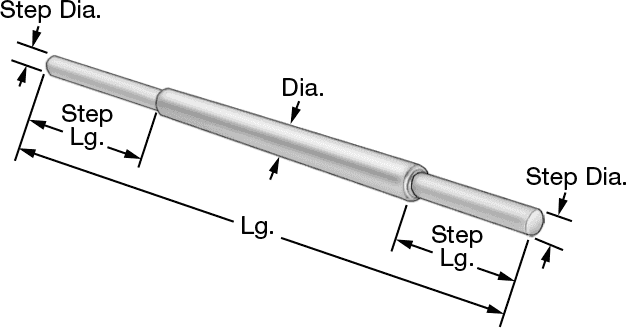
8641tp2l.png
If I apply a moment on the sides and fix the faces at the end of the shaft I get 1 result. If I apply a moment on the end face and fix the other end face I get another result.

If I run a motor on max power and hold the end of the shaft so it does not move... Where should I apply the moment in my calculation, on the end of the shaft I am holding or on the side face of the shaft where the motor is creating the power? How do you express this difference in a torsion calculation? In a torsion calculation there is nowhere to put the face the torque is applied to, but in a finite element analysis the results come out differently if I apply the torque to different faces of the object.
 
Engineering news on Phys.org
The driving torque produced by the armature is balanced by a reaction torque coming from the load .

So where does the driving torque act on the motor shaft ?

Where does the reaction torque from the load act on the motor shaft ?
 
Last edited:
Driving from thicker part of shaft on sides, rection from sides of thinner part of shaft. Why does the FEA analysis come out different though? Shouldn't torque be the same at different parts with different radius regardless of the torque coming from driving end or reaction end?
 

Similar threads

  • · Replies 1 ·
Replies
1
Views
2K
  • · Replies 5 ·
Replies
5
Views
3K
Replies
11
Views
2K
  • · Replies 5 ·
Replies
5
Views
3K
  • · Replies 5 ·
Replies
5
Views
2K
Replies
2
Views
3K
  • · Replies 4 ·
Replies
4
Views
2K
  • · Replies 5 ·
Replies
5
Views
5K
Replies
3
Views
5K