Total energy when potential graph is given

Click For Summary
SUMMARY

The discussion centers on calculating total energy from a position vs. time graph in the context of simple harmonic motion (SHM). The key conclusion is that without the mass of the particle or the spring constant, the total energy cannot be definitively calculated. The energy is expressed as 1/2 kA², where A is the amplitude of 5 m. The final answer provided is -5J, indicating a misunderstanding, as potential energy in SHM cannot be negative.

PREREQUISITES
  • Understanding of simple harmonic motion (SHM)
  • Familiarity with energy conservation principles
  • Knowledge of potential and kinetic energy relationships
  • Basic grasp of oscillatory motion equations
NEXT STEPS
  • Research the derivation of energy formulas in simple harmonic motion
  • Learn about the relationship between mass, spring constant, and oscillation period
  • Study the implications of negative potential energy in physical systems
  • Explore graphical analysis techniques for position vs. time graphs in SHM
USEFUL FOR

Students studying physics, particularly those focusing on mechanics and oscillatory motion, as well as educators seeking to clarify concepts related to energy in simple harmonic systems.

nhmllr
Messages
183
Reaction score
1
Total energy when positions vs time graph is given
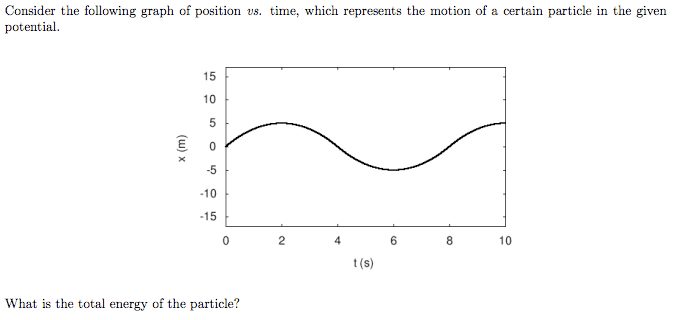
Homework Statement


24fznys.png


(answer: -5J)

Homework Equations


energy initial = energy final

The Attempt at a Solution


At the crest of each wave, the particle has only potential energy, and at the middle of each wave the particle has only kinetic energy, and these values are equal. By looking at the slope when the graph crosses the horizontal axis, you can determine that it travels at 5m/s then. After this point, I do not know how to continue.
 
Last edited:
Physics news on Phys.org
Disregard.
 
You said the potential graph is given. Where is it?

ehild
 
ehild said:
You said the potential graph is given. Where is it?

ehild

I'm sorry, I mis-titled the post originally. The potential graph is not given, only the position vs time graph is given
 
The motion looks SHM. But you need the mass of the particle.

ehild
 
ehild said:
The motion looks SHM. But you need the mass of the particle.

ehild

I gave the entire problem. No mass was given, and nothing analogous to the spring constant was given. However, I think you can find the ratio of the two, as the period = 2π * sqrt(m/k) = 8. I don't see how that helps, though
 
You also know the amplitude, A=5 m. The energy of the SHM is 1/2 kA2. You need the mass.

You also need the zero point of potential energy. If it is SHM, the potential energy is zero at zero position, and it is never negative. Something is very wrong with the problem.

ehild
 

Similar threads

  • · Replies 10 ·
Replies
10
Views
2K
  • · Replies 9 ·
Replies
9
Views
582
  • · Replies 5 ·
Replies
5
Views
14K
Replies
2
Views
2K
Replies
13
Views
18K
  • · Replies 2 ·
Replies
2
Views
2K
Replies
15
Views
2K
  • · Replies 6 ·
Replies
6
Views
2K
  • · Replies 2 ·
Replies
2
Views
2K
Replies
2
Views
1K