Total energy when potential graph is given

Click For Summary

Homework Help Overview

The discussion revolves around determining total energy in a system where only a position vs time graph is provided, with an emphasis on potential energy in the context of simple harmonic motion (SHM).

Discussion Character

  • Exploratory, Assumption checking, Conceptual clarification

Approaches and Questions Raised

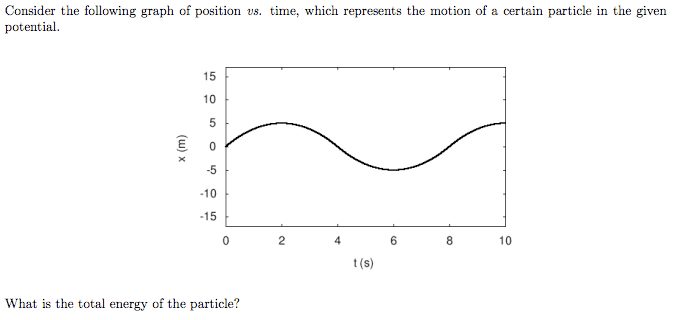
  • Participants discuss the relationship between potential and kinetic energy in SHM, noting that at the crest of the wave, potential energy is maximized while kinetic energy is zero. There is uncertainty about how to proceed without additional information such as mass or a potential energy graph.

Discussion Status

Some participants have provided insights regarding the characteristics of SHM and the need for mass to calculate energy. There is a recognition of missing information, particularly the potential graph and mass, which are critical for further analysis.

Contextual Notes

Participants note that the problem lacks necessary details such as mass and the spring constant, which complicates the analysis of energy in the system. The original poster acknowledges a miscommunication regarding the provided graph.

nhmllr
Messages
183
Reaction score
1
Total energy when positions vs time graph is given
Homework Statement


24fznys.png


(answer: -5J)

Homework Equations


energy initial = energy final

The Attempt at a Solution


At the crest of each wave, the particle has only potential energy, and at the middle of each wave the particle has only kinetic energy, and these values are equal. By looking at the slope when the graph crosses the horizontal axis, you can determine that it travels at 5m/s then. After this point, I do not know how to continue.
 
Last edited:
Physics news on Phys.org
Disregard.
 
You said the potential graph is given. Where is it?

ehild
 
ehild said:
You said the potential graph is given. Where is it?

ehild

I'm sorry, I mis-titled the post originally. The potential graph is not given, only the position vs time graph is given
 
The motion looks SHM. But you need the mass of the particle.

ehild
 
ehild said:
The motion looks SHM. But you need the mass of the particle.

ehild

I gave the entire problem. No mass was given, and nothing analogous to the spring constant was given. However, I think you can find the ratio of the two, as the period = 2π * sqrt(m/k) = 8. I don't see how that helps, though
 
You also know the amplitude, A=5 m. The energy of the SHM is 1/2 kA2. You need the mass.

You also need the zero point of potential energy. If it is SHM, the potential energy is zero at zero position, and it is never negative. Something is very wrong with the problem.

ehild
 

Similar threads

  • · Replies 10 ·
Replies
10
Views
2K
  • · Replies 9 ·
Replies
9
Views
741
  • · Replies 5 ·
Replies
5
Views
14K
Replies
2
Views
2K
Replies
13
Views
18K
  • · Replies 2 ·
Replies
2
Views
2K
Replies
15
Views
2K
  • · Replies 6 ·
Replies
6
Views
2K
  • · Replies 2 ·
Replies
2
Views
2K
Replies
2
Views
1K