Tricky Partial Fractions Question

Click For Summary
SUMMARY

The discussion focuses on solving partial fraction decomposition problems in calculus. The user initially attempted to decompose a function into the form (Bx+C)/x^2 + Ax/(x-1)^2 + Dx(x-1) but received feedback suggesting a more accurate decomposition. The correct approach for the first problem involves using A/x + B/x^2 + C/(x-1) + D/(x-1)^2. For the second problem, the decomposition should be A/x + (Bx+C)/(x^2+3). The user also shared their computed values for constants A, B, C, and D, which were confirmed to be incorrect.

PREREQUISITES
  • Understanding of partial fraction decomposition
  • Familiarity with algebraic manipulation of rational functions
  • Knowledge of logarithmic and inverse trigonometric functions
  • Basic calculus concepts, particularly integration techniques
NEXT STEPS
  • Study the method of partial fraction decomposition in detail
  • Practice solving integrals involving logarithmic and inverse trigonometric functions
  • Explore advanced techniques in algebraic manipulation of rational expressions
  • Review calculus textbooks focusing on integration strategies
USEFUL FOR

Students studying calculus, particularly those focusing on integration techniques, and educators looking for examples of partial fraction decomposition in teaching materials.

ardentmed
Messages
158
Reaction score
0
Hey guys,

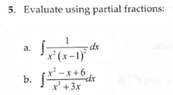
Here is another pair of questions that I'm doubting at the moment:
View attachment 2798

I used partial fractions for A and got (Bx+C)/x^2 + Ax/(x-1)^2 + Dx(x-1) which led me to compute A=1, B=0, C= -1, and D=0, which already sounds off. Do you guys have any suggestions?

Also, for 5b, I calculated B= -1, C=-1, A=2, and a final answer of 2ln(x) - (1/2)ln(x^2 + 3) - (1/3) tan^-1(x/√3) + C. Any tips for this one?

Thanks in advance. I really appreciate the help.
 

Attachments

  • 2.PNG
    2.PNG
    3.3 KB · Views: 104
Physics news on Phys.org
ardentmed said:
Hey guys,

Here is another pair of questions that I'm doubting at the moment:
View attachment 2798

I used partial fractions for A and got (Bx+C)/x^2 + Ax/(x-1)^2 + Dx(x-1) which led me to compute A=1, B=0, C= -1, and D=0, which already sounds off. Do you guys have any suggestions?

Also, for 5b, I calculated B= -1, C=-1, A=2, and a final answer of 2ln(x) - (1/2)ln(x^2 + 3) - (1/3) tan^-1(x/√3) + C. Any tips for this one?

Thanks in advance. I really appreciate the help.

For the first I would use as my partial fraction decomposition:

$\displaystyle \begin{align*} \frac{1}{ x^2 \left( x - 1 \right) ^2} \equiv \frac{A}{x} + \frac{B}{x^2} + \frac{C}{x -1 } + \frac{D}{ \left( x - 1 \right) ^2} \end{align*}$

For the second

$\displaystyle \begin{align*} \frac{x^2 - x + 6}{x \left( x^2 + 3 \right) } &\equiv \frac{A}{x} + \frac{B\,x + C}{x^2 + 3} \end{align*}$
 

Similar threads

  • · Replies 5 ·
Replies
5
Views
2K
  • · Replies 8 ·
Replies
8
Views
2K
  • · Replies 3 ·
Replies
3
Views
2K
  • · Replies 8 ·
Replies
8
Views
2K
  • · Replies 5 ·
Replies
5
Views
2K
  • · Replies 3 ·
Replies
3
Views
2K
  • · Replies 6 ·
Replies
6
Views
2K
  • · Replies 1 ·
Replies
1
Views
3K
  • · Replies 3 ·
Replies
3
Views
2K
  • · Replies 3 ·
Replies
3
Views
2K