Trigonometry triangle Question

  • Context: High School 
  • Thread starter Thread starter basty
  • Start date Start date
  • Tags Tags
    Triangle Trigonometry
Click For Summary

Discussion Overview

The discussion revolves around the properties of trigonometric functions, specifically sine and cosine, in the context of a triangle with angles of 30°, 60°, and 90°. Participants explore definitions and relationships between the sides of the triangle and the values of these trigonometric functions.

Discussion Character

  • Technical explanation
  • Conceptual clarification
  • Debate/contested

Main Points Raised

  • One participant states that for sin 90°, the opposite is r and the hypotenuse is y, leading to the equation sin 90° = r/y.
  • Another participant agrees that using the definition of opposite over hypotenuse results in sin(90) = r/r = 1.
  • Questions arise about the relationship between the sides of the triangle and the angles, particularly regarding the definition of the hypotenuse and the behavior of the side lengths as angles change.
  • Concerns are raised about which angle is being referred to as θ, with clarification that it is the angle labeled 60° in the diagram.
  • Participants discuss the implications of increasing the angle to 90° and what happens to the side lengths x and y, particularly noting that cos(90°) = 0.
  • There is mention of using a unit circle to define trigonometric functions, suggesting an alternative approach to understanding sine and cosine values.

Areas of Agreement / Disagreement

Participants generally agree on the definitions of sine and cosine, but there is some confusion regarding the application of these definitions to the specific triangle in question. Multiple viewpoints exist regarding the interpretation of angles and side lengths, and the discussion remains unresolved on certain points.

Contextual Notes

There are limitations regarding the clarity of which sides correspond to which angles, as well as the assumptions made about the triangle's configuration. The discussion also highlights the dependency on definitions of trigonometric functions and the implications of using different representations, such as the unit circle.

basty
Messages
94
Reaction score
0
For the triangle shown in the below image,

##\sin 60° = \frac{opposite}{hypotenuse} = \frac{y}{r}##
##\sin 30° = \frac{opposite}{hypotenuse} = \frac{x}{r}##

The questions are:

1. What is the opposite and hypotenuse of sin 90°?
2. I am guessing that the opposite and hypotenuse of sin 90 is
r and y respectively so that ##\sin 90° = \frac{opposite}{hypotenuse} = \frac{r}{y}##.
Why sin 90° = 1?
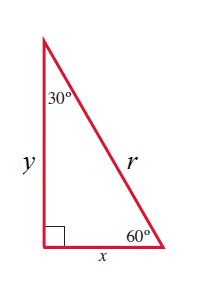
hypotenuse.png
 
Mathematics news on Phys.org
If you use the opposite over the hypotenuse definition then you'd get sin(90) = r/r = 1
 
jedishrfu said:
If you use the opposite over the hypotenuse definition then you'd get sin(90) = r/r = 1

Do you mean that the sin 90° is: the opposite = r and the hypotenuse is = r too?
 
How do you obtain ##\cos 90° = \frac{adjacent}{hypotenuse} = \frac{x}{r} = 0##?
 
basty said:
How do you obtain ##\cos 90° = \frac{adjacent}{hypotenuse} = \frac{x}{r} = 0##?
Look at your triangle. As the angle θ gets larger, the length of the base x gets smaller. The radius r remains constant. When θ = 90°, what must x be?
 
SteamKing said:
Look at your triangle. As the angle θ gets larger, the length of the base x gets smaller. The radius r remains constant. When θ = 90°, what must x be?

There is no θ in my triangle. There are 90°, 60°, and 30° angles. Which one you meant as the θ?
 
basty said:
There is no θ in my triangle. There are 90°, 60°, and 30° angles. Which one you meant as the θ?
The angle which is labeled 60° in your diagram.

The trig functions are defined as in this diagram:

ttrig.gif
 
SteamKing said:
Look at your triangle. As the angle θ gets larger, the length of the base x gets smaller. The radius r remains constant. When θ = 90°, what must x be?

Which side you meant by the radius?

The θ you meant is the one labeled as 60°, but the cos 90° I meant is the right angle.

What should the cos 90° be if the angle is the right angle, not the 60°?
 
  • #10
basty said:
Which side you meant by the radius?

In your diagram of the triangle, the side labeled "r", which I indicated as "the radius r".

The θ you meant is the one labeled as 60°, but the cos 90° I meant is the right angle.
Yes, but in order to calculate sine and cosine for 90°, you pretend to let the angle labeled 60° in your diagram increase to 90°, and examine what happens to the sides x and y in order for this to happen.

What should the cos 90° be if the angle is the right angle, not the 60°?
cos (90°) = 0, always.

Instead of using just a triangle to define the trig functions, often a unit circle (radius = 1) is used, like this:

Trig_functions_on_unit_circle.PNG

As the point P moves counterclockwise around the circle, the coordinates x and y of P are also the values of cos (θ) and sin (θ), respectively.

Here is another diagram showing how sin (θ) varies for different angles θ drawn on a unit circle:

3.png


Similar threads

  • · Replies 10 ·
Replies
10
Views
2K
  • · Replies 12 ·
Replies
12
Views
5K
  • · Replies 1 ·
Replies
1
Views
3K
  • · Replies 18 ·
Replies
18
Views
5K
  • · Replies 1 ·
Replies
1
Views
3K
  • · Replies 5 ·
Replies
5
Views
2K
  • · Replies 2 ·
Replies
2
Views
1K
  • · Replies 8 ·
Replies
8
Views
2K
  • · Replies 4 ·
Replies
4
Views
2K
  • · Replies 4 ·
Replies
4
Views
5K