NODARman
- 57
- 11
- TL;DR
- .
Hi, so I'm trying to find the volume of a shape using integral, I found the equation of one plane in 3D space but the second one is something like that, which I cannot write in integral as a function: ##\frac{2(2x-a)}{a}=-\frac{2(6y-a\sqrt3)}{a\sqrt3}=\frac{2z-a\sqrt3}{a\sqrt3}##
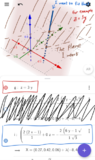
In the 3D viewer program, I wrote this and it made a line, but I needed a plane. Other points of that shape were connected, for example, z=3y and it was a plane, that can be written in integral. When I solve for x it wasn't right in the 3D coordinate system space.
Like I can write integral of (3y)dy but not integral of (2x=3y=4z)dxdydz... :(
Attachments
Last edited by a moderator: