Truss Forces: Calculating F(AD) and F(AB) for Resolution of Forces

  • Thread starter Thread starter chetzread
  • Start date Start date
  • Tags Tags
    Forces Trusses
Click For Summary
SUMMARY

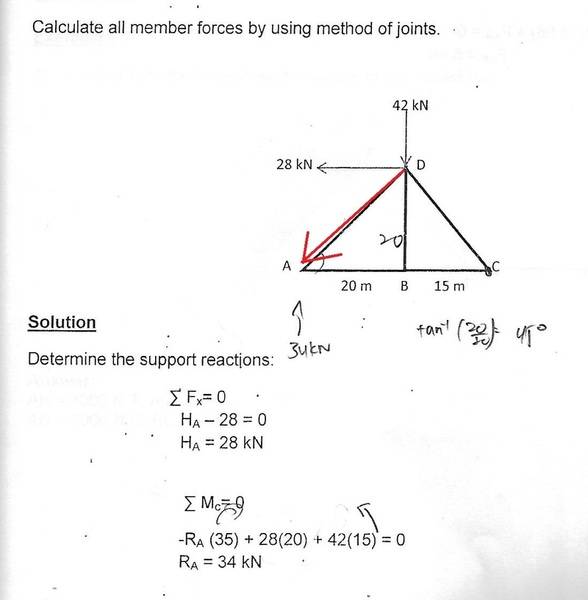
The discussion focuses on calculating the forces F(AD) and F(AB) in a truss system. It establishes that the force F(AD) points towards joint A, indicating compression, while the force F(AB) is derived from the equation (1/sqrt(2))(48.08), which is negative and points leftward. The resolution of forces into vertical and horizontal components is confirmed as essential for these calculations, with the positive X direction defined as rightward.

PREREQUISITES
  • Understanding of truss analysis principles
  • Knowledge of force resolution into components
  • Familiarity with vector notation and directionality
  • Basic proficiency in algebraic manipulation
NEXT STEPS
  • Study the method of joints in truss analysis
  • Learn about calculating internal forces in truss members
  • Explore the concept of equilibrium in static structures
  • Review vector decomposition techniques in physics
USEFUL FOR

Engineering students, structural analysts, and professionals involved in mechanical and civil engineering who are working on truss systems and force calculations.

chetzread
Messages
798
Reaction score
1
1.)
from the calculation of F(AD), the force should point towards A,right? (red arrow)
but, in the calculation of F(AB), the (1/sqrt rt2)(48.08) should be positive,right? (which is pointing towards LEFT)?
qBa9kzc.jpg

2BI6nCl.jpg

2. Homework Equations

The Attempt at a Solution


this involve the resolution of forces into vertical and horizontal axes,am i right?
 
Physics news on Phys.org
chetzread said:
1.)
from the calculation of F(AD), the force should point towards A,right? (red arrow)
but, in the calculation of F(AB), the (1/sqrt rt2)(48.08) should be positive,right? (which is pointing towards LEFT)?
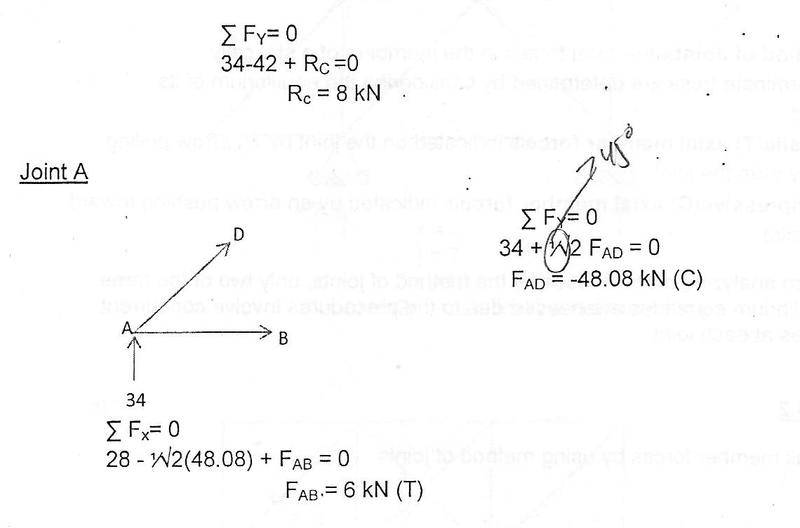
Positive X is rightward, as the equation HA -28 = 0 defined at the start of the solution.
Member AD was found to be in compression and so exerts a leftward force at joint A, so the term 1/(√2)(48.08) is negative.
 
  • Like
Likes   Reactions: chetzread

Similar threads

  • · Replies 2 ·
Replies
2
Views
2K
  • · Replies 7 ·
Replies
7
Views
3K
  • · Replies 1 ·
Replies
1
Views
2K
  • · Replies 2 ·
Replies
2
Views
6K
  • · Replies 2 ·
Replies
2
Views
3K
Replies
3
Views
5K
  • · Replies 7 ·
Replies
7
Views
4K
  • · Replies 1 ·
Replies
1
Views
3K
  • · Replies 1 ·
Replies
1
Views
3K
  • · Replies 1 ·
Replies
1
Views
2K