Trying to understand a derivation in a paper

Click For Summary

Homework Help Overview

The discussion revolves around understanding a derivation related to the effective permeability of two stacked media in the context of electromagnetic waves, as presented in a paper by S.M. Rytov. Participants are examining the notation and equations used in the derivation, particularly focusing on a specific equation labeled (9).

Discussion Character

  • Exploratory, Conceptual clarification, Mathematical reasoning

Approaches and Questions Raised

  • Participants express confusion regarding the notation and the interpretation of equation (9). There are attempts to manipulate the equation into a quadratic form and discussions about the implications of the variables involved. Some participants suggest substitutions to simplify the expressions.

Discussion Status

There is an ongoing exploration of the mathematical relationships and manipulations involved in the derivation. Some participants have made progress in their understanding, while others continue to seek clarification on specific aspects of the equations and notation.

Contextual Notes

Participants note the importance of clear definitions for the variables involved, such as the definitions of α1, α2, and χ, which are critical for understanding the equations being discussed. There is also mention of the quality of the visual aids provided, which may affect comprehension.

AwesomeTrains
Messages
115
Reaction score
3
Hello PF,
first of all I don't know where to put this post as it's not exactly a homework question but a clarification question for a project.
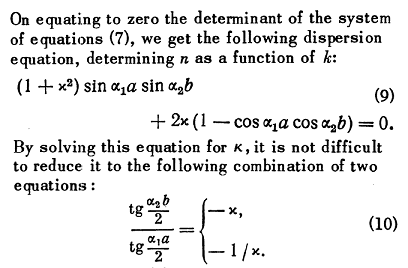
I'm going through the derivation of the effective permeability of two stacked medias, given the polarization of an incoming EM wave but I'm stuck at the point shown in the picture.
The title of the paper is "Electromagnetic Properties of a finely Stratified Medium" by S.M. Rytov in 1956 (I can share it if it's needed).
Homework Statement


HnjA9DP.png

Homework Equations


$$\frac{sin(x)}{cos(x)} = tg(x)$$

The Attempt at a Solution


I don't understand the notation they use and how they solve equation (9).
Does it mean $$\frac{tg\frac{b\alpha_2}{2}}{tg\frac{a\alpha_1}{2}}$$ is equal to -\chi and -1/\chi? Or how is it supposed to be understood? :oldsmile:
Regarding how to solve the equation the closest I get is this: $$\frac{1+\chi^2}{2\chi}\ \ tg(a\alpha_1)\ \ tg(b\alpha_2)+(cos(a\alpha_1)\ \ cos(b\alpha_2))^{-1} = 1 $$
 

Attachments

  • HnjA9DP.png
    HnjA9DP.png
    11.2 KB · Views: 657
Physics news on Phys.org
AwesomeTrains said:
the closest I get is this
(Is that how you solve a quadratic equation ?
(9) is of the form ##a\kappa^2 + b\kappa + c = 0 ## and you are supposed to be able to solve for ##\kappa## :rolleyes:
 
Last edited:
  • Like
Likes   Reactions: Charles Link
I think I got it to work.
Suggestion: Let ##a \alpha_1=\theta ## and ## b \alpha_2=\phi ##. You then get:
## x=\frac{-2(1-cos(\theta)cos(\phi)) \pm 2\sqrt{(cos(\theta)-cos(\phi))^2}}{2 sin(\theta)sin(\phi)} ##.
(This was obtained with the quadratic formula, (## x=\frac{-b \pm \sqrt{b^2-4ac}}{2a} ##, when starting with ## ax^2+bx+c=0 ##), and a little algebra/trig to simplify the terms inside the square root).
Next step is to let ## \theta=2 u ## and ## \phi=2v ##, and expand the ## cos(2u) ## and ## cos(2v) ## and ## sin(2u) ## and ## sin(2v) ## etc.
(Remove the square root sign of course and work with the two separate solutions).
For the "+" sign, I believe you get ## x=-\frac{tan(u)}{tan(v) } ##, and for the "-" sign, ## x=-\frac{tan(v)}{tan(u)} ##.
 
Last edited:
BvU said:
(Is that how you solve a quadratic equation ?
(9) is of hte form ##a\kappa^2 + b\kappa + c = 0 ## and you are supposed to be able to solve for ##\kappa## :rolleyes:
Thanks for the response. Sorry for the bad quality of the picture, the font is not so clear. It's a chi and not a k, k is in the alphas.
I should have written all the definitions in the first post to clarify, my bad :oldeyes:
\alpha_1 = k \sqrt{n_1^2-n^2}, \alpha_2 = k \sqrt{n_2^2-n^2} and \chi=\frac{\mu_2 \alpha_1}{\mu_1 \alpha_2} \\ (n_1^2 = \epsilon_1 \mu_1, n_2^2 = \epsilon_2 \mu_2)
 
##\kappa## or ##\chi##, it's still a quadratic equation :rolleyes:, only this time in ##\chi##, so you solve for ##\chi## :wink: .
 
  • Like
Likes   Reactions: AwesomeTrains
Much simpler just to call it ## x ##. Keeping the symbols as short as possible makes it much easier to type up the solution.
 
  • Like
Likes   Reactions: AwesomeTrains
Thanks for the help! I should be able to get it now, I was trying hard to solve for the k in the alphas :oldeyes:
 
  • Like
Likes   Reactions: Charles Link

Similar threads

  • · Replies 5 ·
Replies
5
Views
2K
Replies
7
Views
2K
  • · Replies 8 ·
Replies
8
Views
1K
  • · Replies 1 ·
Replies
1
Views
2K
  • · Replies 1 ·
Replies
1
Views
2K
  • · Replies 6 ·
Replies
6
Views
4K
Replies
1
Views
2K
  • · Replies 3 ·
Replies
3
Views
3K
  • · Replies 2 ·
Replies
2
Views
2K
  • · Replies 3 ·
Replies
3
Views
2K