Discussion Overview
The discussion revolves around understanding the nature of the roots of a quadratic equation, specifically whether they are real distinct roots or not. Participants explore the quadratic formula, the notation used in expressing solutions, and the implications of complex numbers in relation to the roots.
Discussion Character
- Exploratory
- Technical explanation
- Conceptual clarification
- Debate/contested
Main Points Raised
- Some participants express confusion about whether the roots of the quadratic equation are real distinct roots and seek clarification on the mechanism for determining this.
- One participant emphasizes that the solutions provided are indeed real numbers and suggests that those claiming otherwise may lack understanding.
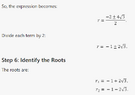
- Another participant points out that the roots are derived from the equation ##x^2 + 2x - 11 = 0## and clarifies the use of the quadratic formula to find solutions.
- A participant explains the notation of ##\pm## and how it relates to completing the square, illustrating the derivation of the roots.
- There is a discussion about the nature of the solutions, with one participant asserting that the roots are not simply opposites of each other but rather distinct values.
- Another participant introduces the concept of conjugates in the context of complex numbers, drawing parallels between real and complex roots.
- Some participants reiterate the need for further contemplation on the topic, indicating ongoing uncertainty.
Areas of Agreement / Disagreement
Participants express differing views on the nature of the roots, with some asserting they are distinct real numbers while others raise questions about their relationships and implications. The discussion remains unresolved regarding the clarity of the distinctions between the roots.
Contextual Notes
There are limitations in the discussion regarding the assumptions made about the roots and the definitions used, particularly in relation to complex numbers and their conjugates. The mathematical steps involved in deriving the roots may also be subject to further exploration.