Turnbuckles and loss of preload

Click For Summary

Discussion Overview

The discussion revolves around the mechanics and functionality of turnbuckles, particularly focusing on their ability to maintain preload under tension and the effects of vibration. Participants explore the implications of turnbuckle design, including thread orientation and locking mechanisms, in various applications.

Discussion Character

  • Exploratory
  • Technical explanation
  • Debate/contested

Main Points Raised

  • Some participants propose that turnbuckles resist tension due to their dual-thread design, which requires the inner body to twist both ways to unscrew.
  • Others argue that tension can indeed unwind the turnbuckle if friction is not sufficient, suggesting that additional locking measures are necessary to prevent loss of preload.
  • A participant questions whether it would be feasible to design turnbuckles with both threads in the same direction to maintain preload, despite potential challenges in length adjustment.
  • Concerns are raised about the necessity of locking mechanisms like jam nuts or lock wire, especially in applications subject to vibration.
  • Some participants mention that turnbuckles can become loose due to vibration and thermal cycling, which may affect their performance.
  • There is a suggestion that a differential screw could serve as an alternative design for fine length adjustment without the issues associated with turnbuckles.

Areas of Agreement / Disagreement

Participants express differing views on the mechanics of turnbuckles and the necessity of locking mechanisms. While some agree on the importance of preventing preload loss, there is no consensus on the best design approach or the implications of using same-hand threads.

Contextual Notes

Participants acknowledge limitations in their discussions, such as the inability to provide full details about specific applications and the complexity of the mechanisms involved. The discussion also highlights the dependence on friction and the potential for external factors like vibration and thermal changes to affect turnbuckle performance.

Who May Find This Useful

Individuals interested in mechanical design, structural engineering, or applications involving tensioning systems may find this discussion relevant.

Juanda
Gold Member
Messages
439
Reaction score
145
Turnbuckles have a right hand thread and a left hand thread.
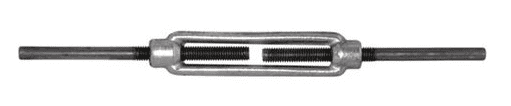
1701807360925.png


That implies that if I pull from both ends, the turnbuckle will resist the tension because the inner body would need to twist both ways simultaneosly to become unscrewed. The same applies to the compression case.

However, can they become loose against vibration? From what I just wrote about them it'd seem like that's not possible but it feels very weird to me. As long as the threaded rods are not allowed to turn, the turnbuckle should not be able to do it either so the preload/position will remain the same.

I know turnbuckles are sometimes locked in place using jam nuts or lock wire but I don't know if that's in cases where the rods could turn independently or if there is a mechanism that could cause a loss of preload even in the scenario I described.
I assume, as a safety measure, it's always convenient to use something like a jam nut but I would like to confirm if it is really necessary in the case where the threaded rods are not allowed to turn.
 
Engineering news on Phys.org
Juanda said:
That implies that if I pull from both ends, the turnbuckle will resist the tension because the inner body would need to twist both ways simultaneosly to become unscrewed. The same applies to the compression case.
I don't think that's right. If you twist the TB one way, it pulls both screws in, and visa-versa. So if it weren't for friction of the screw surfaces in the TB, tension would unwind the TB and the two ends would separate, no?
 
  • Like
Likes   Reactions: Juanda and Lnewqban
You're totally right. My description was incorrect. Additional locking measures are necessary to prevent the loss of preload.
I'm now wondering if it'd possible to make them with both threads in the same direction to avoid that loss of preload. The adjustment of length would not be as convenient but the joint should keep the same length at all times so the preload is sustained.
The middle body could move until it hits one end but as long as enough thread is still engaged in both sides when the collision happens it'd work I believe.
 
Juanda said:
I assume, as a safety measure, it's always convenient to use something like a jam nut but I would like to confirm if it is really necessary in the case where the threaded rods are not allowed to turn.
The turnbuckle must be locked somehow. Otherwise, some small boy will come along and adjust it while trying to find out how it works.

Since there is a left-hand and a right-hand thread, a jam nut, or lock nut, will be placed on the right-hand threaded side.

You could replace a turnbuckle with a threaded rod and two or more nuts, but it would be less convenient.
 
Baluncore said:
The turnbuckle must be locked somehow. Otherwise, some small boy will come along and adjust it while trying to find out how it works.

Since there is a left-hand and a right-hand thread, a jam nut, or lock nut, will be placed on the right-hand threaded side.

You could replace a turnbuckle with a threaded rod and two or more nuts, but it would be less convenient.
For sure. My interest though is more related to the mechanism of the turnbuckle and not the turnbuckle itself.
As usual in this forum, I'm talking about something I cannot give too many details about and give you the full picture although I'd love to. I will try to describe it as accurately as possible without crossing any line.

Image a structure partially held by articulated rods. Now these rods are adjustable in a similar way to a turnbuckle. I don't know if the word turnbuckle would still describe the rod but it's the best way I knew how to describe it. This structure will be tested against vibration so a locking mechanism like a jam nut, locking wire, adhesives, and/or others will be used. But I wanted to confirm how these turnbuckles could come loose in the first place.
I have already confirmed I was imagining the turnbuckle mechanism wrong so this thread already taught me something very useful. I would say the last detail to iron out is:
Is it worth it to make both threads in the same direction to prevent the loss of preload? The adjustment process would be way more inconvenient (even impossible depending on the space available) but it might be safer (the reasoning for this is at #3).

By the way, in case you're worrying, the structure does not put any lives at risk in case of failure or anything like that.
 
Juanda said:
Is it worth it to make both threads in the same direction to prevent the loss of preload?
Yes, but then you could not adjust it and the device would be redundant.

Turnbuckles are used to apply tension, or change the length of a rod.
Turnbuckles come loose due to vibration.

The opposite of a turnbuckle is probably a "coupler nut", "hex coupler nut" or a "joiner nut". It can be used to join two screw threads with a small but variable gap.

A fine length-adjustment device that uses two same-hand threads is a "differential screw".
https://en.wikipedia.org/wiki/Differential_screw
 
  • Like
Likes   Reactions: Juanda
All right I got a much clearer idea now. Thank you all for the input!
 
  • Like
Likes   Reactions: berkeman
The types shown in the pictures are used for supporting heavy exhaust piping of internal combustion engines and for belt tensioners.
Note the counter-nuts and the flexible elements for control of vibration.
crm_group_inc_monolux.png

y-cable-screw-background-metal-equipment-141625476.jpg
 
  • Like
Likes   Reactions: Juanda
In addition to possible vibration of the attached cables, the daily alternating heating and cooling of the turnbuckle and attached cabling can loosen the turnbuckle.
 
  • Informative
  • Like
Likes   Reactions: Juanda and berkeman

Similar threads

  • · Replies 18 ·
Replies
18
Views
3K
  • · Replies 15 ·
Replies
15
Views
2K
Replies
3
Views
2K
  • · Replies 7 ·
Replies
7
Views
3K
  • · Replies 0 ·
Replies
0
Views
1K
Replies
3
Views
2K
Replies
39
Views
16K
  • · Replies 4 ·
Replies
4
Views
3K
  • · Replies 4 ·
Replies
4
Views
4K
  • · Replies 13 ·
Replies
13
Views
4K