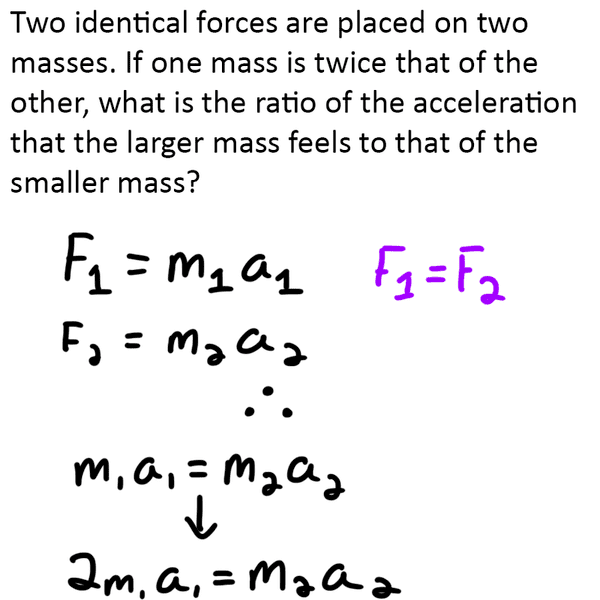
Two identical forces on two different masses....

  • Thread starter Thread starter EthanVandals
  • Start date Start date
  • Tags Tags
    Force Forces Mass
Click For Summary
The discussion revolves around solving a physics problem involving two masses, where one mass is twice the other. The initial equations presented were found to be contradictory, prompting suggestions to express one mass in terms of the other for clarity. After some confusion regarding ratios, it was concluded that if mass m1 is double m2, then the acceleration relationship can be expressed as (2)A1 = A2, indicating that the larger mass accelerates at half the speed of the smaller mass. The final ratio of their accelerations is confirmed to be 2:1. The conversation highlights the importance of correctly setting up equations in physics problems.
EthanVandals
Messages
55
Reaction score
2
Member advised to use the homework template for posts in the homework forums.
Here is all the work I have done so far (hopefully it is right). My brain somewhat shuts down when it comes to ratios.
sv5B5Ds.png
 
Physics news on Phys.org
no, that equation is not right. Identify which mass is m1 and which is m2, then one mass is twice the other. Correct your equation accordingly, then solve for the ratio.
 
You wrote:
m1a1 = m2a2
2m1a1 = m2a2

Those two equations contradict each other. Why don't you write an equation for m1 in terms of m2. Then you can substitute for m1 or m2 into the first equation above.

P.S. Welcome to Physics Forums.

Edit: Sorry PhantomJay. I just now saw your post.
 
TomHart said:
You wrote:
m1a1 = m2a2
2m1a1 = m2a2

Those two equations contradict each other. Why don't you write an equation for m1 in terms of m2. Then you can substitute for m1 or m2 into the first equation above.

P.S. Welcome to Physics Forums.

Edit: Sorry PhantomJay. I just now saw your post.
So something more like this then? I got this far, then got confused again as to what kind of ratio I'm supposed to get since I'm not given any values. If I divided by M2, then it would give me (2)A1=A2...so is that saying that the mass that is double the size of the other one is going to accelerate at half the speed of the smaller mass? And would the ratio then be 2:1? Thanks for all your help! :)

EDIT: I'm not sure why my new work isn't showing up...The basics are that I set M1=(2)M2, therefore (2)M2A1=M2A2.

http://imgur.com/a/XdNIG
 
  • Like
Likes TomHart
EthanVandals said:
The basics are that I set M1=(2)M2, therefore (2)M2A1=M2A2.

Edit: Sorry, I read your edit and missed above it. You got the ratio right: 2:1
 
Thread 'Correct statement about size of wire to produce larger extension'
The answer is (B) but I don't really understand why. Based on formula of Young Modulus: $$x=\frac{FL}{AE}$$ The second wire made of the same material so it means they have same Young Modulus. Larger extension means larger value of ##x## so to get larger value of ##x## we can increase ##F## and ##L## and decrease ##A## I am not sure whether there is change in ##F## for first and second wire so I will just assume ##F## does not change. It leaves (B) and (C) as possible options so why is (C)...

Similar threads

Replies
7
Views
2K
Replies
1
Views
1K
  • · Replies 21 ·
Replies
21
Views
1K
  • · Replies 3 ·
Replies
3
Views
1K
Replies
2
Views
1K
  • · Replies 25 ·
Replies
25
Views
1K
  • · Replies 11 ·
Replies
11
Views
689
  • · Replies 17 ·
Replies
17
Views
3K
  • · Replies 10 ·
Replies
10
Views
1K