Diff.Ed
- 5
- 0
Homework Statement
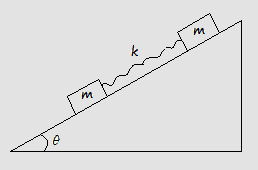
Two blocks both of mass m are placed on an inclined plane making an angle \theta with the ground. The two masses are connected with a spring of spring constant k. The coefficient of kinetic friction is \mu _k for both blocks. Assume that the spring is initially stretched to a length L+x_0 where L is its equilibrium length when it is at rest on a flat surface. Find the displacement of the two blocks ALONG THE INCLINE as a function of time,t, assuming that at that particular time the spring is still stretched. (Hint : Call the displacement of the leading block along the inclined plane x_1. Write the displacement of the trailing block in terms of x_1 and stretch in the spring, x. You will have two time-dependent equations in two unknowns.)
Related Equations
F=-kx (Hooke's Law), differential equations
The attempt at a solution
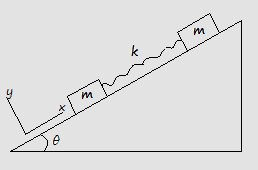
m\frac{d^2x_1}{dt^2}=-k(x_1+x_0)-mg\sin\theta+\mu _k mg\cos\thetaand general solution of this diff. equation
I couldn't continue anymore. Could you help me ?
Two blocks both of mass m are placed on an inclined plane making an angle \theta with the ground. The two masses are connected with a spring of spring constant k. The coefficient of kinetic friction is \mu _k for both blocks. Assume that the spring is initially stretched to a length L+x_0 where L is its equilibrium length when it is at rest on a flat surface. Find the displacement of the two blocks ALONG THE INCLINE as a function of time,t, assuming that at that particular time the spring is still stretched. (Hint : Call the displacement of the leading block along the inclined plane x_1. Write the displacement of the trailing block in terms of x_1 and stretch in the spring, x. You will have two time-dependent equations in two unknowns.)
Related Equations
F=-kx (Hooke's Law), differential equations
The attempt at a solution
m\frac{d^2x_1}{dt^2}=-k(x_1+x_0)-mg\sin\theta+\mu _k mg\cos\theta
x_1 = A\sin(\sqrt{k/m}t) + B\cos(\sqrt{k/m}t) - \frac{kx_0+mg\sin\theta+\mu _k mg\cos\theta}{k}
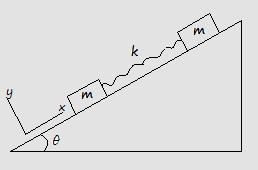
m\frac{d^2x_2}{dt^2}=k(x_1+x_0)-mg\sin\theta+\mu _k mg\cos\theta
m\frac{d^2x_2}{dt^2}=k(x_1+x_0)-mg\sin\theta+\mu _k mg\cos\theta
I couldn't continue anymore. Could you help me ?
Last edited: