Unclear steps in a Zorich proof (Measurable sets and smooth mappings)

  • Context: Undergrad 
  • Thread starter Thread starter Unconscious
  • Start date Start date
  • Tags Tags
    Proof Sets Smooth
Click For Summary
SUMMARY

The discussion focuses on the proof steps in Zorich's Mathematical Analysis II, specifically regarding the compactness of the set ##\overline{E}_t## and the boundedness of the Jordan-measurable set ##E_x=\phi(E_t)##. Participants assert that the assumption of boundedness is crucial for understanding the properties of these sets. The conversation highlights the relationship between Jordan measure and compactness, emphasizing that a set with Jordan measure zero must indeed be bounded, thereby leading to compactness.

PREREQUISITES
  • Understanding of Jordan-measurable sets and their properties
  • Familiarity with compactness in the context of topology
  • Knowledge of measure theory, particularly Jordan measure
  • Basic concepts of mathematical analysis as presented in Zorich's Mathematical Analysis II
NEXT STEPS
  • Study the properties of Jordan-measurable sets in detail
  • Explore the implications of compactness in metric spaces
  • Review the definitions and properties of measure-zero boundaries
  • Investigate the relationship between bounded sets and compactness in analysis
USEFUL FOR

Mathematics students, particularly those studying real analysis, researchers in measure theory, and anyone seeking to deepen their understanding of compactness and Jordan measure in mathematical proofs.

Unconscious
Messages
77
Reaction score
12
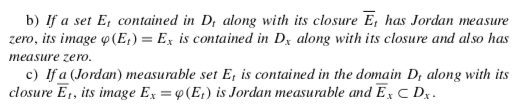
From Zorich, Mathematical Analysis II, sec. 11.5.2:

RyY4p.png

LvyLj.png


where as one can read from the statement, the sets could also be unbounded.

I do not report here the proof of the fact a), beacuse I have no doubt about it and one can, without the presence of dark steps in the reasoning, assume a) as prooved and pass to the analysis of b) and c).
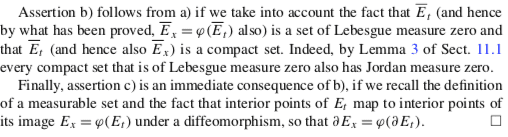
The proposed proofs of these are the following:
qGfJF.png


My questions are:

proof of b): why is ##\overline{E}_t## compact? In particular, I can't understand its boundedness.

proof of c): by hypothesis ##E_t## is Jordan-measurable (that is, it is bounded with measure-zero boundary). Then, why also should ##E_x=\phi(E_t)## be bounded, in general?
 
Physics news on Phys.org
I haven't thought about jordan measure ever before, but if ##\overline{E}_t## has jordan measure zero, does that imply it must be compact? It seems like a plausible consequence of the definition. I think if it's not bounded, then any finite set of rectangles you draw that cover the whole set must have infinite area, right?
 
  • Like
Likes   Reactions: Unconscious
Right, thank you.
 

Similar threads

  • · Replies 1 ·
Replies
1
Views
1K
  • Poll Poll
  • · Replies 1 ·
Replies
1
Views
6K