Higgy
- 43
- 0
I've drawn up a simple system to help with my question.
Suppose we prepare an atom in an excited state ([itex]| 4 \rangle[/itex] in the figure), and it can spontaneously decay to the ground state ([itex]| 1 \rangle[/itex]) through either of two intermediate states ([itex]| 2 \rangle[/itex] or [itex]| 3 \rangle[/itex]).
Is the probability that it decays along a particular pathway dependent only on the transition dipole matrix elements connecting the relevant states of that pathway?
Is there a way (even for a similar, but different system) that I could "force" the atom to decay one way and not the other?
I'm trying to dream up an exhaustive list of possibilities (which might end up being a short list). One thought I had was to apply a electric field to Stark shift the states out of resonance (but the system becomes complicated, due to mixing...). Similarly with a magnetic field, if I had specified magnetic sublevels.
Just thought I'd put the question out there to see if there are any interesting related phenomena that people know of.
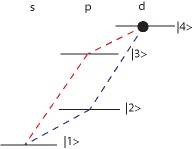
Suppose we prepare an atom in an excited state ([itex]| 4 \rangle[/itex] in the figure), and it can spontaneously decay to the ground state ([itex]| 1 \rangle[/itex]) through either of two intermediate states ([itex]| 2 \rangle[/itex] or [itex]| 3 \rangle[/itex]).
Is the probability that it decays along a particular pathway dependent only on the transition dipole matrix elements connecting the relevant states of that pathway?
Is there a way (even for a similar, but different system) that I could "force" the atom to decay one way and not the other?
I'm trying to dream up an exhaustive list of possibilities (which might end up being a short list). One thought I had was to apply a electric field to Stark shift the states out of resonance (but the system becomes complicated, due to mixing...). Similarly with a magnetic field, if I had specified magnetic sublevels.
Just thought I'd put the question out there to see if there are any interesting related phenomena that people know of.
Last edited by a moderator: