Understanding Complex Solutions and Plotting on a Function Graph

Click For Summary

Homework Help Overview

The discussion revolves around understanding complex solutions of quadratic equations, specifically when the discriminant is less than zero. Participants explore how to interpret and visualize these complex solutions on a function graph, particularly for the quadratic function y = 5x² + 2x + 1.

Discussion Character

  • Conceptual clarification, Problem interpretation, Assumption checking

Approaches and Questions Raised

  • Participants discuss the implications of a negative discriminant and the nature of complex roots. Questions arise about how to represent complex solutions on a plot and the meaning of expressions involving complex numbers in the context of the quadratic function.

Discussion Status

Some participants have provided insights into the nature of complex numbers and their graphical representation. There is an exploration of the concept of a complex plane versus the real plane, and how these relate to the original quadratic function. However, explicit consensus on the interpretation of complex solutions in this context has not been reached.

Contextual Notes

Participants note that the quadratic function does not intersect the x-axis, indicating the absence of real roots, which raises questions about the visualization of complex solutions. There is also mention of traditional notation differences for complex numbers.

usermath
Messages
5
Reaction score
0
When I solve a quadratic equation I need to find a Discriminant. If D>0 I have no problem. I can find x1 and x2. And when I draw a parabola I can see the x1 and x2 on a X-line.

But when D<0 I don't understand where I can find x1 and x2 on a plot of function.

For example for 5x2+2x+1=0
I have complex solutions: x1 = -0.2-0.4j and x2 = -0.2+0.4j

Ok. It's the answer, but what I can do with one? Where can I find this points on the plot of function?

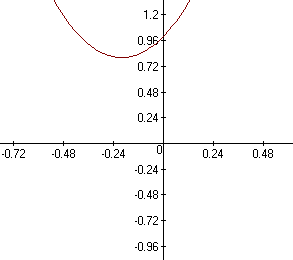
It's a plot of funciton y=5x2+2x+1
GPryzOC.png


Coordinates of a Minimum Point is X = -0,2 Y = 0,8.

What does (y=0; x=-0.2+0.4) mean? How can I use this expression? Where I can find the point with coordinates y=0; x=-0.2+0.4j ?
 
Physics news on Phys.org
usermath said:
When I solve a quadratic equation I need to find a Discriminant. If D>0 I have no problem. I can find x1 and x2. And when I draw a parabola I can see the x1 and x2 on a X-line.

But when D<0 I don't understand where I can find x1 and x2 on a plot of function.

For example for 5x2+2x+1=0
I have complex solutions: x1 = -0.2-0.4j and x2 = -0.2+0.4j

Ok. It's the answer, but what I can do with one? Where can I find this points on the plot of function?

It's a plot of funciton y=5x2+2x+1
GPryzOC.png


Coordinates of a Minimum Point is X = -0,2 Y = 0,8.

What does (y=0; x=-0.2+0.4) mean? How can I use this expression? Where I can find the point with coordinates y=0; x=-0.2+0.4j ?
Not on the Real Plane, unfortunately.

Since the parabola shown does not intersect the x-axis, it has no real roots.

Because the discriminant D < 0, it does have a pair of complex conjugate roots which satisfy the equation.

Applying the Quadratic formula should give you:

x = {-2 ± √[(-4)2-4(5)(1)]} / (2)(5)

or x = -0.2 ± 0.2 i [Note: you made an arithmetic error when you took the square root of D]
 
I think traditionally "i" is used instead of "j" for complex numbers but that doesn't matter for your question.

The graph you are showing is a 2-dimensional graph of the x-y plane. x and y are real numbers so this is the "real" plane. Graphically there are no real values for x where y=0.

However, if you were to create another plane perpendicular to the x-y plane where you now use j as the "z"-axis then this is the "complex" plane. If you now plot the values of y for different values of x+zj you would get something in 3-dimensions that looks like a series of inverted parabolas that look like a saddle (called a hyperbolic paraboloid). Graphically you would see that the saddle intersects the y=0 plane on two lines: x = -0.2+0.2zj and x = -0.2 - 0.2zj.

image007.gif


In the picture z has taken the place of y and vice versa.
 
Thanks a lot. It was very useful answers for me.
 

Similar threads

Replies
17
Views
3K
  • · Replies 5 ·
Replies
5
Views
4K
Replies
8
Views
5K
  • · Replies 2 ·
Replies
2
Views
2K
  • · Replies 9 ·
Replies
9
Views
3K
  • · Replies 10 ·
Replies
10
Views
4K
  • · Replies 6 ·
Replies
6
Views
2K
  • · Replies 10 ·
Replies
10
Views
3K
  • · Replies 7 ·
Replies
7
Views
2K
Replies
2
Views
2K