Understanding Conditional Probability with Dependent Variables

  • Thread starter Thread starter hodor
  • Start date Start date
Click For Summary
The discussion centers on a user's confusion regarding conditional probability in the context of dependent variables. They encounter a problem where introducing a restriction alters the independence of two variables, making original probabilities ineffective. The user struggles with recalculating probabilities, particularly P(K|B,M), after establishing that P(B=murderer, Maid=murderer) equals zero. Another participant clarifies that while P(B,murderer, Maid=murderer) is zero, it does not necessitate a change in P(K|B=murderer,M=murderer). The conversation highlights the complexities of conditional probability when dealing with dependent variables and the importance of correctly interpreting relationships between them.
hodor
Messages
7
Reaction score
0
Hi,

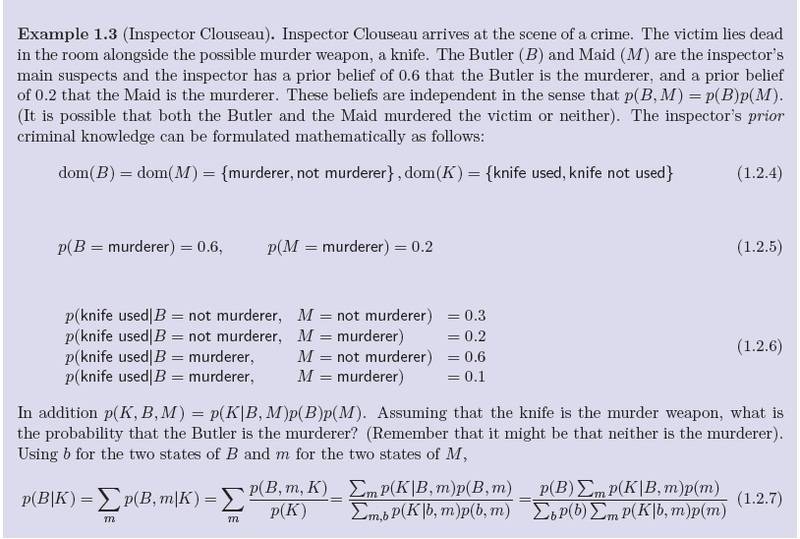
I've run into a snag trying to read a textbook problem. Here is the original example, it's pretty straightforward. The problem I have is when I get to the exercise and it asks me to place a restriction on this example. This restriction seems to break the independence of two variables and renders all the probabilities in the original example useless to me. For example:

HXPAUZ8.jpg


a6cTuIp.jpg


So, ignoring that it's asking for a code update here, I seem to have P(Butler = murderer, Maid = murderer) = 0 and so on. But it appears I can't recalculate P(K) (knife used) since B and M are no longer independent. So I really don't understand how to proceed. This leads me to believe I'm misinterpreting things so I thought I'd ask here. Thanks.
 
Physics news on Phys.org
I don't see why you would need that independence. You have P(B, not M) and P(M, not B) and there are no other cases to consider.
 
Ok, I had thought since those probabilities had changed, the P(k|B,M) probabilities would also have to change, and without ndependence I wouldn't be able to recalculate. It seems I can set P(K|B=murderer,M=murderer)=0 and reuse the others unchanged, but that still makes me a bit uncomfortable?
 
hodor said:
It seems I can set P(K|B=murderer,M=murderer)=0 and reuse the others unchanged, but that still makes me a bit uncomfortable?

No, P(K|B=murderer,M=murderer) is not changed - it is P(B=murderer,M=murderer) that is 0, and P(B=murderer,~M=murderer) etc. are different.
 
ok, thanks. I had assumed that since P(B=murderer,M=murderer) had changed, P(K|B=murderer,M=murderer) would change since P(K|B=murderer,M=murderer) = P(K,B=murderer,M=Murderer)/P(B=murderer,M=murderer), and similarly for the other conditionals.
 
The standard _A " operator" maps a Null Hypothesis Ho into a decision set { Do not reject:=1 and reject :=0}. In this sense ( HA)_A , makes no sense. Since H0, HA aren't exhaustive, can we find an alternative operator, _A' , so that ( H_A)_A' makes sense? Isn't Pearson Neyman related to this? Hope I'm making sense. Edit: I was motivated by a superficial similarity of the idea with double transposition of matrices M, with ## (M^{T})^{T}=M##, and just wanted to see if it made sense to talk...

Similar threads

  • · Replies 4 ·
Replies
4
Views
2K
  • · Replies 7 ·
Replies
7
Views
743
  • · Replies 1 ·
Replies
1
Views
2K
  • · Replies 2 ·
Replies
2
Views
2K
  • · Replies 6 ·
Replies
6
Views
3K
  • · Replies 3 ·
Replies
3
Views
3K
  • · Replies 6 ·
Replies
6
Views
2K
  • · Replies 10 ·
Replies
10
Views
3K
  • · Replies 4 ·
Replies
4
Views
3K
  • · Replies 2 ·
Replies
2
Views
2K