Understanding Conditional Probability with Dependent Variables

  • Context: Undergrad 
  • Thread starter Thread starter hodor
  • Start date Start date
Click For Summary

Discussion Overview

The discussion revolves around understanding conditional probability in the context of dependent variables, particularly in a textbook example involving a murder scenario. Participants explore how introducing restrictions affects the independence of variables and the recalculation of probabilities.

Discussion Character

  • Exploratory
  • Technical explanation
  • Debate/contested

Main Points Raised

  • One participant expresses confusion about how to proceed when a restriction breaks the independence of two variables, leading to a belief that original probabilities become unusable.
  • Another participant suggests that independence may not be necessary, pointing out that specific probabilities can still be calculated without it.
  • A participant questions whether the change in joint probabilities necessitates a change in conditional probabilities, indicating discomfort with the implications of the dependency.
  • Further clarification is provided that while the joint probability P(B=murderer, M=murderer) is zero, the conditional probability P(K|B=murderer, M=murderer) remains unchanged.
  • One participant assumes that changes in joint probabilities would also affect conditional probabilities, referencing the relationship between them.

Areas of Agreement / Disagreement

Participants do not reach a consensus on the necessity of independence for recalculating probabilities, and there are competing views on how changes in joint probabilities affect conditional probabilities.

Contextual Notes

There are unresolved assumptions regarding the nature of independence and how it impacts the calculation of conditional probabilities in this specific scenario.

hodor
Messages
7
Reaction score
0
Hi,

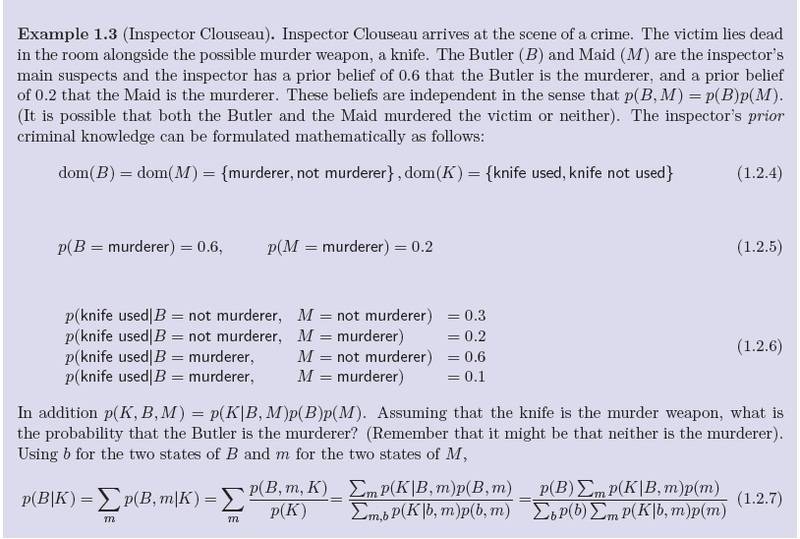
I've run into a snag trying to read a textbook problem. Here is the original example, it's pretty straightforward. The problem I have is when I get to the exercise and it asks me to place a restriction on this example. This restriction seems to break the independence of two variables and renders all the probabilities in the original example useless to me. For example:

HXPAUZ8.jpg


a6cTuIp.jpg


So, ignoring that it's asking for a code update here, I seem to have P(Butler = murderer, Maid = murderer) = 0 and so on. But it appears I can't recalculate P(K) (knife used) since B and M are no longer independent. So I really don't understand how to proceed. This leads me to believe I'm misinterpreting things so I thought I'd ask here. Thanks.
 
Physics news on Phys.org
I don't see why you would need that independence. You have P(B, not M) and P(M, not B) and there are no other cases to consider.
 
Ok, I had thought since those probabilities had changed, the P(k|B,M) probabilities would also have to change, and without ndependence I wouldn't be able to recalculate. It seems I can set P(K|B=murderer,M=murderer)=0 and reuse the others unchanged, but that still makes me a bit uncomfortable?
 
hodor said:
It seems I can set P(K|B=murderer,M=murderer)=0 and reuse the others unchanged, but that still makes me a bit uncomfortable?

No, P(K|B=murderer,M=murderer) is not changed - it is P(B=murderer,M=murderer) that is 0, and P(B=murderer,~M=murderer) etc. are different.
 
ok, thanks. I had assumed that since P(B=murderer,M=murderer) had changed, P(K|B=murderer,M=murderer) would change since P(K|B=murderer,M=murderer) = P(K,B=murderer,M=Murderer)/P(B=murderer,M=murderer), and similarly for the other conditionals.
 

Similar threads

  • · Replies 1 ·
Replies
1
Views
3K
  • · Replies 4 ·
Replies
4
Views
2K
  • · Replies 16 ·
Replies
16
Views
2K
  • · Replies 1 ·
Replies
1
Views
2K
  • · Replies 2 ·
Replies
2
Views
2K
  • · Replies 1 ·
Replies
1
Views
3K
  • · Replies 7 ·
Replies
7
Views
1K
  • · Replies 3 ·
Replies
3
Views
3K
  • · Replies 6 ·
Replies
6
Views
3K
  • · Replies 1 ·
Replies
1
Views
2K