SUMMARY
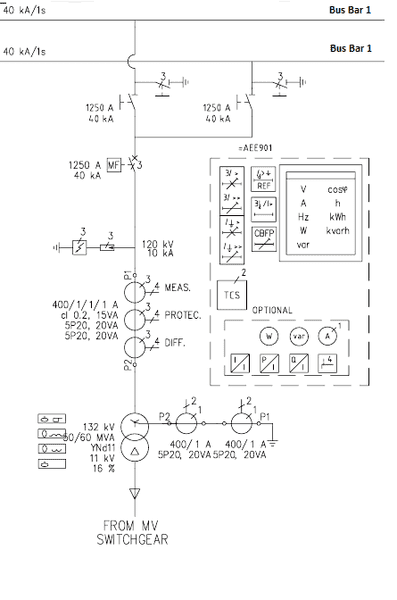
This discussion focuses on the differences between Current Transformers (CTs) used for protection and measurement in Substation Level Design (SLD). It clarifies that measurement CTs prioritize accuracy within the nominal current range, while protection CTs are designed to handle higher currents, often requiring larger cores to prevent saturation. The conversation also touches on the wiring configurations of CTs, specifically Delta and Wye setups, and the significance of CT notation. Additionally, the participants discuss the implications of having multiple cores in CTs, emphasizing the distinction between the two types of CTs based on their specifications.
PREREQUISITES
- Understanding of Current Transformers (CTs)
- Knowledge of Substation Level Design (SLD)
- Familiarity with Delta and Wye wiring configurations
- Basic principles of electrical protection and measurement systems
NEXT STEPS
- Research specifications for Protection CTs versus Measurement CTs
- Learn about wiring configurations for CTs in Delta and Wye setups
- Explore the implications of CT core sizes on performance and saturation
- Investigate the role of differential CTs in protection schemes
USEFUL FOR
Electrical engineers, protection system designers, and professionals involved in substation design and maintenance will benefit from this discussion.