Understanding Decay Schemes to Interpreting Energy Levels and Symbols

  • Context: Graduate 
  • Thread starter Thread starter Mahavir
  • Start date Start date
  • Tags Tags
    Decay
Click For Summary
SUMMARY

This discussion focuses on understanding decay schemes, specifically related to the disintegration of the mother nucleus and the subsequent energy levels of daughter isotopes, particularly xenon. Key elements include the interpretation of half-integer values representing spin and parity, energy levels in keV, and lifetimes of excited states. The arrows indicate possible follow-up decays, with associated labels detailing partial decay width, energy differences, and decay types. The discussion clarifies the significance of percentages under I131, comparative half-lives, and types of electromagnetic transitions such as M1, E2, and M4 (hexadecapole).

PREREQUISITES
  • Understanding of nuclear decay processes
  • Familiarity with energy levels and lifetimes in nuclear physics
  • Knowledge of electromagnetic transition types (M1, E2, M4)
  • Basic grasp of decay constants and comparative half-lives
NEXT STEPS
  • Research the principles of beta decay and its implications on daughter isotopes
  • Study the concept of decay schemes in nuclear physics
  • Learn about the significance of spin and parity in nuclear states
  • Explore the calculations of decay constants and their relation to half-lives
USEFUL FOR

Students and professionals in nuclear physics, researchers analyzing decay schemes, and educators teaching concepts related to nuclear disintegration and energy levels.

Mahavir
Messages
18
Reaction score
0
Apologies for this question, but I'm trying to understand what I'm looking at here and was unable to find an answer online.
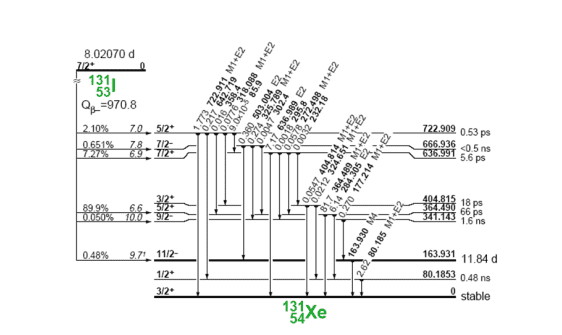
GuTnG.png


From my understanding, this is a decay scheme that shows the percentage of each energy level at which the disintegrated mother nucleus has reached after the disintegration has occurred. But what do the other numbers and arrows show?

Where I'm stuck is the symbols and numbers. I've tried to look in my textbook as well to no avail.

I would really appreciate your help.

Many thanks!
 

Attachments

  • GuTnG.png
    GuTnG.png
    17 KB · Views: 1,161
Last edited by a moderator:
Physics news on Phys.org
The half-integer values on the left with the signs are spin and parity. At the right side you have the energies (in keV) and lifetimes of the excited states.
The arrows are possible follow-up decays of xenon. Their labels: Not sure what the first number is. Partial decay width would be reasonable but doesn't fit well. The second number is the energy difference, the third one tells you which type of decay it is.
 
  • Like
Likes   Reactions: Mahavir
Starting from left to right..The percentage under the I131 are the percentage of the beta decays that lead to the various energy levels of the daughter . The next number is the Log of the comparative half lives for the decays to the various levels. The comparative half live is proportional to the decay constant for that transition. The next number with the +/- signs are the spin and parity of the Xe131 states. The numbers above the energy levels in Xe131 are the percent of total gamma decay for that transition, the next above is the energy of the gamma ray for that transition, and the M1, E2, M4 refer to the type of electromagnetic transitions, magnetic dipole, electric quadrapole and magenetic octopole respectively. The numbers to the right of the Xe131 energy levels are the energies and half lives of those states. The Qβ- is he Q-value of the decay, the excess energy of the decay available to the beta particles as kinetic energy.

Edit: The M4 term should have been hexadecapole not octopole.
 
Last edited:
  • Like
Likes   Reactions: Mahavir
gleem said:
Starting from left to right..The percentage under the I131 are the percentage of the beta decays that lead to the various energy levels of the daughter . The next number is the Log of the comparative half lives for the decays to the various levels. The comparative half live is proportional to the decay constant for that transition. The next number with the +/- signs are the spin and parity of the Xe131 states. The numbers above the energy levels in Xe131 are the percent of total gamma decay for that transition, the next above is the energy of the gamma ray for that transition, and the M1, E2, M4 refer to the type of electromagnetic transitions, magnetic dipole, electric quadrapole and magenetic octopole respectively. The numbers to the right of the Xe131 energy levels are the energies and half lives of those states. The Qβ- is he Q-value of the decay, the excess energy of the decay available to the beta particles as kinetic energy.

Edit: The M4 term should have been hexadecapole not octopole.
mfb said:
The half-integer values on the left with the signs are spin and parity. At the right side you have the energies (in keV) and lifetimes of the excited states.
The arrows are possible follow-up decays of xenon. Their labels: Not sure what the first number is. Partial decay width would be reasonable but doesn't fit well. The second number is the energy difference, the third one tells you which type of decay it is.

Thank you both ever so much! It makes a great deal more sense.
 

Similar threads

  • · Replies 8 ·
Replies
8
Views
4K
  • · Replies 4 ·
Replies
4
Views
4K
  • · Replies 1 ·
Replies
1
Views
2K
  • · Replies 7 ·
Replies
7
Views
2K
  • · Replies 49 ·
2
Replies
49
Views
12K
  • · Replies 5 ·
Replies
5
Views
3K
  • · Replies 1 ·
Replies
1
Views
2K
  • · Replies 13 ·
Replies
13
Views
2K
  • · Replies 1 ·
Replies
1
Views
2K
  • · Replies 7 ·
Replies
7
Views
2K