Understanding Divisibility Rules: Proving 4 Does Not Divide n^2 + 5

  • Thread starter Thread starter Instinctlol
  • Start date Start date
  • Tags Tags
    Proof
Click For Summary
SUMMARY

The discussion centers on proving that for all integers n, 4 does not divide n² + 5. The participants present multiple proofs, including a case analysis based on the parity of n and congruence arguments modulo 4. They demonstrate that if 4 divides n² + 5, it leads to contradictions, such as 4 dividing 5 or 6, which is impossible. The proofs emphasize the importance of staying within integer constraints and avoiding unnecessary complexity.

PREREQUISITES
  • Understanding of integer properties and divisibility
  • Familiarity with modular arithmetic, specifically mod 4
  • Knowledge of quadratic expressions and their behavior under division
  • Ability to construct mathematical proofs and analyze logical arguments
NEXT STEPS
  • Study the properties of quadratic residues modulo 4
  • Learn about integer divisibility rules and their applications
  • Explore different proof techniques in number theory, such as contradiction and case analysis
  • Review modular arithmetic concepts and their implications in proofs
USEFUL FOR

Mathematics students, particularly those studying number theory, educators preparing for exams, and anyone interested in understanding divisibility and proof techniques in mathematics.

Instinctlol
Messages
79
Reaction score
0
Prove: For all integer n, 4 does NOT divide n2 + 5

The definition of | means the definition of divide.
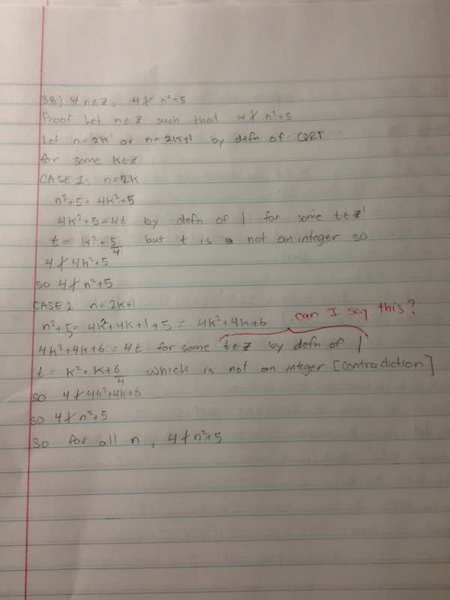
348sso9.jpg


I need very thorough correction, down to the last support for every thing. Thank you
 
Physics news on Phys.org
You're doing more work than you need to.
For case 1, when n = 2k, you have n2 + 5 = (2k)2 + 5 = 4k2 + 5 = 4(k2 + 1) + 1. Clearly 4 | 4(k2 + 1), but it can't also divide 4(k2 + 1) + 1.

For case 2, use a similar argument.
 
I would state, re the first that from:

4k2+5=4t ,

you may also write:

5=4(t-k2) , for t,k2 integers, which is not possible, i.e.,

5=4x has no solutions in integers (e.g. 4 is not invertible in integers.).

But that is a matter of preference (since I don't know the constraints; what you are or not allowed to work with).

To check possible congruences (mod4) , check the values (mod4) of each of the squares of : 4k, 4k+1,4k+2, 4k+3.

------------------------------

OR:

4|(n2+5) , then n2+5==0(mod4)→

n2==3mod4. But you can check that n2==0,1,2 but not 3 (mod4).
 
Last edited:
But there is nothing wrong with my proof right?
 
rather than use "not an integer" arguments, it would be cleaner to stay totally within the integers.

that is, if 4k2+ 5 = 4t

then 5 = 4(t - k2) → 4|5, impossible.

similarly, if 4k2 + 4k + 9 = 4t

then 9 = 4(t - k2 + k) → 4|9, also impossible.

*******

alternate proof # 1:

if 4|n2 + 5, then n2+5 must be even, so n2 must be odd → n is odd.

therefore n = 4k+1 or 4k+3 (all odd numbers are of one of these 2 forms).

(4k+1)2 + 5 = 16k2 + 8k + 6,

if this is divisible by 4, then 16k2 + 8k + 6 = 4t, so

6 = 4(t - 4k2 - 2k) → 4|6.

(4k+3)2 + 5 = 16k2 + 24k + 14, and as before:

16k2 + 24k + 14 = 4t implies 14 = 4(t - 4k2 - 6k),

so that 4|14, a contradiction.

*******

alternate proof #2:

let [a] = the residue class of a mod 4.

if 4|n2 + 5, then [n2 + 5] = [0], so [n2] = [-5] = [3].

but [n2] = [n][n] = [0][0], [1][1],[2][2], or [3][3].

[0][0] = [0] ≠ [3]
[1][1] = [1] ≠ [3]
[2][2] = [4] = [0] ≠ [3]
[3][3] = [9] = [1] ≠ [3],

so there is no n for which [n2] = [3], and so no n for which [n2+5] = [0], so 4 does not divide n2+ 5

********

why provide 3 proofs, when all you want to know is: is yours OK? hmm...it's a mystery, no? perhaps you think about it for a little bit.
 
Last edited:
Deveno said:
rather than use "not an integer" arguments, it would be cleaner to stay totally within the integers.

that is, if 4k2+ 5 = 4t

then 5 = 4(t - k2) → 4|5, impossible.

similarly, if 4k2 + 4k + 9 = 4t

then 9 = 4(t - k2 + k) → 4|9, also impossible.

*******

alternate proof # 1:

if 4|n2 + 5, then n2+5 must be even, so n2 must be odd → n is odd.

therefore n = 4k+1 or 4k+3 (all odd numbers are of one of these 2 forms).

(4k+1)2 + 5 = 16k2 + 8k + 6,

if this is divisible by 4, then 16k2 + 8k + 6 = 4t, so

6 = 4(t - 4k2 - 2k) → 4|6.

(4k+3)2 + 5 = 16k2 + 24k + 14, and as before:

16k2 + 24k + 14 = 4t implies 14 = 4(t - 4k2 - 6k),

so that 4|14, a contradiction.

why provide 3 proofs, when all you want to know is: is yours OK? hmm...it's a mystery, no? perhaps you think about it for a little bit.

I like the way you did the first two proofs, they look simple and to the point. I understand that there are many ways to do the same proof and it is always better to be able to write proofs efficiently because not all proofs are always this short.

I am reluctant to use your mod proof because we have not learned it that way. I have an exam coming up and I want to be able to just follow the professors style to get full points :-p
 
Instinctlol said:
I like the way you did the first two proofs, they look simple and to the point. I understand that there are many ways to do the same proof and it is always better to be able to write proofs efficiently because not all proofs are always this short.

I am reluctant to use your mod proof because we have not learned it that way. I have an exam coming up and I want to be able to just follow the professors style to get full points :-p

that is a fair point.. professors usually appreciate it when students don't "get ahead of themselves" and use theorems/concepts that haven't been covered yet.

that said, there's no harm in "looking ahead" and understanding that what you have done can be viewed an alternate way. it's like looking at two views of a 3-D object: one from the front, and one from the side. neither view is "wrong", but they are certainly different.
 
Proof seems correct; only thing is I don't know what you

are allowed to use (mostly: can you bring up rationals, or do you have to stay within

the integers?). If everything your using is allowed, it seems correct to me.
 

Similar threads

  • · Replies 2 ·
Replies
2
Views
2K
  • · Replies 1 ·
Replies
1
Views
1K
  • · Replies 18 ·
Replies
18
Views
2K
  • · Replies 4 ·
Replies
4
Views
2K
  • · Replies 1 ·
Replies
1
Views
2K
  • · Replies 3 ·
Replies
3
Views
2K
  • · Replies 13 ·
Replies
13
Views
3K
  • · Replies 10 ·
Replies
10
Views
2K
  • · Replies 11 ·
Replies
11
Views
3K
  • · Replies 5 ·
Replies
5
Views
5K