Understanding Electric Motor Rotation & Magnetic Field Vibrations

Click For Summary

Homework Help Overview

The discussion revolves around understanding the operation of electric motors, specifically the relationship between current flow, magnetic fields, and the resulting rotation of the motor. Participants are exploring concepts related to electromagnetism and the mechanics of motor function.

Discussion Character

  • Exploratory, Conceptual clarification, Assumption checking

Approaches and Questions Raised

  • Participants are attempting to clarify the direction of current flow and magnetic field orientation in relation to motor rotation. Questions are raised about the application of the right-hand rule and its implications for understanding force direction on the wire.

Discussion Status

The discussion is ongoing, with participants sharing their understanding and questioning each other's interpretations. Some guidance has been offered regarding the right-hand rule and the conventions of current and magnetic field directions, but there is no explicit consensus on the correct interpretation of the diagram or the motor's operation.

Contextual Notes

There are indications of confusion regarding the conventions of current flow and magnetic field direction. Participants express uncertainty about their diagrams and the application of the right-hand rule, suggesting a need for further clarification and resources.

alicia113
Messages
103
Reaction score
0
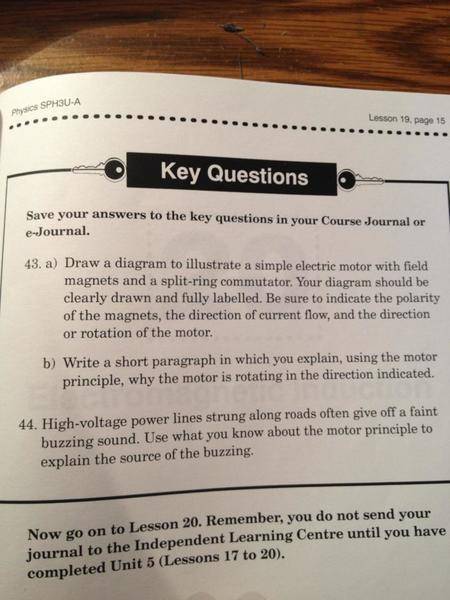
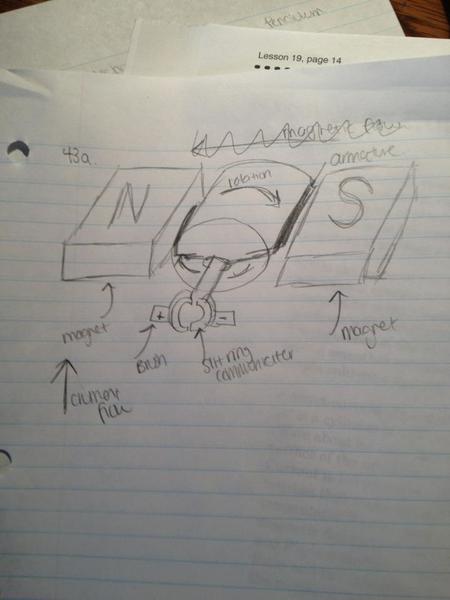
ok, so i have drawn a diagram for 43 and i would like to know if i have done it correctly.. i believe the rotation should go the other way. Also can someone help me with the paragraph to wrtie about it

and for the other question, does it have something to do with the magnetic field causing the wires to vibrate and give off a faint buzzing noise. If so could someone please help me explain it better, thanks.
531204_10151940436615526_1155109508_n.jpg


295333_10151940436850526_1584268255_n.jpg
 
Physics news on Phys.org
and from what i know the current flows from S to N so my rotation i believe is wrong and that is how the motor goes in the direction
 
alicia113 said:
and from what i know the current flows from S to N so my rotation i believe is wrong and that is how the motor goes in the direction

I think you might be getting current and the magnetic field confused.

1. Do you know (by convention) which direction your magnetic field points in your drawing?
(left to right or right to left?)

2. Do you know which way the current is flowing (conventional) in your drawing of... let's use the part of the wire on the left hand side of your drawing, the straight part closest to the North Pole of your magnet?

3. Do you know the right hand rule that allows you to find the direction of the Force on the part of the wire mentioned in #2?
 
yes i know the right hand rule........ and i do not understand number 1 and 2 :(
 
is my current flow wrong than ??
 
so becasue it flows from south to north and when using the right hand rule.. my direction of it rotating should be the opposite way?
 
Current flows from + to -

The permanent magnets you have drawn produce a magnetic field between them yes?

Which way does the field point? N to S or S to N...? What is the convention, in other words, what do we all agree on about the direction of the magnetic field based on your drawing and the poles (N and S)?
 
s to N?
 
alicia113 said:
s to N?

Out of North into South. Thats the rule we have all agreed upon. N to S.

So in the part of the wire that is closest to the North pole that you have drawn going into the page, which way is the force on that piece of wire? You now need to use the right hand rule.

You know the direction of the magnetic field, you know the direction of the current in that piece of wire, so which way is the force on the wire at that particular orientation?
 
  • #10
pgardn said:
Out of North into South. Thats the rule we have all agreed upon. N to S.

So in the part of the wire that is closest to the North pole that you have drawn going into the page, which way is the force on that piece of wire? You now need to use the right hand rule.

You know the direction of the magnetic field, you know the direction of the current in that piece of wire, so which way is the force on the wire at that particular orientation?


I don't know how I find that. All my book gives me is the right hand rule and talkes about the parts of a motor.

But okay so my current flow goes from north to south. so my diagram is rotating the correct way. as the amateur spins the direction of the current in the loop of wire keeps reversing as the coul reaches a position where the force is no longer produced as a rotation.
 
  • #11
And by using the right-hand rule, it shows the direction of the Motor spinning. Because as you fold over your hand your right hand the direction goes from north to south so that is the way it rotates
 
  • #12
alicia113 said:
I don't know how I find that. All my book gives me is the right hand rule and talkes about the parts of a motor.

But okay so my current flow goes from north to south. so my diagram is rotating the correct way. as the amateur spins the direction of the current in the loop of wire keeps reversing as the coul reaches a position where the force is no longer produced as a rotation.

Current is used to describe the flow of electricity, not magnetic fields.

The magnetic field points from Left to right in your drawing, now which way does the electric current flow in the piece of wire that you have drawn next to the North pole of the magnet?
 
  • #13
Alicia you probably need to find a better book and talk to your teacher.

You seem a bit weak on this stuff.

I am going to leave you with this applet that shows the physical process. I got to go to work.

http://www.walter-fendt.de/ph14e/electricmotor.htm
 

Similar threads

  • · Replies 19 ·
Replies
19
Views
3K
  • · Replies 11 ·
Replies
11
Views
2K
  • · Replies 7 ·
Replies
7
Views
7K
  • · Replies 6 ·
Replies
6
Views
2K
  • · Replies 3 ·
Replies
3
Views
2K
  • · Replies 5 ·
Replies
5
Views
1K
  • · Replies 7 ·
Replies
7
Views
3K
  • · Replies 4 ·
Replies
4
Views
2K
  • · Replies 7 ·
Replies
7
Views
2K
  • · Replies 3 ·
Replies
3
Views
2K