Understanding Factoring a Quadratic Equation: Common Mistakes and Solutions

Click For Summary

Homework Help Overview

The discussion revolves around understanding the factoring of quadratic equations, particularly the role of coefficients in the factored form and the equivalence of different forms of quadratic equations. Participants explore common mistakes and clarify concepts related to quadratic and cubic equations.

Discussion Character

  • Exploratory, Conceptual clarification, Assumption checking

Approaches and Questions Raised

  • Participants question why expanding the factored form does not yield the original equation, and whether the quadratic formula can be applied to parts of an equation. There is also discussion about the necessity of the leading coefficient in the factored form of quadratic and cubic equations.

Discussion Status

There is an ongoing exploration of the concepts, with some participants providing insights into the equivalence of factored forms and questioning the significance of coefficients. Guidance has been offered regarding the application of the quadratic formula and the nature of roots in quadratic and cubic equations.

Contextual Notes

Participants express confusion about the role of coefficients in factored forms and the implications of complex roots. There is mention of homework policies that discourage providing complete solutions, emphasizing the learning process.

ainster31
Messages
158
Reaction score
1

Homework Statement


Question + attempt:

nhv7hUy.png


Homework Equations


The Attempt at a Solution


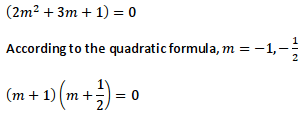
Why is it that when I expand the factored form, I don't get the original equation?
 
Physics news on Phys.org
ainster31 said:

Homework Statement


Question + attempt:

nhv7hUy.png


Homework Equations


The Attempt at a Solution


Why is it that when I expand the factored form, I don't get the original equation?
You get m2 + (3/2)m + 1 = 0, which is equivalent to the original equation. Just multiply both sides by 2.
 
  • Like
Likes   Reactions: 1 person
Mark44 said:
You get m2 + (3/2)m + 1 = 0, which is equivalent to the original equation. Just multiply both sides by 2.

Let's say we have $$2{ m }^{ 2 }+3m+1=60$$.

Would I be able to apply the quadratic formula to the left hand-side of the equation only?
 
ainster31 said:
Let's say we have $$2{ m }^{ 2 }+3m+1=60$$.

Would I be able to apply the quadratic formula to the left hand-side of the equation only?
No. The Quadratic Formula requires that your equation be in the form ax2 + bx + c = 0, with a ≠ 0.
 
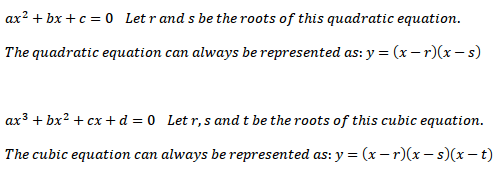
How true is the below?

Oc8CsjI.png
 
ainster31 said:
How true is the below?

Oc8CsjI.png

What do you think? These look like textbook problems. Our policy here is that we don't do the work for students. Tell me what you think and why, and I'll tell you if you're right or where you went wrong.
 
Mark44 said:
What do you think? These look like textbook problems. Our policy here is that we don't do the work for students. Tell me what you think and why, and I'll tell you if you're right or where you went wrong.

They're not problems. They're statements that I wrote.

If I recall correctly, in the 10th grade, the teacher said the factored form of a quadratic equation is ##y=(x-r)(x-s)## and in the 11th grade, the teacher said the factored form of a cubic equation is ##y=(x-r)(x-s)(x-t)##. However, in the 11th grade, the teacher changed it to ##y=a(x-r)(x-s)(x-t)## later.

I don't understand why the cubic equation has the a coefficient and not the quadratic one.
 
Last edited:
ainster31 said:
They're not problems. They're statements that I wrote.

If I recall correctly, in the 10th grade, the teacher said the general form of a quadratic equation is ##y=(x-r)(x-s)## and in the 11th grade, the teacher said the general form of a cubic equation is ##y=(x-r)(x-s)(x-t)##.
The general form of a quadratic function is y = ax2 + bx + c. The right side of this can be written as a(x -r)(x -s). It's possible that r and s are complex numbers, though.
ainster31 said:
However, in the 11th grade, the teacher changed it to ##y=a(x-r)(x-s)(x-t)## later.
The general form of a cubic function is y = ax3 + bx2 + cx + d. The right side can be written in factored form as a(x - r)(x - s)(x - t), with possibly some of the roots being complex. Complex roots come in pairs, so we can't have more than two complex roots in a cubic equation.
 
Is there an example of a general quadratic equation where when factored, a is not 1?

Edit: Actually, never mind. Thanks.
 
  • #10
2m2 + 3m + 2 = 0
==> 2(m + 1)(m + 1/2) = 0
 
  • #11
Actually, my understanding still might be poor.

aTInkj3.png
 
  • #12
2x2 - 2 = 0
==> 2(x2 - 1) = 0
==> 2(x - 1)(x + 1) = 0

The coefficient a that appears in ax2 + bx + c = 0 is exactly the same as the one that appears in a(x - r)(x - s).

BTW, you can use the quadratic formula for this equation, but it's not necessary. After removing the common factor to get 2(x2 - 1), I just factored the expression inside the parentheses, using the formula x2 - b2 = (x - b)(x + b).

For the problem in post #1, you have
2m2 + 3m + 2 = 0
==> 2(m2 + (3/2)m + 1) = 0
==> 2(m + 1)(m + 1/2) = 0

To go from the 2nd step to the 3rd, I factored, but you can also use the quadratic formula.

Note that 2(m + 1)(m + 1/2) = 0 and (m + 1)(m + 1/2) = 0 are equivalent equations. They both have exactly the same solutions.
 
  • #13
Mark44 said:
Note that 2(m + 1)(m + 1/2) = 0 and (m + 1)(m + 1/2) = 0 are equivalent equations. They both have exactly the same solutions.

So what is the point of the a coefficient if you can always divide it out?
 
  • #14
There's not really a point. a is just the coefficient of the squared term in a quadratic equation, just like be is the coefficient of the first degree term, and c is the constant.
 
  • #15
Thanks for the help.

My confession is that I'm a second-year computer engineering student.

It's kind of sad. Factoring quadratic and cubic equations always bugged me. The original quadratic is from trying to solve an auxiliary equation of a differential equation. Lol
 
  • #16
You need to multiply by 2, because when you were factoring, your formula was divided by 2.
 

Similar threads

  • · Replies 5 ·
Replies
5
Views
2K
  • · Replies 9 ·
Replies
9
Views
3K
Replies
3
Views
2K
  • · Replies 6 ·
Replies
6
Views
2K
  • · Replies 12 ·
Replies
12
Views
4K
  • · Replies 15 ·
Replies
15
Views
2K
Replies
6
Views
2K
  • · Replies 11 ·
Replies
11
Views
2K
  • · Replies 7 ·
Replies
7
Views
2K
  • · Replies 14 ·
Replies
14
Views
2K