Artimodes
- 1
- 0
Hello everyone,
I'm a newcomer to this forum! I've been having particular difficulty lately with understanding function notation in higher level mathematics. I felt like it was a general post so I posted in the general math section. I've finished calculus 3 and am going to take engineering math (basically ODE and applications) next spring.
It is my understanding that for a three dimensional function, for example an elliptic paraboloid, it's written like:
f(x,y)= z =x2+y2
However, after looking at Paul's Online Notes on ODE here, he starts to describe Newton's Second Law as a differential equation. I knew that, but his notation threw me off:
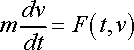
Is force in this case a three dimensional function, due to force being a function of the derivative of velocity while velocity is a function of time? Just confused.
Thanks for any help
I'm a newcomer to this forum! I've been having particular difficulty lately with understanding function notation in higher level mathematics. I felt like it was a general post so I posted in the general math section. I've finished calculus 3 and am going to take engineering math (basically ODE and applications) next spring.
It is my understanding that for a three dimensional function, for example an elliptic paraboloid, it's written like:
f(x,y)= z =x2+y2
However, after looking at Paul's Online Notes on ODE here, he starts to describe Newton's Second Law as a differential equation. I knew that, but his notation threw me off:
Is force in this case a three dimensional function, due to force being a function of the derivative of velocity while velocity is a function of time? Just confused.
Thanks for any help