Understanding Green's second identity and the reciprocity theorem

Click For Summary
SUMMARY

This discussion focuses on Green's second identity and its application in electrostatics, specifically in the context of Jackson's 3rd edition problem 1.12. The participants derive relationships using Poisson's equation and Gauss's law, ultimately leading to the reciprocity theorem. Key insights include the importance of normal derivatives in the context of conductors and the physical interpretation of work done in assembling charge distributions. The discussion emphasizes that the energy required to assemble two charge distributions in each other's potentials is equal, reinforcing the reciprocity theorem.

PREREQUISITES
  • Understanding of Green's second identity
  • Familiarity with Poisson's equation and Gauss's law
  • Knowledge of electric potential and charge distributions
  • Basic concepts of electrostatics and boundary value problems
NEXT STEPS
  • Study the derivation of Green's second identity in electrostatics
  • Explore applications of the reciprocity theorem in boundary value problems
  • Investigate the physical interpretations of work done in electrostatics
  • Read the paper on solving boundary-value electrostatics problems using Green's reciprocity theorem
USEFUL FOR

Students and professionals in physics, particularly those specializing in electrostatics, mathematical physics, and boundary value problems. This discussion is beneficial for anyone seeking to deepen their understanding of Green's identities and their applications in electrostatics.

peguerosdc
Messages
28
Reaction score
7
Homework Statement
If ##\phi## is the potential due to a volume-charge density ##\rho##within a volume V and a surface-charge density ##\sigma##on the conducting surface S bounding the volume V, while ##\phi '## is the potential due to another charge distribution ##\rho##and##\rho'##, prove Green's reciprocity theorem.
Relevant Equations
Green's reciprocity theorem:

## \int_V \rho \phi' dV + \int_S \sigma \phi' dS = \int_V \rho' \phi dV + \int_S \sigma' \phi dS ##
This is Jackson's 3rd edition 1.12 problem.

So, for both ## \phi ## and ## \phi' ##, I started from Green's second identity:

## \int_V ( \phi \nabla^2 \phi' - \phi' \nabla^2 \phi )dV = \int_S ( \phi \frac {\partial \phi'} {\partial n} - \phi' \frac {\partial \phi} {\partial n} ) dS ##

And used Poisson's equation ## \nabla^2 \phi = - \frac \rho \epsilon ## and Gauss's law and ## (E = - \nabla \phi) ## to get the relation ## \frac {\partial \phi} {\partial n} = - \frac \sigma \epsilon ## between the surface charge density and the electric potential, which resulted in:

## \int_V \rho \phi' dV - \int_S \sigma \phi' dS = \int_V \rho' \phi dV - \int_S \sigma' \phi dS ##

So this is where I am stuck. I have checked many solution's on the internet and they say that the key is to realize that the normals ##n## in Gauss's law equations are pointing out of the conductor (actually, Jackson says: "where ## \frac {\partial} {\partial n} ## is the normal derivative at the surface S directed outwards from inside the volume V"), whereas the normals in Green's theorem are pointing into the conductor, so you can flip the - signs to end with the identity you want to prove. This is how I picture this (not sure is this correct):
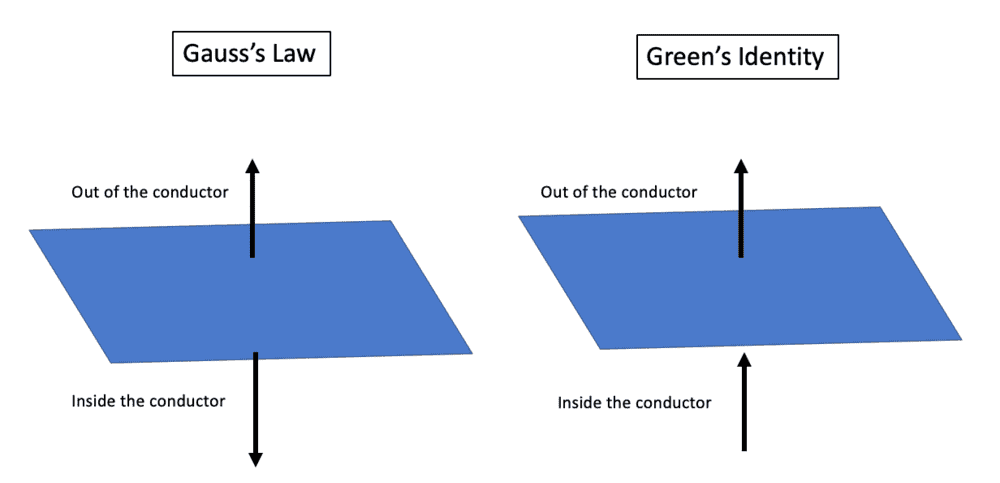
Screen Shot 2019-09-11 at 1.38.19 PM.png


Why is this the case? This made me realize that I don't understand how to derive Green's identity as I don't get why we are considering the normals in that direction. And, if my drawing is correct, we are only changing the sign inside the conductor where ## E = 0 ##, so why does this even matter?

And finally, what is the physical meaning of this theorem? I see a relationship between the work ## W = \frac 1 2 \int \rho \phi dV ## which gets you the energy required to assemble charge distribution ##\rho## in an electric potential ##\phi##, so I read Green's reciprocity identity as "the energy required to assemble a system made of a charge distribution ##\rho## and ##\sigma## in a potential produced by ##\rho'## and ##\sigma'## is the same energy required to assemble a system made of a charge distribution ##\rho'## and ##\sigma'## in a potential produced by ##\rho## and ##\sigma##" . Is my understanding correct?
 
  • Like
Likes   Reactions: Delta2
Physics news on Phys.org
peguerosdc said:
...actually, Jackson says: "where ## \frac {\partial} {\partial n} ## is the normal derivative at the surface S directed outwards from inside the volume V"...
Since ##V## is a non-conducting region bounded by a conducting surface (or surfaces), Jackson's statement implies that the normal derivative ##\frac{\partial}{\partial n}## at the surface is directed into the conductor.

And used ... ## \frac {\partial \phi} {\partial n} = - \frac \sigma \epsilon ## between the surface charge density and the electric potential
The negative sign on the right occurs when the normal derivative on the left side is directed out of the conductor. But this normal direction is opposite to ##\frac{\partial}{\partial n}## as is being used in the current application of Green's second theorem where the normal derivative is into the conductor. So, you have ## \frac {\partial \phi} {\partial n} = + \frac \sigma \epsilon ## if ## \frac {\partial} {\partial n} ## is in the direction as used in Green's second theorem.
And finally, what is the physical meaning of this theorem?
I see a relationship between the work ## W = \frac 1 2 \int \rho \phi dV ## which gets you the energy required to assemble charge distribution ##\rho## in an electric potential ##\phi##
The meaning of ##W## here is that it represents the work required to assemble a charge distribution ##\rho## starting with all of the charge dispersed at infinity. The meaning of ##\phi## in the integral for ##W## is that it represents the final potential due to the assembled charge after the charge is assembled. So, I'm not sure of the interpretation of your statement "energy required to assemble charge distribution ##\rho## in an electric potential ##\phi##". At the start of the assembly, the potential is zero everywhere.
so I read Green's reciprocity identity as "the energy required to assemble a system made of a charge distribution ##\rho## and ##\sigma## in a potential produced by ##\rho'## and ##\sigma'## is the same energy required to assemble a system made of a charge distribution ##\rho'## and ##\sigma'## in a potential produced by ##\rho## and ##\sigma##" .
I don't think this is a correct interpretation. I don't see a physical interpretation of ## W = \frac 1 2 \int \rho \phi' dV ## where ##\phi'## is the potential due to some other charge distribution rather than the potential due to ##\rho## itself.

There might be a way to give a physical interpretation of Green's reciprocity theorem that I don't see. But, even without a physical interpretation, the theorem has some useful applications. For example, in my second edition of Jackson, the theorem is presented in a homework problem where you are asked to prove the theorem. The next problem presents a nice application of the theorem.
 
Last edited:
  • Like
Likes   Reactions: Delta2
TSny said:
Since ##V## is a non-conducting region bounded by a conducting surface (or surfaces), Jackson's statement implies that the normal derivative ##\frac{\partial}{\partial n}## at the surface is directed into the conductor.

The negative sign on the right occurs when the normal derivative on the left side is directed out of the conductor. But this normal direction is opposite to ##\frac{\partial}{\partial n}## as is being used in the current application of Green's second theorem where the normal derivative is into the conductor. So, you have ## \frac {\partial \phi} {\partial n} = + \frac \sigma \epsilon ## if ## \frac {\partial} {\partial n} ## is in the direction as used in Green's second theorem.

So, just to confirm, would this be a correct sketch of the direction of the normal direction according to Green's theorem?
Screen Shot 2019-09-14 at 12.53.33 AM.png


I don't think this is a correct interpretation. I don't see a physical interpretation of ## W = \frac 1 2 \int \rho \phi' dV ## where ##\phi'## is the potential due to some other charge distribution rather than the potential due to ##\rho## itself.

Ok, that's true, the equation ## W = \frac 1 2 \int \rho \phi dV ## is the energy required to assemble ##\rho## and ##\phi## is the potential due to ##\rho## itself. In fact, as far as I remember, why we are taking only half of that quantity as we are "counting" the work twice precisely because of that. But if you remove the ##\frac 1 2## and you turn ##\phi## into ##\phi'## (meaning that the potential is caused by another distribution), then you end up with Green's identity if you take into account that it would take you the same amount of work to assemble ##\rho## in a potential ##\phi'## (produced by ##\rho'##) as to assemble ##\rho'## in a potential ##\phi## (produced by ##\rho##). The only difference is that Green's identity looks more general (?) as it also considers a conductor bounding the charge distribution.

I did more research about this and found that https://www.researchgate.net/publication/270622608_Solving_boundary-value_electrostatics_problems_using_Green's_reciprocity_theoremtalks about this relationship in section II (except that it leaves out the conducting surface). Maybe that paper explains better the idea I am talking about.
 
  • Like
Likes   Reactions: Delta2
peguerosdc said:
So, just to confirm, would this be a correct sketch of the direction of the normal direction according to Green's theorem?
View attachment 249632
Yes. Of course, in some texts they might take the normal direction to be in the opposite direction but make up for it by changing signs in the statement of Green's theorem.

Ok, that's true, the equation ## W = \frac 1 2 \int \rho \phi dV ## is the energy required to assemble ##\rho## and ##\phi## is the potential due to ##\rho## itself. In fact, as far as I remember, why we are taking only half of that quantity as we are "counting" the work twice precisely because of that.
Yes.

But if you remove the ##\frac 1 2## and you turn ##\phi## into ##\phi'## (meaning that the potential is caused by another distribution), then you end up with Green's identity if you take into account that it would take you the same amount of work to assemble ##\rho## in a potential ##\phi'## (produced by ##\rho'##) as to assemble ##\rho'## in a potential ##\phi## (produced by ##\rho##). The only difference is that Green's identity looks more general (?) as it also considers a conductor bounding the charge distribution.

I did more research about this and found that https://www.researchgate.net/publication/270622608_Solving_boundary-value_electrostatics_problems_using_Green's_reciprocity_theoremtalks about this relationship in section II (except that it leaves out the conducting surface). Maybe that paper explains better the idea I am talking about.
Thanks for the reference. I took a quick look at section II. It gives a nice interpretation of ## W = \int \rho \phi' dV ##. First assemble the charge configurations ##\rho## and ##\rho'## while keeping the two configurations infinitely far apart from one another. The work required for this is ## W = \frac 1 2 \int \rho \phi dV + \frac 1 2 \int \rho' \phi' dV##. Then consider the work required to bring the two assembled distributions to their final locations near each other. If we bring in the assembled ##\rho'## first and then bring in the assembled ##\rho##, the work for this is ## W = \int \rho \phi' dV ##. If instead we bring in the assembled ##\rho## first followed by the assembled ##\rho'##, the work is ##\int \rho' \phi dV##. But these two works must be equal, so ##\int \rho \phi' dV= \int \rho' \phi dV##.

If some of the unprimed and primed charge is spread on surfaces as surface charge density, then we would write

##\int \rho \phi' dV + \int \sigma \phi' dS= \int \rho' \phi dV + \int \sigma' \phi dS##.

So you get the reciprocity theorem without needing Green's second theorem.
 
  • Like
Likes   Reactions: peguerosdc

Similar threads

  • · Replies 7 ·
Replies
7
Views
6K
  • · Replies 3 ·
Replies
3
Views
2K
  • · Replies 2 ·
Replies
2
Views
2K
  • · Replies 1 ·
Replies
1
Views
1K
  • · Replies 1 ·
Replies
1
Views
558
  • · Replies 1 ·
Replies
1
Views
2K
  • · Replies 1 ·
Replies
1
Views
4K
Replies
6
Views
3K
  • · Replies 3 ·
Replies
3
Views
1K
  • · Replies 9 ·
Replies
9
Views
3K