Understanding Lyapunov Exponent: Why Do We Use an Exponential Function?

Click For Summary
SUMMARY

The discussion centers on the Lyapunov Exponent and its reliance on exponential functions to analyze the behavior of chaotic systems, particularly in the context of the Lorenz attractor. Participants emphasize that the fluctuations of Δ(t) around a finite value are crucial for understanding the separation of orbits. The conversation highlights the importance of taking the inner limit before the outer limit to avoid discrepancies in results. This approach ensures that the chaotic nature of orbits is accurately captured through exponential expansion over time.

PREREQUISITES
  • Understanding of Lyapunov Exponent and its mathematical formulation
  • Familiarity with chaotic systems and the Lorenz attractor
  • Knowledge of limits in calculus, particularly inner and outer limits
  • Basic concepts of differential equations and their applications in dynamical systems
NEXT STEPS
  • Study the mathematical derivation of the Lyapunov Exponent in chaotic systems
  • Explore the properties of the Lorenz attractor and its implications in chaos theory
  • Learn about the role of limits in calculus, focusing on inner and outer limits
  • Investigate differential equations and their significance in modeling dynamic systems
USEFUL FOR

Researchers, mathematicians, and physicists interested in chaos theory, as well as students studying dynamical systems and their applications in real-world phenomena.

ATY
Messages
30
Reaction score
1
Hey guys,
I need your help. I am not sure if this is the right part of the forum to ask this question.

So I started reading papers about the Lyapunov Exponent, but there is something I do not understand in the formula. Why
3b69fa3cef032d756df32ee5d7e98bb4.png
? It seems logical that we want
033d4d4ea6fa6d82f7d0b251f0b13bb3.png
because we want to get the Exponent at a certain point and therefore the startingpoints should be really close together.
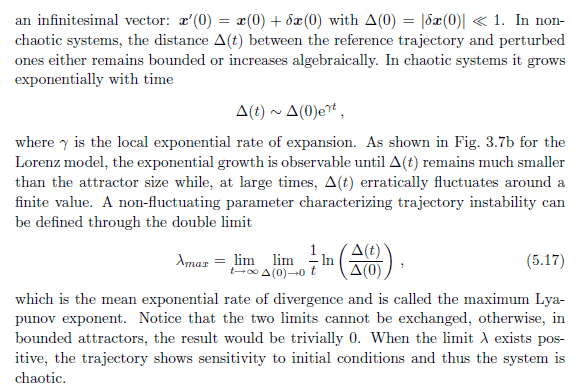
I added a text from a book which says, that we have
3b69fa3cef032d756df32ee5d7e98bb4.png
, because then my
df19220ab64edaf1ce547c35a46632c2.png
will fluctuate around a finite value, but I have no clue why an exponential function should do this. Maybe somebody can help me.
8feeac681c.png
 
I am a bit rusty on this topic, but let me give it a try.

I am guessing that the fluctuations of Δ(t) around a finite value that the text mentions is a reference to what happens when forming the inner limit, so to speak. The initial exponential expansion phase is when the two originally very close orbits follow each other around in the same branch of the Lorenz attractor and the fluctuation then occur when when the orbits around some value of t separate into each branch and the state of the two orbits becomes uncorrelated. Another way to say it is that the fluctuations only occur if you take the outer limit before the inner limit (as the text also warns about will give a different result). If you take the inner limit first, it can be replaced by a measure that is similar to how you define the differential coefficients and once that limit is made there is no fluctuation.

The outer limit is then needed to make a kind of integral along the orbit. For instance, for an orbit to be chaotic the flow around the orbit must in net be exponentially expanding over all times and not just during any initial transient.
 

Similar threads

  • · Replies 3 ·
Replies
3
Views
4K
  • · Replies 17 ·
Replies
17
Views
2K
  • · Replies 9 ·
Replies
9
Views
3K
  • · Replies 11 ·
Replies
11
Views
3K
  • · Replies 16 ·
Replies
16
Views
2K
  • · Replies 15 ·
Replies
15
Views
4K
  • · Replies 4 ·
Replies
4
Views
3K
  • · Replies 43 ·
2
Replies
43
Views
8K
  • · Replies 8 ·
Replies
8
Views
3K
Replies
2
Views
3K