Understanding Partial Fraction Decomposition in Integrals

Click For Summary

Discussion Overview

The discussion revolves around the process of partial fraction decomposition in the context of integrating rational functions. Participants are examining specific integral problems and the correctness of their solutions, focusing on the decomposition of the integrands and the subsequent integration steps.

Discussion Character

  • Homework-related
  • Mathematical reasoning
  • Debate/contested

Main Points Raised

  • One participant presents an integral problem involving the expression (3x^3+18x^2+37-4) / (x^2+6x+10)^2 and claims to have found a solution, but expresses uncertainty about its correctness.
  • Another participant emphasizes the need to see the work done to identify where the misunderstanding may lie, specifically asking for the partial fraction decomposition of the integrand.
  • A different participant provides a proposed decomposition for the integrand, suggesting a specific form that could facilitate integration.
  • One participant reflects on a previous negative experience related to the accuracy of their answer, indicating confusion over the notation used for the inverse tangent function.
  • Another participant shares a personal experience regarding inconsistencies in how trigonometric functions are accepted in submissions, noting that certain formats are sometimes counted as incorrect.
  • A later reply points out a potential error in the last denominator of the participant's incorrect submission, suggesting there may be a missing variable.

Areas of Agreement / Disagreement

Participants do not reach a consensus on the correctness of the initial solution provided. There are multiple competing views regarding the proper decomposition and integration steps, and the discussion remains unresolved.

Contextual Notes

Participants express uncertainty about specific steps in the integration process and the notation used, which may affect the interpretation of their answers. There are also indications of confusion regarding the formatting of mathematical expressions in submissions.

stripedcat
Messages
44
Reaction score
0
First the example problem. This is an integral of the whole thing

(3x^3+24x^2+56x-5) / (x^2+8x+17)^2

The answer comes out to be

3/2 ln(x^2+8x+17) - (49/2 tan^-1(x+4)) - (25x+105 / 2(x^2+8x+17) + C

I would show all the steps but I'm still not sure on how to use the format tools, so that would get really messy to read.

The 'real' problem is

(3x^3+18x^2+37-4) / (x^2+6x+10)^2

Which I solve to be...

3/2 ln(x^2+6x+10)- (43/2 tan^-1(x+3)) - (25x+82 / 2(x^2+6x+10)) + C

Which is 'wrong', I keep coming back with that same answer though, and online resources seem to confirm it?

I just don't know where I'm going wrong.
 
Physics news on Phys.org
We can't really tell you where you are going wrong without seeing your work. :D

The first step is to obtain the partial fraction decomposition of the integrand...what did you get for that?
 
MarkFL said:
We can't really tell you where you are going wrong without seeing your work. :D

The first step is to obtain the partial fraction decomposition of the integrand...what did you get for that?

For the second problem?

(3x^3+18x^2+37-4) / (x^2+6x+10)^2 =

((3x / x^2+10x) / (x^2+6x+10)) + ((7x-4) / (x^2+6x+10)^2)

That is what you wanted?
 
Okay, the actual integrand must be:

$$\frac{3x^3+18x^2+37x-4}{\left(x^2+6x+10\right)^2}$$

You have the second term correct, but the actual decomposition is:

$$\frac{3x}{x^2+6x+10}+\frac{7x-4}{\left(x^2+6x+10\right)^2}$$

Now, I would suggest adding zero to each numerator in a form that makes integrating easier...what do you get after doing this?
 
Scratch all that noise.

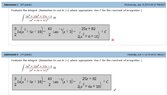
My answer was 'wrong', and yes, there was a uh... 'not so kind' email over this.

Typing out tan^-1 vs using the system to make a 'tan^-1( )

You tell me if you can tell the difference, maybe I just don't see it.

View attachment 2791
 

Attachments

  • Math what now.jpg
    Math what now.jpg
    44.3 KB · Views: 107
Last edited:
stripedcat said:
Scratch all that noise.

My answer was 'wrong', and yes, there was a uh... 'not so kind' email over this.

Typing out tan^-1 vs using the system to make a 'tan^-1( )

You tell me if you can tell the difference, maybe I just don't see it.

View attachment 2791

For the inverse tangent function, try Arctan(x). Your input is probably making the computer read it as [tan(x)]^(-1).
 
Anything is possible.

Had a problem last week with other trig related inputs.

The examples always showed 'sinx', but if you put in 'sinx' for your answer, it counted it wrong... But only sometimes.

But it always counted sin(x) right.
 
Look at the last denominator in the incorrect submission...there is a missing $x$. :D
 

Similar threads

  • · Replies 5 ·
Replies
5
Views
2K
  • · Replies 6 ·
Replies
6
Views
2K
  • · Replies 3 ·
Replies
3
Views
2K
  • · Replies 3 ·
Replies
3
Views
2K
  • · Replies 5 ·
Replies
5
Views
2K
  • · Replies 8 ·
Replies
8
Views
2K
  • · Replies 3 ·
Replies
3
Views
2K
  • · Replies 4 ·
Replies
4
Views
3K
Replies
1
Views
1K
  • · Replies 3 ·
Replies
3
Views
3K