Understanding the Eigenframe: Definition and Importance

  • Context: Graduate 
  • Thread starter Thread starter K41
  • Start date Start date
  • Tags Tags
    Definition
Click For Summary

Discussion Overview

The discussion revolves around the concept of an eigenframe, exploring its definition and significance in the context of linear operators, tensor fields, and applications in physics and mathematics. Participants engage with the theoretical aspects, potential interpretations, and the prerequisites for understanding the topic.

Discussion Character

  • Exploratory
  • Technical explanation
  • Debate/contested
  • Conceptual clarification

Main Points Raised

  • Some participants express uncertainty about the term "eigenframe," noting a lack of definitions in common resources.
  • One participant proposes that an eigenframe could refer to a coordinate frame field whose directions are defined by the eigenvectors of a tensor field at a point on a differentiable manifold.
  • Another participant mentions the relationship between eigenvalues and eigenvectors, suggesting that an eigenframe might represent a basis of eigenvectors or a reference frame for a moving particle.
  • Concerns are raised about the prerequisites for understanding eigenframes, with some participants suggesting that a background in linear algebra is necessary before tackling tensor analysis.
  • There is a disagreement regarding the relevance of certain mathematical concepts, such as tangent bundles and manifolds, to the understanding of eigenframes, with some participants asserting that these are not typically covered in engineering education.
  • Participants share links to external resources that may provide context or applications related to eigenframes, though some express difficulty in comprehending the material.

Areas of Agreement / Disagreement

Participants do not reach a consensus on the definition or implications of eigenframes. Multiple competing interpretations and viewpoints are presented, reflecting a range of understanding and familiarity with the underlying concepts.

Contextual Notes

Some participants indicate limitations in their understanding of linear algebra and tensor analysis, which may affect their ability to engage with the topic fully. There are also references to the specific educational backgrounds of participants, suggesting that familiarity with certain mathematical frameworks may vary.

K41
Messages
94
Reaction score
1
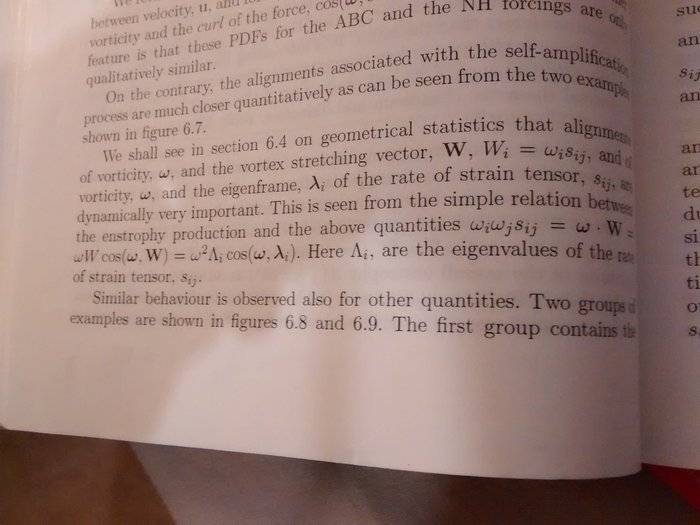
What is an eigenframe?

attachment.php?attachmentid=552208&d=1466204732.jpg
 
Physics news on Phys.org
I've never heard of an Eigenframe and neither, apparently, has Google or DuckDuckGo.

However, there's a fairly natural guess we can make. If a linear operator L on a n-dimensional vector space V is non-degenerate, it will have n orthonormal eigenvectors. These form a nice orthonormal basis for V, and bases can be called 'frames'.

If we are concerned with a differentiable manifold rather than just a single vector space then a (1 1) tensor field T on the manifold can be interpreted as a field of linear operators on the tangent bundle. There will be a unique coordinate frame field whose coordinate directions at any point are those of the eigenvectors of the tensor (qua linear operator) at that point. It would make sense to call that coordinate frame field an 'eigenframe' pf the tensor field T.
 
andrewkirk said:
I've never heard of an Eigenframe and neither, apparently, has Google or DuckDuckGo.

However, there's a fairly natural guess we can make. If a linear operator L on a n-dimensional vector space V is non-degenerate, it will have n orthonormal eigenvectors. These form a nice orthonormal basis for V, and bases can be called 'frames'.

If we are concerned with a differentiable manifold rather than just a single vector space then a (1 1) tensor field T on the manifold can be interpreted as a field of linear operators on the tangent bundle. There will be a unique coordinate frame field whose coordinate directions at any point are those of the eigenvectors of the tensor (qua linear operator) at that point. It would make sense to call that coordinate frame field an 'eigenframe' pf the tensor field T.

I don't understand any of this.

fresh_42 said:
I've found a few occurrences, however no definition. Maybe you could read more out of its applications than I can.

Density matrices:
https://books.google.de/books?id=o0...l5DFoQ6AEIOTAG#v=onepage&q=eigenframe&f=false

Spin:
http://easyspin.org/documentation/hamiltonian.html

https://en.wikipedia.org/wiki/Axiality_and_rhombicity

I don't understand anything on these pages but I think the last link may be onto something but I don't understand the applications part.
 
djpailo said:
I don't understand any of this.

If you don't understand "any of this," which includes eigenvectors, then you haven't studied linear algebra enough to have the prerequisites for tensor analysis.

Also, after you learn linear algebra, you might want to study a more general introductory fluid mechanics text before going back to this one which specializes in turbulence.
 
  • Like
Likes   Reactions: jim mcnamara
The Bill said:
If you don't understand "any of this," which includes eigenvectors, then you haven't studied linear algebra enough to have the prerequisites for tensor analysis.

Also, after you learn linear algebra, you might want to study a more general introductory fluid mechanics text before going back to this one which specializes in turbulence.

I understand the physics of what is being explained but wanted it or firmer mathematical background. Just for your reference, engineers don't learn about tangent bundles. Nor do engineers learn much (or anything) about manifolds.

Secondly, you don't know anything about turbulence if indeed your inferring that I need an understanding of tangent bundles and manifolds to understand some of it. If you don't want to help, then fine, but don't be so rude. Please don't post here again, thanks.
 
Eigenvalues and eigenvectors are nothing mysterious. For a linear operator ##L## (function, mapping whatever, as long as it is linear), the equation ##L(x) = Lx = c \cdot x## for a number ##c## means: ##x## is an eigenvector of ##L## with eigenvalue ##c##. That's it. It becomes more interesting when we try to interpret what an eigenvector physically means, or if there is a whole basis consisting of only eigenvectors (to possibly a couple of different eigenvalues).

I think the most likely meaning is, considering what @andrewkirk has said and what is written in the examples I've found, that an eigenframe is either a reference frame that consists of a basis of eigenvectors or more simply: the reference frame of a (moving) particle, since "eigen" means "belonging to", "its property" or "proper". I tend to the latter.

Because "proper" isn't a good translation it has been dropped and people just used the German prefix eigen. (Somewhere here on PF there is a whole thread about the origin and usage of "eigen".)

https://www.physicsforums.com/threads/where-does-the-nomenclature-eigen-originate.843038/
 

Similar threads

  • · Replies 3 ·
Replies
3
Views
2K
  • · Replies 45 ·
2
Replies
45
Views
6K
  • · Replies 1 ·
Replies
1
Views
3K
  • · Replies 1 ·
Replies
1
Views
3K
  • · Replies 8 ·
Replies
8
Views
3K
  • · Replies 4 ·
Replies
4
Views
4K
  • · Replies 10 ·
Replies
10
Views
1K
  • · Replies 4 ·
Replies
4
Views
2K
  • · Replies 8 ·
Replies
8
Views
3K
  • · Replies 26 ·
Replies
26
Views
2K