Understanding the normal vector

  • Thread starter Thread starter nobahar
  • Start date Start date
  • Tags Tags
    Normal Vector
Click For Summary
SUMMARY

The discussion clarifies the concept of the normal force, emphasizing that it is not merely a reaction to gravitational force but rather a response to the perpendicular component of gravity acting on an object resting on a tilted surface. The normal force is defined as the force exerted by a surface that is perpendicular to the object, counteracting the component of gravitational force acting into the surface. The equation mentioned, -1*m*a*cos(x), illustrates how the normal force is calculated based on the angle of the slope and the mass of the object. The true action-reaction pairs involve the gravitational forces between the Earth and the object, as well as the normal forces between the object and the slope.

PREREQUISITES
  • Understanding of Newton's laws of motion, particularly the third law.
  • Familiarity with vector decomposition in physics.
  • Basic knowledge of forces acting on objects on inclined planes.
  • Concept of atomic/molecular compression in materials.
NEXT STEPS
  • Study the principles of vector decomposition in physics.
  • Learn about forces on inclined planes and their calculations.
  • Explore the concept of atomic/molecular forces and their role in material behavior.
  • Investigate the implications of Newton's third law in various physical scenarios.
USEFUL FOR

Students of physics, educators explaining mechanics, and anyone interested in understanding the dynamics of forces acting on objects on inclined surfaces.

nobahar
Messages
482
Reaction score
2
Hello!
I have a question regarding the normal force. From what I have read, it is a force in repsonse to compression of the atom/molecules in an object. So that the molecules are forced closed togeather by a force, and, due to Newton's third law, there is a 'reaction' force. I can understand this for forces applied perpendicular to the surface of the object: the normal force will then also be perpendicular and in the opposite direction.
Now (I guess that you can see where this is going), when an object lies on a tilted surface, the normal force is perpendicular to the surface. I have clearly misunderstood what the normal force is or I have interpreted the compression incorrectly, as to me this would contradict the third law. Since the compression is due to gravity, would not the atoms/molecules be compressed in the direction of the force due to gravity, and therefore exert an equal and opposite force? Instead, the normal force is described by the equation -1*m*a*cos(x). I have included a rather pretty picture for your enjoyment, and because my description is probably quite poor.
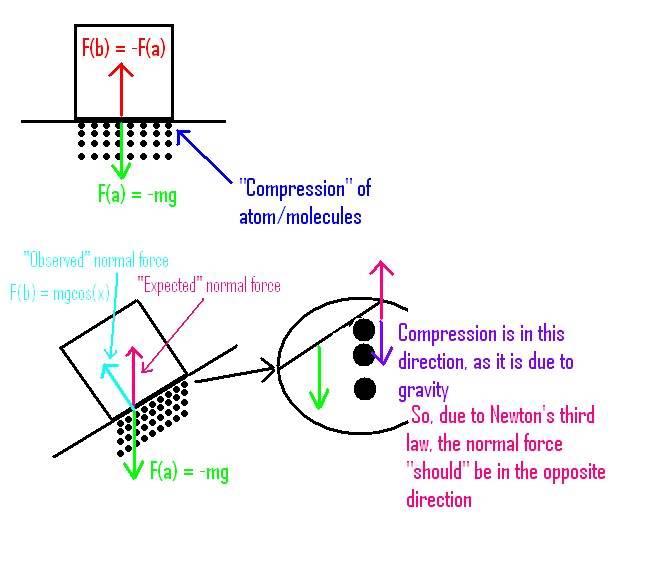
normal.jpg
 
Physics news on Phys.org
Remember that the force vector for gravity can be broken into components.

Let's break it up into two components, one along the direction of the slope, and one perpendicular to the surface of the slope.

It is only this second component that pulls the object into the surface of the slope. (The parallel component pulls the object along the slope, not into it.) Therefore, the normal force is opposite to this perpendicular component of gravity, not the full gravity vector.

Also:

While the normal force certainly wouldn't exist without gravity pulling the object into the surface, it is not correct to say that it is the reaction force to the gravitational force.

The actual "action-reaction pair" will be 1. The force of gravity of the Earth pulling on the box and 2. The force of gravity from the box pulling on the earth. We usually don't think about the second, since it has a negligible effect on the earth, but nevertheless, this is the true "reaction force."

The "normal force from the slope on the box" has a reaction pair as well. It's the "normal force from the box pushing on the slope," Again, we usually don't think about this force because we assume the slope is fixed and can't move. However, this is the true action reaction pair to which the normal force belongs.
 
Last edited:
Thanks GO1, that was very clear and precise. It amazes me how a textbook can't explain it like that.
I'm guessing that the normal forces are both a product of the compression of the atoms in the objects.
 

Similar threads

  • · Replies 8 ·
Replies
8
Views
1K
  • · Replies 6 ·
Replies
6
Views
2K
Replies
7
Views
2K
  • · Replies 8 ·
Replies
8
Views
4K
  • · Replies 57 ·
2
Replies
57
Views
5K
  • · Replies 5 ·
Replies
5
Views
2K
Replies
8
Views
2K
Replies
9
Views
2K
Replies
2
Views
3K
  • · Replies 10 ·
Replies
10
Views
2K