Understanding the Parallelogram Area Formula: A Quest for Proof

  • Context: Undergrad 
  • Thread starter Thread starter kripkrip420
  • Start date Start date
  • Tags Tags
    Paradox Parallelogram
Click For Summary

Discussion Overview

The discussion revolves around the area of a parallelogram and the formula for calculating it, specifically the formula A*B*sin(theta) as presented on Wikipedia. Participants explore the implications of changing angles on the area and seek proofs or clarifications regarding the formula's validity and assumptions.

Discussion Character

  • Exploratory
  • Technical explanation
  • Debate/contested
  • Mathematical reasoning

Main Points Raised

  • One participant questions the assumption that the area of a parallelogram remains the same as that of a rectangle when angles change, specifically noting contradictions in their reasoning.
  • Another participant challenges the idea that the area should remain constant regardless of the angle, suggesting that as the angle approaches zero, the area diminishes to zero.
  • A suggestion is made to visualize the problem using graph paper to better understand the area changes when transforming a rectangle into a parallelogram.
  • Several participants emphasize that changing the angle does indeed affect the area, providing examples to illustrate this point.
  • One participant offers a proof by stating that the height of the parallelogram can be expressed as A*sin(theta), leading to the area being calculated as base times height.
  • Another participant expresses surprise at the realization that the area does not remain constant and acknowledges the excitement of discovering this mathematical insight.

Areas of Agreement / Disagreement

Participants generally disagree on the assumption that the area remains constant when the angle changes. Multiple viewpoints are presented regarding the relationship between angle and area, with some participants providing proofs while others express confusion or seek clarification.

Contextual Notes

Some participants express uncertainty about their assumptions and reasoning, particularly regarding the implications of angle changes on area calculations. The discussion reflects a range of understandings and interpretations of the area formula.

kripkrip420
Messages
54
Reaction score
0
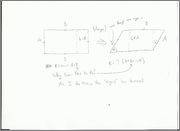
Hi there! My question involves the area of a parallelogram. Now, I know how to prove the commonly used formula (b*h) very easily, however, there is a formula given on Wikipedia as an alternative that states...Given two sides B and C with angle (theta), B*C*sin(theta)=Area of a parallelogram. Now the problem is that there is no proof given for this problem and I keep coming up with contradictions in my head. For example, say you start with a rectangle with sides A and B where A does not equal B. Now, take that rectangle and move two of it's angles that are collinear(lie on the same side or line) through an equivalent angle (theta). What you will be left with is a parallelogram whose sides are the same length as the rectangle we started with (A and B). We know that the rectangle has an area of A*B, so it should be safe to assume that the parallelogram has the same area. This is where the trouble comes in (in my head at least). The definition given in Wikipedia states that the area of a parallelogram with two sides A and B and an angle theta is equal to A*B*sin(theta). So, my questions to you is, where is my sin(theta) missing? What mistake(s) have I made? Have there been any incorrect assumptions I have made? Does anyone know a proof for the formula given on Wikipedia? For all those who help me in understanding and using there time to help me out, thank you in advance!

(Image below to describe my reasoning.)
Scan.jpg
 
Last edited:
Mathematics news on Phys.org
why ? "...so it should be safe to assume that the parallelogram has the same area."? If the angle were 90 degrees, the parallelogram would have zero error.
 
pongo38 said:
why ? "...so it should be safe to assume that the parallelogram has the same area."? If the angle were 90 degrees, the parallelogram would have zero error.

Yes. But what I am saying is that the angle is less than 90 degrees. All I have done is taken the original rectangle and "Pushed it" so that it went "sideways." I am just wondering why the area would not simply be A*B instead of A*B*sin(theta) because if it were A*B and the angle is less than 90, then the area has decreased where my logical reasoning says it shouldn't have. I haven't done nothing to the original rectangle but "transform" it. The area should remain the same regardless.

If you know the proof to the formula, could you post it as that may clear up some misconceptions on my part. Thank you for your help!
 
Changing the angle does change the area. Imagine you kept collapsing the angle so it went to 0. You would be left with a line segment with 0 area, just like the formula ABsin(0) would give you.
 
I suggest you will get valuable insight from drawing your rectangle, upright, and distorted, on graph paper, and count the little squares in both cases.
 
You seem to be assuming that the area should be the same no matter what the angle is. To see that this is not true, imagine continuing to tilt the side more and more so that angle becomes almost 0. As that side tilts more and more the area becomes smaller and smaller eventually (as the titling side merges the with the adjacent side) going to 0.

(I now see that this is what LeonardEuler said first.)
 
If you have side A and base B, and theta the angle between them, then the height is just A sin(theta), which gives your base times height. How's that for your proof?
 
HallsofIvy said:
You seem to be assuming that the area should be the same no matter what the angle is. To see that this is not true, imagine continuing to tilt the side more and more so that angle becomes almost 0. As that side tilts more and more the area becomes smaller and smaller eventually (as the titling side merges the with the adjacent side) going to 0.

(I now see that this is what LeonardEuler said first.)

HOLY CRAP! Thank you so much. I cannot believe I didn't think of that! It makes so much sense. It doesn't seem like it when you think about it though...You would think that the area remains constant...GEEZ! Math is exciting! Thank you all and especially you! Very simplistic solution! USE LIMITS! HAHA!
 
LeonhardEuler said:
Changing the angle does change the area. Imagine you kept collapsing the angle so it went to 0. You would be left with a line segment with 0 area, just like the formula ABsin(0) would give you.

Sorry. Just realized you said this first! Take the comment I made to "HallsofIvy" and apply it to yourself as well! Thank you!
 
  • #10
daveb said:
If you have side A and base B, and theta the angle between them, then the height is just A sin(theta), which gives your base times height. How's that for your proof?

Thank you! I clearly do not think in a direct mannerism...Anyone else left-handed? Thanks again to everyone for your help! I always seem to have problems with the simple math problems, yet I find set theory and linear algebra rather straightforward...
 

Similar threads

  • · Replies 5 ·
Replies
5
Views
3K
  • · Replies 1 ·
Replies
1
Views
2K
  • · Replies 1 ·
Replies
1
Views
1K
  • · Replies 18 ·
Replies
18
Views
4K
Replies
1
Views
1K
  • · Replies 5 ·
Replies
5
Views
3K
  • · Replies 2 ·
Replies
2
Views
2K
  • · Replies 6 ·
Replies
6
Views
2K
  • · Replies 29 ·
Replies
29
Views
5K
  • · Replies 4 ·
Replies
4
Views
2K