Understanding the Physics: Solving the Bowling Ball Problem in Lecture Halls

  • Thread starter Thread starter parwana
  • Start date Start date
  • Tags Tags
    Ball Bowling
Click For Summary
When a bowling ball is released from rest at the tip of a demonstrator's nose, it swings back to its original position without striking her due to the conservation of energy, as it has no initial kinetic energy. If the ball is pushed from the starting position, it gains initial kinetic energy, allowing it to swing further on its return, potentially striking the demonstrator. The discussion emphasizes that without an initial push, the ball's energy is conserved, and it will not exceed its starting height. However, with a push, the ball retains kinetic energy upon return, increasing the risk of impact. This highlights the importance of understanding energy conservation in physics demonstrations.
parwana
Messages
182
Reaction score
0
A bowling ball is suspended from the ceiling of a lecture hall by a strong cord. The ball is drawn away from its equilibrium position and released from rest at the tip of the demonstrator's nose, as shown in Figure Q5.8.
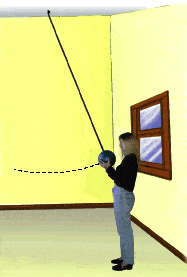
q5-8.gif


If the demonstrator remains stationary, explain why the ball does not strike her on its return swing.

Would this demonstration be safe if the ball were given a push from its starting position at her nose?

yes
no
I know its no, but I can't put it into words why. Please help

Explain.
 
Physics news on Phys.org
Conservation of energy.
 
^ can you provide a more detailed explanation on both please
 
neglecting air resistance, Kinetic energy would be conserved & the ball would not go any further than its starting point (this is common sense)

However, if there is a push at the beginning, there is an initial kinetic energy, meaning on its return swing, the ball will go further than the point from where it was pushed until Ke = 0. Since Ke did not equal 0 on the initial swing (if there is a push), it would not equal zero at that same point upon its return, meaning it would still be in motion, meaning it would clock her in the face :)

I know my explanation isn't exactly clear but I hope it helps
 
thank u that helped
 
The book claims the answer is that all the magnitudes are the same because "the gravitational force on the penguin is the same". I'm having trouble understanding this. I thought the buoyant force was equal to the weight of the fluid displaced. Weight depends on mass which depends on density. Therefore, due to the differing densities the buoyant force will be different in each case? Is this incorrect?

Similar threads

Replies
12
Views
4K
Replies
4
Views
2K
Replies
2
Views
2K
  • · Replies 24 ·
Replies
24
Views
3K
  • · Replies 7 ·
Replies
7
Views
2K
  • · Replies 5 ·
Replies
5
Views
3K
  • · Replies 10 ·
Replies
10
Views
4K
  • · Replies 4 ·
Replies
4
Views
5K
  • · Replies 1 ·
Replies
1
Views
1K
  • · Replies 1 ·
Replies
1
Views
2K