Olly Vogel
Hello everyone :)
I was given a problem reguarding Venturi effect. By a coincidence, I found a youtube video which solves the same question, but I didn't undersand one of its equations.
The problem:
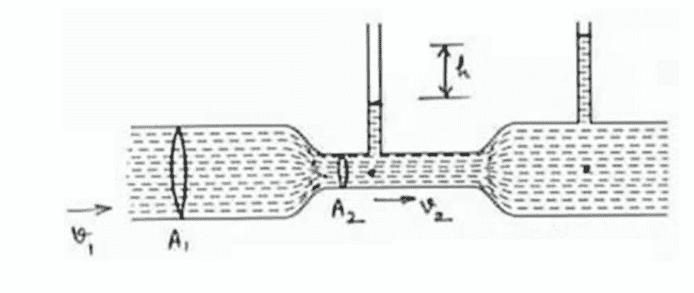

There is this pipe system of flowing ideal liquid. The cross-sections A1 and A2 are given, the water in the vertical pipes is static, and the height diffrence h is also given. I need to find the velecoties v1, v2.
The video with the problem and the answer:
In order to solve this, I need to use 3 equations:
1) A1*P1=A2*P2
2) 1/2*(v2)^2+P2=1/2*(v1)^2+P1
3) P2=P1+ρgh
I don't understand 3, because I thought the fact that the bottom of the left vertical pipe is lower than the right one matters. In other words, how can I claim that the pressure in the top of the water in left pipe equals to the point in the other pipe in the same height.
Thanks!
I was given a problem reguarding Venturi effect. By a coincidence, I found a youtube video which solves the same question, but I didn't undersand one of its equations.
The problem:
There is this pipe system of flowing ideal liquid. The cross-sections A1 and A2 are given, the water in the vertical pipes is static, and the height diffrence h is also given. I need to find the velecoties v1, v2.
The video with the problem and the answer:
In order to solve this, I need to use 3 equations:
1) A1*P1=A2*P2
2) 1/2*(v2)^2+P2=1/2*(v1)^2+P1
3) P2=P1+ρgh
I don't understand 3, because I thought the fact that the bottom of the left vertical pipe is lower than the right one matters. In other words, how can I claim that the pressure in the top of the water in left pipe equals to the point in the other pipe in the same height.
Thanks!