Understanding Translation Symbology in Scientific Formulas: A Homestudy Guide

  • Context: Undergrad 
  • Thread starter Thread starter Scott S
  • Start date Start date
  • Tags Tags
    Translation
Click For Summary
SUMMARY

This discussion focuses on translating mathematical symbology in scientific formulas, specifically formulas 13, 14, and 15. Key variables include Y and X as planar coordinates, n as the number of points, σβ as the standard error of angle observation, σs as the standard error of distance observation, and Σ representing the summation. The main confusion arises from the interpretation of subscripts and parentheses in the formulas, particularly regarding the calculation of Xn and Xi-1. The example provided illustrates the summation of squared differences between coordinates, clarifying the intended calculations.

PREREQUISITES
  • Understanding of mathematical notation and symbology
  • Familiarity with statistical concepts such as standard error
  • Basic knowledge of coordinate geometry
  • Ability to interpret mathematical formulas with subscripts and superscripts
NEXT STEPS
  • Study the application of summation notation in statistical analysis
  • Learn about standard error calculations in data analysis
  • Explore coordinate transformations in geometry
  • Review mathematical notation conventions in scientific literature
USEFUL FOR

Researchers, students in mathematics or statistics, and professionals involved in data analysis who need to understand and apply scientific formulas accurately.

Scott S
Messages
22
Reaction score
0
Sorry, 30 years since college and I wasn't awake all the time.
I'm trying to translate the symbology in the attached pics.
Some of the super/subscripts are throwing me off in formulae 13, 14 and 15.

Y and X = planar coordinates of points.
n = number of points.
σβ = standard error of angle observation.
σs = standard error of distance observation.
Σ = the sum in parenthesis.
Si = sum of distances.

The parenthesis are the problems.
Would Xn equal the last coordinate and Xi-1 each proceeding coordinate, so that I should sum the final minus each proceeding X?
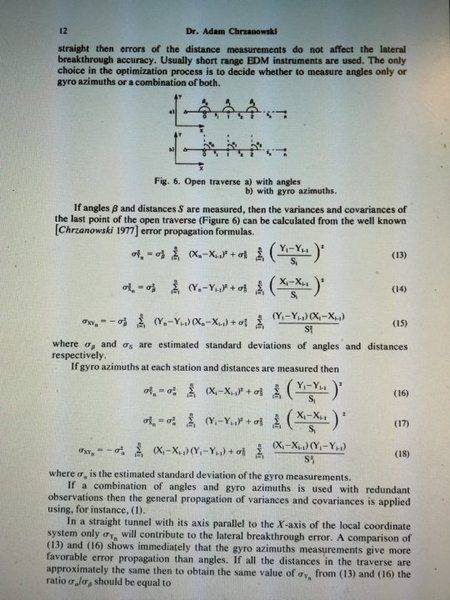
traverse closure 1.jpg


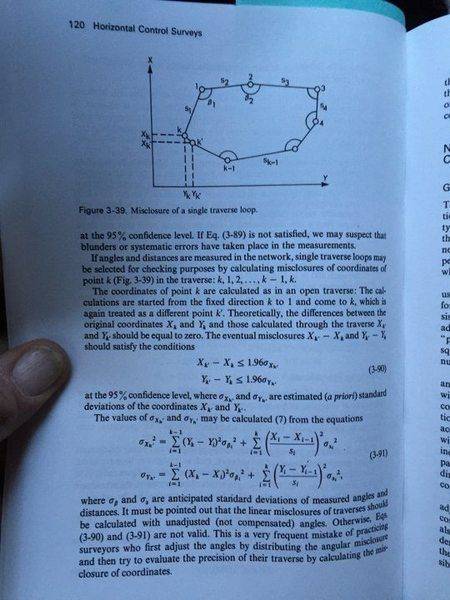
The same formulae in 3-91.
traverse closure 2.jpg
 
Last edited by a moderator:
Physics news on Phys.org
Scott S said:
Sorry, 30 years since college and I wasn't awake all the time.
I'm trying to translate the symbology in the attached pics.
Some of the super/subscripts are throwing me off in formulae 13, 14 and 15.

Y and X = planar coordinates of points.
n = number of points.
σβ = standard error of angle observation.
σs = standard error of distance observation.
Σ = the sum in parenthesis.
Si = sum of distances.

The parenthesis are the problems.
Would Xn equal the last coordinate and Xi-1 each proceeding coordinate, so that I should sum the final minus each proceeding X?
View attachment 96281

The same formulae in 3-91.
View attachment 96282

For example:
\begin{array}{l}\sum_{i=1}^n \left( \frac{X_i - X_{i-1}}{S_i} \right)^2\\<br /> = \left(\frac{X_1-X_0}{S_1}\right)^2 + \left(\frac{X_2 - X_1}{S_2}\right)^2 + \cdots + \left( \frac{X_n - X_{n-1}}{S_n}\right)^2<br /> \end{array}
Is that what you were uncertain about?
 
Yes!
Thank you.
 

Similar threads

  • · Replies 0 ·
Replies
0
Views
2K
  • · Replies 10 ·
Replies
10
Views
2K
  • · Replies 1 ·
Replies
1
Views
3K
  • · Replies 6 ·
Replies
6
Views
5K
  • · Replies 29 ·
Replies
29
Views
7K
  • · Replies 14 ·
Replies
14
Views
4K
  • · Replies 4 ·
Replies
4
Views
5K
  • · Replies 4 ·
Replies
4
Views
3K