gleem said:
To clarify you wish an explanation of why the questions presented are either correct or incorrect?
Stephen Tashi said:
The conventions of the homework sections of the forum are that you should not simply ask "Why is this the right answer?" or "Why is this a wrong answer?". Explain your calculations or reasoning for thinking an answer is correct - or incorrect.
Your writing does not clearly state your questions. For example, you write "Here's the first question" and then you quote a question from an exercise. That doesn't explain what your own first question is about the material. What is your own first question?
Sorry about that. I guess I was trying to keep from writing a small essay. I'll go through my reasoning for each, but I'm sure you'll find my reasoning to be quite flawed. I would like it if you could pick me up on where my reasoning falls short so that I can improve my understanding of these questions.
Question 1a
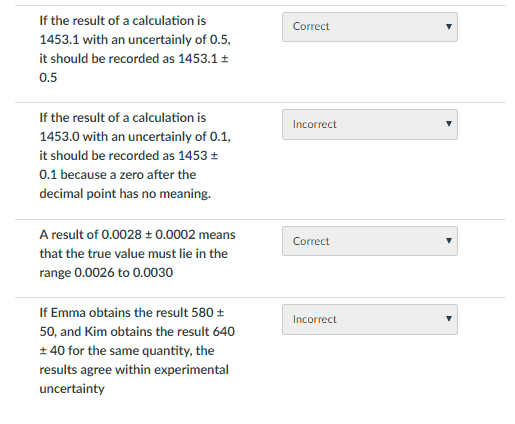
If the result of a calculation is 1453.1 with an uncertainly of 0.5, it should be recorded as 1453.1 ± 0.5
I answered true to this, because the decimal places match, so this should be correct notation.
Question 1b
If the result of a calculation is 1453.0 with an uncertainly of 0.1, it should be recorded as 1453 ± 0.1 because a zero after the decimal point has no meaning.
I answered false to this, because the decimal place in the value is important as it shows precision. Also, as before, the decimal places need to match.
Question 1c
A result of 0.0028 ± 0.0002 means that the true value must lie in the range 0.0026 to 0.0030
Perhaps this one seemed too straightforward here, and misled me. I answered true to this one. It seemed that the +- should give the values between the range [0.0026,0.0030]
Question 1d
If Emma obtains the result 580 ± 50, and Kim obtains the result 640 ± 40 for the same quantity, the results agree within experimental uncertainty
I answered incorrect to this, as the values for the second one could be much higher for the first. However, upon re-thinking this one, I think it would make sense fot this to be correct, as the values overlap, and the true value would lie within the overlap.
Question 2a
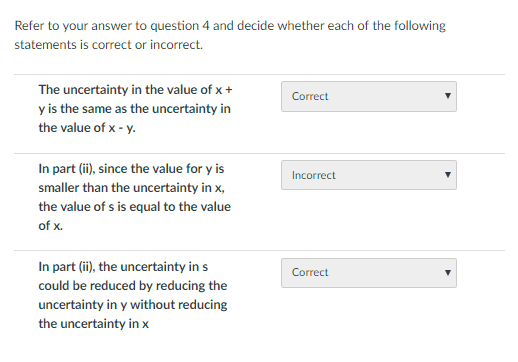
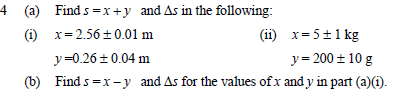
The uncertainty in the value of x + y is the same as the uncertainty in the value of x - y.
I answered true to this, because since uncertainty is +-, it shouldn't matter if we are adding or subtracting. The uncertainty will add either way
Question 2b
In part (ii), since the value for y is smaller than the uncertainty in x, the value of s is equal to the value of x.
I answered incorrect to this one, because the uncertainty could be either positive or negative. However adding y to x will result in x being increased positively. Therefore, I considered this to be false.
Question 2c
In part (ii), the uncertainty in s could be reduced by reducing the uncertainty in y without reducing the uncertainty in x
I answered true to this, because adding two numbers with uncertainties should increase the uncertainty. However, if I was incorrect in Question 2b, then I would probably be incorrect in this one too.
Question 3a
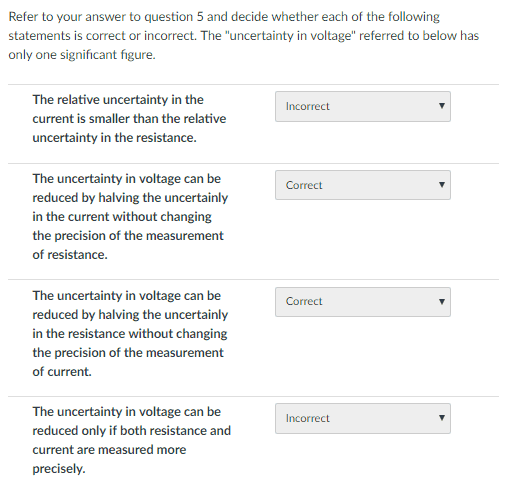
The relative uncertainty in the current is smaller than the relative uncertainty in the resistance.
I calculated the relative uncertainty to be about 8.8%. This is from ∆x/x = 0.05/0.57 ≈ 0.088. The relative uncertainty for the resistance is 0.2/10=0.02. Therefore the current has a higher relative uncertainty. I answered false to this one.
Question 3b
The uncertainty in voltage can be reduced by halving the uncertainly in the current without changing the precision of the measurement of resistance.
Since voltage is given by V=IR, we need to multiply these together. I answered true to this, because decreasing uncertainty from one side should decrease the uncertainty in the final answer.
Question 3c
The uncertainty in voltage can be reduced by halving the uncertainly in the resistance without changing the precision of the measurement of current.
I answered true to this as well, based on the same logic as the previous question. However, I am guessing that this may be false because the current has the larger uncertainty, and so decreasing uncertainty in the resistance may have a negligible effect. I'm not sure though.
Question 3d
The uncertainty in voltage can be reduced only if both resistance and current are measured more precisely.
I answered false to this, as this contradicted my logic for the previous two questions. Reducing uncertainty in at least the current should decrease the uncertainty in the voltage.
Question 4a
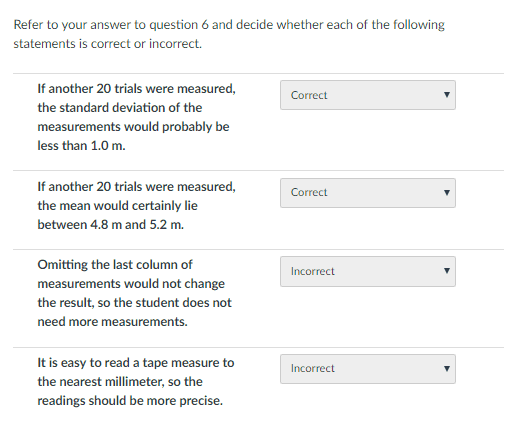
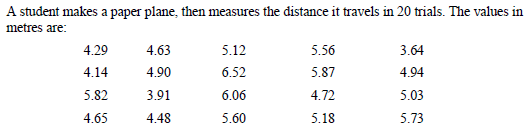
If another 20 trials were measured, the standard deviation of the measurements would probably be less than 1.0 m.
I answered true to this, because I calculated the standard deviation to be about 0.76. This was already well under 1 meter, so more measurements would almost certainly keep the standard deviation under a meter.
Question 4b
If another 20 trials were measured, the mean would certainly lie between 4.8 m and 5.2 m.
I answered true to this, because I calculated the mean to be about 5.04m. Since this is between 4.8m and 5.2m I concluded that this should not change much with more measurements, provided they are not wildly different. Therefore, I answered true.
Question 4c
Omitting the last column of measurements would not change the result, so the student does not need more measurements.
I answered false to this, but I'm not sure about it. I answered false because although a small number of measurements should give you a good idea, I would have thought more measurements will always make a more complete picture.
Question 4d
It is easy to read a tape measure to the nearest millimeter, so the readings should be more precise.
I answered false to this, because I thought that the taking averages should more or less cancel out some degree of precision here. Perhaps I'm wrong.
If you've the time, I'd appreciate a few pointers on where my thought process is wrong. Apologies for the long post. Thank you