Understanding Wave Functions and Normalization in Quantum Physics

  • Thread starter Thread starter Techsmart07
  • Start date Start date
  • Tags Tags
    Lost Quantum
Click For Summary

Homework Help Overview

The discussion revolves around understanding wave functions and normalization in quantum physics, specifically focusing on a particle confined between x=0 and x=L. The original poster expresses confusion regarding the normalization of the wave function and the calculation of probabilities within specified intervals.

Discussion Character

  • Exploratory, Conceptual clarification, Mathematical reasoning

Approaches and Questions Raised

  • Participants discuss the normalization condition for wave functions and the implications of symmetry in probability calculations. There are attempts to clarify how to derive the normalization constant A and the probability of finding the particle in specific regions.

Discussion Status

Some participants have provided guidance on using integrals to find the normalization constant A, while others express uncertainty about the wave function's form and its implications. There is an ongoing exploration of the necessary steps to solve the problem, with no clear consensus reached yet.

Contextual Notes

The original poster notes that the course is pre-differential equations, which may limit the depth of mathematical techniques discussed. Additionally, there is mention of a lack of examples in the textbook, contributing to the confusion.

Techsmart07
Messages
3
Reaction score
0
I have been taking an introduction to thermal/quantum physics course, and we are passing over quantum right now, and my teacher has us completely bewildered. This course is pre-differential equations, so most of the stuff is broadly explained, and the book has almost no examples for direction.

Homework Statement


The figure below shows the wave function [tex]\Psi[/tex](x) for a particle confined between x=0 and x=L.A) Find an expression for A in order that the wave function can be normalized. B) What is the probability of finding the particle in the region 0<x<L/4?

untitled.jpg


2. relevant formulas
(sorry if its not perfect setup, not used to the math functions on here)
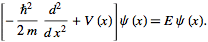
NumberedEquation4.gif

P(x) = [tex]\Psi[/tex]2(x)dx

The Attempt at a Solution


Honestly, I don't really even know what to do, so I couldn't make an attempt.
I feel lost on this entire section of the book...
 
Physics news on Phys.org
Like you said the particle is confined between x=0 and x=L so the chance of finding there is 1.

Because of symmetrie the chance of finding the particle between x=0 and x=L/2 is a half. So 1/2=Int((2*A*x)^2/L^2,x=0...L/2)
 
Bendavid2 said:
Like you said the particle is confined between x=0 and x=L so the chance of finding there is 1.

Because of symmetrie the chance of finding the particle between x=0 and x=L/2 is a half. So 1/2=Int((2*A*x)^2/L^2,x=0...L/2)

Say what? Yes, if I were finding the chance in L/2, that would make sense. However, this provides no explanation (as far as I can see) on how to find A or the chance for L/4.
I don't need a full answer, just somewhere to start. I looked over my formulas twice and couldn't find anything relating to A that uses variables that are offered in this problem, and I don't know the wave function, so I can't just plug it into the probability formula. It feels like either I am missing information, or that I am just overlooking something simple. (For those that have this book, its richard wolfson's University physics volume 2).
 
You are already given the form of [tex]\psi[/tex]. The only thing missing is the value of A.
If you integrate your formula for the total probability of finding the particle between 0 and L you will get something dependening on A. Now as Bendavid mentioned the total probability of finding the particle somewhere has to be 1. So you can determine the value of A.
 
Techsmart07 said:
I don't know the wave function

You have a graph of it, showing the parameters A and L, which you can assume as given. The graph consists of two straight line segments. What's the equation of a straight line?
 
A straight line that goes as you showed us. The reason I only go from zero to a half L is that otherwise you have to split up you intergral. The only reason to work out that intergral is to get the value of A.
 
The normalization condition for a wave function ψ(x) is

[tex]\int_{-\infty}^{\infty} |\psi(x)|^2\,dx = 1[/tex]

In this problem, ψ(x) is non-zero only between 0 and L, so you have

[tex]\int_{0}^{L} |\psi(x)|^2\,dx = 1[/tex]

Find the function that describes ψ(x), evaluate the integral, and solve for A.
 
Ok, I understand now. Sorry, i misinterpreted what was said.
 

Similar threads

  • · Replies 7 ·
Replies
7
Views
3K
  • · Replies 10 ·
Replies
10
Views
2K
Replies
7
Views
2K
  • · Replies 19 ·
Replies
19
Views
3K
Replies
1
Views
2K
  • · Replies 3 ·
Replies
3
Views
2K
  • · Replies 8 ·
Replies
8
Views
2K
  • · Replies 5 ·
Replies
5
Views
2K
  • · Replies 8 ·
Replies
8
Views
2K
  • · Replies 2 ·
Replies
2
Views
3K