kyin01
- 47
- 0
Hi everyone! So I am taking mechanical physics right now (calc based) and I seem to have a bit of trouble understanding work / kinetic energy.
\vec{F}=m\vec{a}
Kinetic energy= \frac{mv^{2}}{2}
Work_{net} = \Delta \frac{mv^{2}}{2}
Okay so first, my understanding is like this, please correct me if I am thinking about it the wrong way. \vec{F}=m\vec{a} so if the same amount of force is applied to both and one has a different mass from the other, than acceleration is different and thus velocity is different.
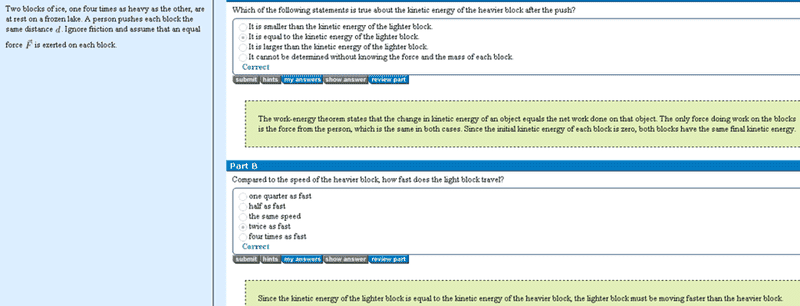
With that said I knew that velocity is different, but why should the kinetic energy be equal?
Can't we have a situation where the velocity is changed to the point where if we plug our two velocities and our different masses in the \frac{mv^{2}}{2} equation the kinetic energy will not be equal?
Now here is where I get lost, my thinking was when there is friction. In the problem it says no friction. If no friction shouldn't the velocity be the same for both masses when the same force is applied? because there is no fiction force to oppose it?
So I am kinda lost as how to understand the way kinetic energy work.
Thanks for your time.
Homework Statement
Homework Equations
\vec{F}=m\vec{a}
Kinetic energy= \frac{mv^{2}}{2}
Work_{net} = \Delta \frac{mv^{2}}{2}
The Attempt at a Solution
Okay so first, my understanding is like this, please correct me if I am thinking about it the wrong way. \vec{F}=m\vec{a} so if the same amount of force is applied to both and one has a different mass from the other, than acceleration is different and thus velocity is different.
With that said I knew that velocity is different, but why should the kinetic energy be equal?
Can't we have a situation where the velocity is changed to the point where if we plug our two velocities and our different masses in the \frac{mv^{2}}{2} equation the kinetic energy will not be equal?
Now here is where I get lost, my thinking was when there is friction. In the problem it says no friction. If no friction shouldn't the velocity be the same for both masses when the same force is applied? because there is no fiction force to oppose it?
So I am kinda lost as how to understand the way kinetic energy work.
Thanks for your time.