Undetermined beam problem supported by three different springs

  • Thread starter Thread starter Eran
  • Start date Start date
  • Tags Tags
    Beam Springs
Click For Summary

Discussion Overview

The discussion revolves around the problem of analyzing a beam supported by three different springs under a uniform distributed load. Participants explore various methods and considerations for solving this statically indeterminate problem, including the effects of spring elasticity and rigid body movement.

Discussion Character

  • Technical explanation
  • Debate/contested
  • Mathematical reasoning

Main Points Raised

  • Some participants note that the problem is statically indeterminate and requires more than the two equations of static equilibrium to find reactions in each spring.
  • There is a discussion about the need to consider the deflection of the beam at the supports due to the elasticity of the springs, which complicates the calculations.
  • Some suggest that methods for analyzing beams on elastic supports exist, but they may not be sufficient for cases with multiple springs.
  • One participant mentions that the presence of multiple springs introduces rigid body movement, making the solution less intuitive and more complex.
  • Another proposes using superposition to solve the problem if the spring constants are known, referencing an article with a relevant example.
  • There is a suggestion to analyze the beam as rigid if the stiffness of the springs is significantly different from that of the beam.
  • Some participants express uncertainty about the applicability of superposition, noting that it may not assume the beam is a rigid body.
  • One participant argues that the problem may relate to "Beams on elastic foundation" and should be approached differently.

Areas of Agreement / Disagreement

Participants express differing views on the best approach to solve the problem, with no consensus reached on a single method. There are competing ideas regarding the use of superposition and the treatment of the beam's rigidity.

Contextual Notes

Participants highlight the complexity introduced by multiple springs and the need for specific spring constants, indicating that assumptions about stiffness and interactions may affect the analysis.

Eran
Messages
5
Reaction score
0
Hi,

I thought it would be an easy one but it isn't...

I am trying to solve the problem of a beam supported by three different springs with a uniform distributed load:
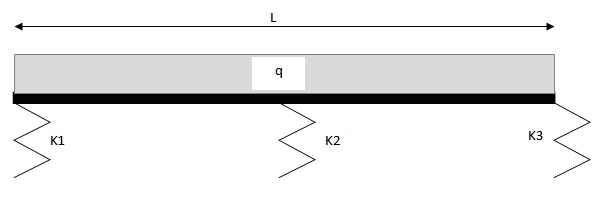
upload_2016-4-25_13-28-14.png
 
Engineering news on Phys.org
Eran said:
Hi,

I thought it would be an easy one but it isn't...

I am trying to solve the problem of a beam supported by three different springs with a uniform distributed load:

View attachment 99729
It doesn't matter if the supports are rigid or if the supports are springs: you have a beam which is statically indeterminate. You'll need to use more than the two equations of static equilibrium to obtain the reactions in each spring.
 
Thanks. But if I ignore the springs elasticity and just calculate the deflection between the supports I now need to add the deflection in each of the supporting points (because they are elastic). I can't just calculate the deflection of each point due to the calculated reaction because the reaction itself depends on the spring coefficient, doesn't it?
 
Eran said:
Thanks. But if I ignore the springs elasticity and just calculate the deflection between the supports I now need to add the deflection in each of the supporting points (because they are elastic). I can't just calculate the deflection of each point due to the calculated reaction because the reaction itself depends on the spring coefficient, doesn't it?
Correct.

There are methods for analyzing beams on elastic supports, just like there are methods for analyzing beams on fixed supports.

The following article includes (p. 5) the case of a cantilever beam propped on a spring at the free end:

http://www.nptel.ac.in/courses/105101085/downloads/lec-29.pdf
 
Thanks. I know this article, but it isn't enough. Because when you have more than a single spring in the system there is also a rigid body movement of the beam involved and this somehow makes the solution much less intuitive and complex. There are articles on a non-uniform, flexible foundations (See http://boundaryvalueproblems.springeropen.com/articles/10.1186/1687-2770-2012-5) but those are way too complex for a simple problem like this one.
 
Eran said:
Thanks. I know this article, but it isn't enough. Because when you have more than a single spring in the system there is also a rigid body movement of the beam involved and this somehow makes the solution much less intuitive and complex. There are articles on a non-uniform, flexible foundations (See http://boundaryvalueproblems.springeropen.com/articles/10.1186/1687-2770-2012-5) but those are way too complex for a simple problem like this one.
The beam in the OP rests on several discrete springs. There are other types of elastic support, like the one referenced in the article above, where a beam rests on a continuous elastic foundation of indeterminate length. I would think that analyzing the latter would be somewhat different than analyzing the former.
 
Depending on the stiffness of the springs, have you considered analyzing the problem as if the beam were rigid and only the springs deflected?
 
Eran said:
Hi,

I thought it would be an easy one but it isn't...

I am trying to solve the problem of a beam supported by three different springs with a uniform distributed load:

View attachment 99729
You can try to solve this beam if you know the spring constants for the supports by using superposition.

This article has an example of a 2-span continuous beam where the reactions are calculated using superposition:

http://ocw.nthu.edu.tw/ocw/upload/8/259/Chapter_10-98.pdf

See pp. 8-9.

These problems are tough to solve in general. It's better if you have some specific springs in mind for the supports.
 
Mech_Engineer said:
Depending on the stiffness of the springs, have you considered analyzing the problem as if the beam were rigid and only the springs deflected?
Hi,

Yes. This is an easy task to do, but gets much more complicated when the beam is not considered as a rigid body
 
  • #10
Are the springs the same order of magnitude in stiffness as the beam itself? It seems that if the beam is much stiffer than the springs (or if the springs are much stiffer than the beam) you should be able to solve via superposition...
 
  • #11
Eran said:
Hi,

Yes. This is an easy task to do, but gets much more complicated when the beam is not considered as a rigid body
AFAIK, superposition does not assume the beam is a rigid body. In the example cited, the deflection of the beam due to the central support is calculated such that it exactly counteracts the central deflection of a simply supported beam with the distributed load shown.
 
  • #12
Regarding superposition, I was referring to the possibility of solving the problems independently and then combining their results. This assumes the combined problems have minimal "interaction" as in the case the beam's stiffness is much different than the spring stiffness. It might be an approximation but could give a useful result.
 
  • #14
Hi, I am currently working on a very similar problem and was curious if you ever solved it.
 

Similar threads

Replies
6
Views
4K
  • · Replies 13 ·
Replies
13
Views
6K
  • · Replies 7 ·
Replies
7
Views
1K
  • · Replies 8 ·
Replies
8
Views
3K
  • · Replies 15 ·
Replies
15
Views
2K
Replies
4
Views
2K
  • · Replies 4 ·
Replies
4
Views
2K
Replies
33
Views
5K
  • · Replies 2 ·
Replies
2
Views
2K
  • · Replies 3 ·
Replies
3
Views
3K