Uniform Circular Motion question

Click For Summary
SUMMARY

The discussion centers on solving a Uniform Circular Motion problem using the equations x = Acos(ωt) and y = Asin(ωt). The correct answer is A, as the oscillating nature of the x and y positions indicates circular motion. Participants clarify the distinction between centripetal and tangential acceleration, emphasizing that non-zero centripetal acceleration is responsible for the curved path while tangential acceleration governs speed changes. An analytical approach is recommended, involving the derivation of velocity functions and plotting points to visualize the circular trajectory.

PREREQUISITES
  • Understanding of trigonometric functions (sine and cosine)
  • Familiarity with concepts of centripetal and tangential acceleration
  • Knowledge of Uniform Circular Motion principles
  • Ability to plot mathematical functions
NEXT STEPS
  • Study the derivation of velocity functions from position functions in circular motion
  • Learn about the relationship between centripetal acceleration and tangential acceleration
  • Explore graphical methods for visualizing circular motion
  • Investigate analytical techniques for solving physics problems involving circular motion
USEFUL FOR

Students studying physics, particularly those focusing on mechanics and circular motion, as well as educators seeking to explain these concepts effectively.

15ongm
Messages
7
Reaction score
0
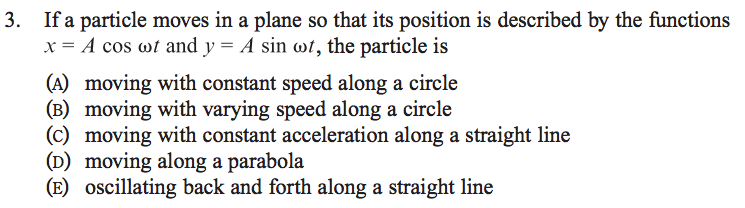
1. The problem
2ed416p.jpg

The answer is A.

Homework Equations


x = Acoswt
y = Asinwt

The Attempt at a Solution


C is not correct because the x & y positions are in terms of sin & cos, so the acceleration can't be constant.
D is not correct because x & y are oscillating in value.
E is not correct because y is changing with time

Therefore it's either A or B, which makes sense since x & y are oscillating, they have to form some sort of circle.

I'm stuck between A & B. How do you know the particle is moving with constant speed? B/c the acceleration is definitely not 0. In fact, how do you know these 2 functions describe a circle?
 
Physics news on Phys.org
The easiest way to realize that it's a circle is to pick values for A and ##\omega## and just plot a few points. The more technical explanation is that cos(x) decreases at the same time and rate as sin(x) increases and then they switch (if you plot these two functions it's easy to see), so y will increase while x decreases at the same rate and then the opposite will happen. The effect of this is to trace a circle.

It seems like you are confusing centripetal acceleration with tangential acceleration. Non-zero centripetal acceleration is what makes the path curved rather than straight, but the change in speed along the path (tangential velocity) is governed by tangential acceleration. If you read up on tangential velocity (I'm sure it's in your textbook somewhere) you should be able to see why the particle described above moves at a constant speed.
 
  • Like
Likes 15ongm
sk1105 said:
The easiest way to realize that it's a circle is to pick values for A and ##\omega## and just plot a few points. The more technical explanation is that cos(x) decreases at the same time and rate as sin(x) increases and then they switch (if you plot these two functions it's easy to see), so y will increase while x decreases at the same rate and then the opposite will happen. The effect of this is to trace a circle.

It seems like you are confusing centripetal acceleration with tangential acceleration. Non-zero centripetal acceleration is what makes the path curved rather than straight, but the change in speed along the path (tangential velocity) is governed by tangential acceleration. If you read up on tangential velocity (I'm sure it's in your textbook somewhere) you should be able to see why the particle described above moves at a constant speed.

There is an analytical way to solve this problem. I would definitely recommend taking the analytical route whenever possible.

15ongm said:
How do you know the particle is moving with constant speed?

You have functions to describe the vertical and horizontal positions of the particle. Start by trying to find functions to describe the vertical and horizontal velocities of the particles.

15ongm said:
how do you know these 2 functions describe a circle?

It will become apparent if you follow my above approach.
 
Last edited:
  • Like
Likes 15ongm
Hello 15,

It isn't mentioned explicitly in the problem statement, but you may assume A and ##\omega## are constant in time.
As the others say, drawing a figure is the most logical thing to do.
If you want the analytical approach, ask what the distance of (x,y) to (0,0) is, and ask what the angle of the vector (x,y) with the x-axis is.
 
  • Like
Likes 15ongm
The book claims the answer is that all the magnitudes are the same because "the gravitational force on the penguin is the same". I'm having trouble understanding this. I thought the buoyant force was equal to the weight of the fluid displaced. Weight depends on mass which depends on density. Therefore, due to the differing densities the buoyant force will be different in each case? Is this incorrect?

Similar threads

Replies
55
Views
3K
  • · Replies 8 ·
Replies
8
Views
2K
Replies
1
Views
808
  • · Replies 11 ·
Replies
11
Views
3K
  • · Replies 6 ·
Replies
6
Views
2K
Replies
2
Views
2K
  • · Replies 2 ·
Replies
2
Views
2K
Replies
38
Views
4K
  • · Replies 4 ·
Replies
4
Views
2K
  • · Replies 3 ·
Replies
3
Views
3K