Uniform Circular Motion: Why is the velocity changing?

Click For Summary

Homework Help Overview

The discussion revolves around the concept of uniform circular motion, specifically addressing why the velocity is considered to be changing despite its constant magnitude. Participants are examining the relationship between velocity, acceleration, and direction in this context.

Discussion Character

  • Conceptual clarification, Assumption checking

Approaches and Questions Raised

  • Participants are exploring the nature of velocity as a vector quantity and discussing the implications of its direction changing while maintaining constant magnitude. Questions arise regarding the interpretation of the problem and the significance of direction versus magnitude in the context of acceleration.

Discussion Status

The discussion is active, with participants affirming the conceptual understanding of velocity and acceleration as vector quantities. There is an acknowledgment of differing interpretations of the question, and some guidance has been offered regarding the nature of these vectors.

Contextual Notes

One participant notes the importance of an axis of reference when discussing changes in direction, while another emphasizes that changes occur regardless of such conditions. The original poster's confusion about the answer choices indicates potential ambiguity in the question itself.

physicsbaig
Messages
9
Reaction score
0
I encountered this question in a practice test for an upcoming exam. My first inkling was to answer with (C) because in uniform circular motion, the acceleration always points towards the center of the circle, but the actual answer was D. Do you think this question was just an issue of direction and not magnitude? I know that acceleration nor the velocity are changing in magnitude BUT are changing in direction, given an axis of reference. What do you think? Thanks for your help in advance!
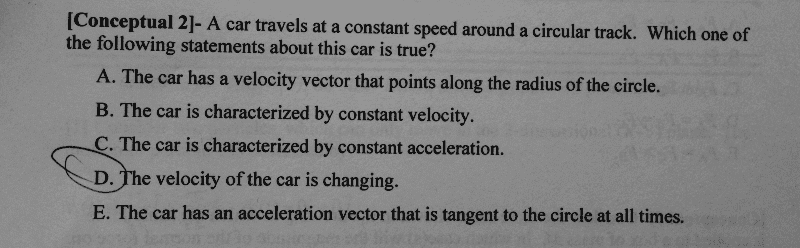
upload_2014-10-2_10-45-9.png
 
Physics news on Phys.org
Hello Baiq and welcome to PF. Use the template (although I agree it's not extremely useful here). Read the guidelines too.
What I think is that you have the right conceptual picture (*). I take it that velocity in this context is a vector quantity and then there is only one answer that is not blatantly wrong.

(*) but then your first inkling would have to be that both B) and C) are right...

And: "given an axis of reference" is not a condition: they change, period.
 
Thank you! Velocity is a vector quantity. That is something I'll remember.
 
And acceleration is too !
 

Similar threads

Replies
55
Views
3K
Replies
1
Views
916
  • · Replies 8 ·
Replies
8
Views
2K
  • · Replies 7 ·
Replies
7
Views
3K
  • · Replies 6 ·
Replies
6
Views
2K
  • · Replies 10 ·
Replies
10
Views
3K
  • · Replies 14 ·
Replies
14
Views
4K
Replies
38
Views
4K
  • · Replies 1 ·
Replies
1
Views
2K