Uniform convergence of functions

Click For Summary
SUMMARY

The discussion centers on the concept of uniform convergence of functions, specifically addressing the sequence of functions ##f_n(x) = x^n##. It is established that while each function in the sequence is continuous, the limit function ##f(x) = \lim_{n \to \infty} f_n(x)## is discontinuous at ##x=1##. The participants clarify that the sequence does not converge uniformly on the interval ##[0,1)##, leading to the conclusion that the limit function is not continuous due to the lack of uniform convergence.

PREREQUISITES
  • Understanding of uniform convergence in the context of real analysis
  • Familiarity with continuous functions and their properties
  • Knowledge of metric spaces and the Hausdorff property
  • Basic comprehension of sequences and limits in calculus
NEXT STEPS
  • Study the definition and properties of uniform convergence in detail
  • Explore the implications of discontinuity in limit functions
  • Investigate the relationship between Cauchy sequences and uniform convergence
  • Examine examples of uniform convergence in various function spaces
USEFUL FOR

Mathematicians, students of real analysis, and anyone interested in the properties of convergence in function sequences.

chwala
Gold Member
Messages
2,828
Reaction score
421
TL;DR
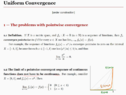
Kindly see attached (interest is on highlighted in red.)

Where is the discontinuity in the given function or is discontinuity as a result of having two different limits? i.e sequence converging in opposite directions in respect to the given domains.
I need clarification on this part.
1708632535701.png
 

Attachments

  • 1708632519025.png
    1708632519025.png
    79.6 KB · Views: 116
Physics news on Phys.org
The limit function, ##f(x)##, in that counterexample is clearly discontinuous at ##x=1##. Yet, all the functions ##f_n(x)## are continuous.
 
I think a bit clear now ... if i consider the sequence; ##1^n## will always be ##= 1## as ##n→∞## therefore sequence at that point remains the same hence no convergence if i may say that at ##x=1##.
 
##f_n(x)=x^n## are continuous functions.
$$
\displaystyle{f(x):=\lim_{n \to \infty}f_n(x)=\lim_{n \to \infty}x^n}=\begin{cases}0&\text{ if }0\leq x< 1\\1&\text{ if }x=1\end{cases}
$$
##f(x)## is not continuous since it jumps from ##0## for all values left of ##x=1## to ##1## for ##x=1.## This is a discontinuity.

Another example:

If we walk the unit square from bottom left to top right then we have to walk 2 units.
This does not change if we walk half a step to the right, then half a step to the top, another half of a step to the right, and finally another half to the top. That makes 2 units in total.
This does not change if we walk a quarter of a step to the right, then a quarter of a step to the top, another quarter, and so on until we end up at the top right corner. Still 2 units in total.
This does not change if we walk an eighth of a step to the right, another eighth of a step to the top etc.
No matter how small our steps will be. As long as we walk only to the right and to the top, we will have to walk 2 units in total. Nevertheless, we constantly approach the diagonal of the unit square which is of length ##\sqrt{2}\neq 2.## Hence, no matter how close we get pointwise to the diagonal, our path is of length 2 whereas we get pointwise closer to the diagonal of length ##\sqrt{2}.##
 
  • Informative
Likes   Reactions: chwala
Notice ##x^n## is not Cauchy on ##[0,1]##. Since the sequences don't converge uniformly, the limit is not continuous. And, strictly speaking, as a whole, the sequence doesn't converge to different limits. This isn't possible in a Hausdorff space, and every metric space is Hausdorff.
 
  • Informative
Likes   Reactions: chwala
WWGD said:
Notice ##x^n## is not Cauchy on ##[0,1]##. Since the sequences don't converge uniformly, the limit is not continuous.
What's the definition of uniform convergence of a sequence?

Also, the functions don't converge uniformly on ##[0,1)##, yet the limit function is continuous on that domain.
 
PeroK said:
What's the definition of uniform convergence of a sequence?

Also, the functions don't converge uniformly on ##[0,1)##, yet the limit function is continuous on that domain.
I know what it means. I've never said uniforms convergence is necessary. Only that it's sufficient.
 
WWGD said:
I know what it means. I've never said uniforms convergence is necessary. Only that it's sufficient.
Well, no, you said it was necessary:
WWGD said:
Since the sequences don't converge uniformly, the limit is not continuous.
 

Similar threads

  • · Replies 3 ·
Replies
3
Views
2K
  • · Replies 16 ·
Replies
16
Views
3K
  • · Replies 1 ·
Replies
1
Views
2K
  • · Replies 1 ·
Replies
1
Views
2K
  • · Replies 7 ·
Replies
7
Views
2K
  • · Replies 2 ·
Replies
2
Views
2K
  • · Replies 2 ·
Replies
2
Views
2K
Replies
26
Views
2K
  • · Replies 4 ·
Replies
4
Views
2K
  • · Replies 2 ·
Replies
2
Views
3K