Unit vector in Magnetic boundary condition

Click For Summary

Homework Help Overview

The discussion revolves around the use of unit vectors in magnetic boundary conditions, specifically how to define the unit vector (an) in the context of two different regions. Participants are exploring the implications of vector orientation and physical representation in relation to the equations involved.

Discussion Character

  • Conceptual clarification, Assumption checking

Approaches and Questions Raised

  • The original poster seeks clarification on the definition of the unit vector (an) and its application in magnetic boundary equations. Some participants question the assumptions made about vector orientation and the physical meaning behind the unit vector.

Discussion Status

Participants are actively engaging in the discussion, with some providing insights into the physical representation of unit vectors. There is an exploration of different interpretations regarding the orientation of vectors and their implications in the equations, but no consensus has been reached.

Contextual Notes

There is a mention of arbitrary axes and the potential confusion arising from purely algebraic approaches. The discussion highlights the importance of understanding the physical context in which the unit vector operates.

baby_1
Messages
159
Reaction score
16
Hello
I'm getting confused when I want to use magnetic boundary equation

gif.gif

could you tell me how we define the unit vector(an) in this equation?
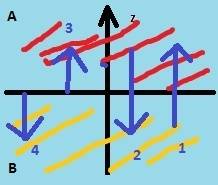
for example you assume that we have two different region (A in red and B in yellow) which vector (1,2,3,4) is right for

gif.gif
equation and which is right for
gif.gif
too?
1265692900_1413527336.jpg


Thank you
 
Physics news on Phys.org
Start by writing out the definition of ##\hat a_n## ... what does it represent?
 
Thank you dear Simon
As I check the reference book an is a vector from region 2 to 1 according
57BH_%257Ba%257D-H_%257Bb%257D%257D%2529%253DJ_%257Bs%257D&hash=db3f0d7fe017d4275f25bf05efbff018.png
equation it means an could be (az) and for
57BH_%257Bb%257D-H_%257Ba%257D%257D%2529%253DJ_%257Bs%257D&hash=5456d86ce3345ed3b89b64f6b9cb6d76.png
equation could be (-az) , Am I right?
 
No: axes are arbitrary so just relabelling it is begging the question.
You are having trouble like this because you are trying to do all your work in the tidy abstract world of pure algebra.
Science is messier than that.

Concentrate on the physical meaning of the unit vector you want to know about - there is something in the real physical world that it is supposed to represent and describe. What is it?

i.e. I may orient x-y-z axes so that the x-y plane lies on the surface of my window with y-axis pointing upwards.
Therefore - ##\hat a_y## is the unit vector pointing the opposite way to gravity, ##\hat a_x## is the unit vector pointing along the windowsill from left to right, and ##\hat a_z## is the unit vector pointing into the house and normal to the windowpane.

See what I mean? Each vector has a real-world meaning.
So what is the real-world meaning of ##\hat a_n##?
 
  • Like
Likes   Reactions: baby_1

Similar threads

Replies
26
Views
2K
  • · Replies 11 ·
Replies
11
Views
2K
Replies
8
Views
1K
  • · Replies 1 ·
Replies
1
Views
1K
  • · Replies 4 ·
Replies
4
Views
3K
  • · Replies 9 ·
Replies
9
Views
1K
  • · Replies 4 ·
Replies
4
Views
2K
  • · Replies 4 ·
Replies
4
Views
3K
Replies
1
Views
2K
  • · Replies 3 ·
Replies
3
Views
2K