nacho said:
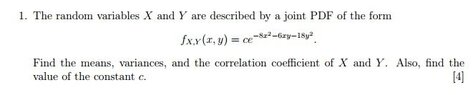
Please refer to the attached image.
How am I supposed to integrate this, it's impossible to find anything!
Also in this case try to avoid a 'brute force approach' supposing the f(x,y) is a normal bivariate p.d.f. like...
$\displaystyle f(x,y) = \frac{1}{2\ \pi\ \sigma_{x}\ \sigma_{y}\ \sqrt{1- \rho^{2}}}\ e^{- \frac{z}{2\ (1-\rho^{2})}}\ (1)$
... where...
$\displaystyle z = \frac{(x-\mu_{x})^{2}}{\sigma_{x}^{2}} + \frac{(y-\mu_{y})^{2}}{\sigma_{y}^{2}} - 2\ \frac{\rho\ (x - \mu_{x})\ (y-\mu_{y})}{\sigma_{x}\ \sigma_{y}}\ (2)$
In Your formula there are in the exponent only quaqdratic terms in x and y, so that is $\displaystyle \mu_{x}=\mu_{y}=0$ and that means that You have to find the unknown terms $\sigma_{x}$, $\sigma_{y}$ and $\rho$. That can be performed writing...
$\displaystyle \sigma^{2}_{x}\ (1-\rho^{2}) = \frac{1}{4}$
$\displaystyle \sigma^{2}_{y}\ (1-\rho^{2})= \frac{1}{9}$
$\displaystyle \sigma_{x}\ \sigma_{y}\ \frac{1-\rho^{2}}{\rho} = \frac{1}{6}\ (3)$
Are you able to solve the (3) finding $\sigma_{x}$, $\sigma_{y}$ and $\rho$?...
Kind regards
$\chi$ $\sigma$