Unravelling the Math Behind an Unusual Sequence

  • Thread starter Thread starter LCSphysicist
  • Start date Start date
  • Tags Tags
    Sequence
Click For Summary
The discussion critiques the mathematical reasoning behind a sequence involving a man, a wheel, and a stool. It highlights inaccuracies in the text's accounting, particularly in transitioning between different configurations and system boundaries. The sequence incorrectly jumps from a total of 3L to 5L without proper justification. The participants agree that the original text is misleading and that careful accounting is essential. Accurate mathematical reasoning is crucial for understanding the sequence correctly.
LCSphysicist
Messages
644
Reaction score
162
Homework Statement
I will say below.
Relevant Equations
Theoric question.
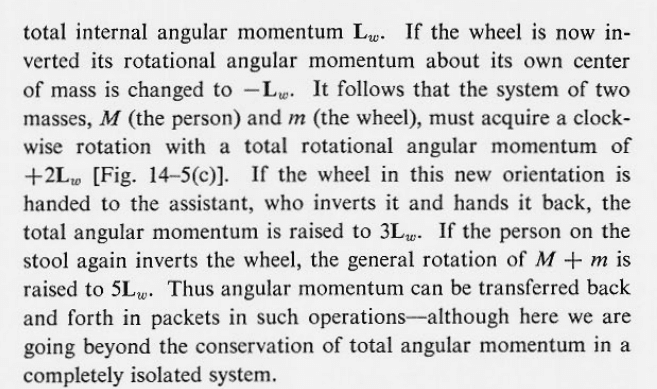
I am trying to understand the math on this text:
1590280143524.png

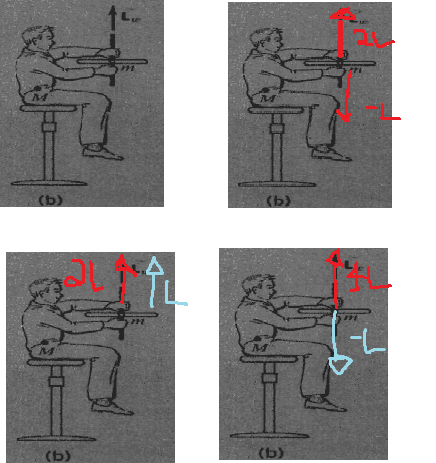
Why is not this sequence below right?:
1590280370576.png

At first, +L, so the man inverts the wheel and he now has +2L
So he give the wheel to assistent, who inverts the wheel, now wheel +L, the assistant give it to the man.
The man + wheel have now +3L, the wheel is inverted and so, the man + stool finish with +4L
 
  • Like
Likes etotheipi
Physics news on Phys.org
LCSphysicist said:
The man + wheel have now +3L, the wheel is inverted and so, the man + stool finish with +4L
You are correct. The text is incorrect.

The text gets a little too fast and loose with the accounting, jumping from ##3L\omega## (for stool+man+wheel) to ##5L\omega## (for stool+man alone). Changing system configuration and system boundaries both in the same step is just asking for trouble.

You've done that accounting properly.
 
  • Like
Likes jim mcnamara, berkeman, LCSphysicist and 1 other person
The book claims the answer is that all the magnitudes are the same because "the gravitational force on the penguin is the same". I'm having trouble understanding this. I thought the buoyant force was equal to the weight of the fluid displaced. Weight depends on mass which depends on density. Therefore, due to the differing densities the buoyant force will be different in each case? Is this incorrect?

Similar threads

  • · Replies 3 ·
Replies
3
Views
3K
  • · Replies 3 ·
Replies
3
Views
2K
  • · Replies 2 ·
Replies
2
Views
1K
  • · Replies 3 ·
Replies
3
Views
3K
  • · Replies 1 ·
Replies
1
Views
2K
Replies
21
Views
2K
  • · Replies 2 ·
Replies
2
Views
14K
  • · Replies 1 ·
Replies
1
Views
3K
  • · Replies 9 ·
Replies
9
Views
2K
  • · Replies 9 ·
Replies
9
Views
2K