Solving Energy Concept Problem: Masses m1, m2, m3 Speed of m3 After 2.5m

  • Thread starter Thread starter BunDa4Th
  • Start date Start date
  • Tags Tags
    Concept Energy
Click For Summary
The discussion focuses on solving a physics problem involving three masses connected by strings over frictionless pulleys. The key point is that all masses move with the same speed due to the inextensibility of the string, and the system's energy conservation must be applied to find the speed of m3 after it descends 2.5 meters. The total energy available is calculated using gravitational potential energy, and the kinetic energy of m3 is expressed in terms of the potential energy changes of m1 and m2. Participants highlight the importance of accounting for the kinetic energy of all masses involved, particularly m1, which was initially overlooked. The final calculations lead to a speed for m3, but discrepancies in results prompt further clarification on energy conservation principles.
BunDa4Th
Messages
188
Reaction score
0
Three objects with masses m1 = 4.0 kg, m2 = 10.0 kg, and m3 = 15.0 kg, respectively, are attached by strings over frictionless pulleys, as indicated in Figure P5.32. The horizontal surface is frictionless and the system is released from rest. Using energy concepts, find the speed of m3 after it moves down a distance of 2.5 m.
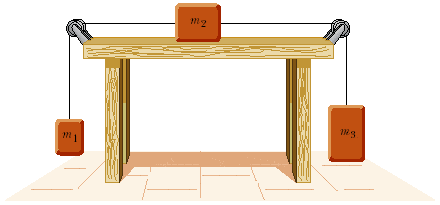
p5-32.gif


Okay, I am lost at this. At first I thought this was a simple problem using
V^2 = 2adeltaX which apparently is not, if it is then i am doing something wrong. I read on the conservative energy in the book I am using and understand a bit of it but not sure where to start.

I seriously don't know where to start or what i am doing right now. I seem to enter number randomly sometimes.
 
Last edited by a moderator:
Physics news on Phys.org
First of all you should realize that all the masses have the same speed because the wire is unstretchable. Next, try to imagine what happens when the system is released. Because M3 is heavier than M1, and because the horizontal surface is frictionless, M3 will fall.

Now, when I solve problems like this I think to myself: "What puts a limit to the speed of M3". The anwer is the kinetic energy gained by M2, and the potential energy gained by M1 when it moves up. So you find the total energy available (which would be M3*g*2.5), and subtract the energies due to the limiting factors. This gives you the total energy available to the kinetic energy of M3.
 
the protential energy for m1 would be 98

the total energy available is 367.5

I am not sure how to find the kinetic energy of m2 since KE = 1/2mv^2 not knowing what v is how would i go about solving this?
 
can anyone explain how this problem work in simple terms?
 
Just write the complete equation:

<br /> \frac{1}{2}M_3 v^2 = M_3 g \Delta h - \frac{1}{2}M_2 v^2 - M_1 g \Delta h<br />

Where the term om the left is the kinetic energy of M3 (the one you want to calculate), the first term on the right is the total energy available (with \Delta h=2.5m, the second term is the kinetic energy of M2 and the last term is the potential energy increase of M1. So you get an equation with only one unknown.

You don't have to know v of M2, because it is the same v as for M3.
 
The concept would be the same even if the horizontal surface was not frictionless. Then you would just subtract the energy delivered to the surface due to friction as well, and this energy would be the the frictional force times the distance traveled (2.5m).
 
thanks for explaining this. I now know what mistake i made. I was trying to solve everything on its own instead of making it into one equation.

thanks again.
 
okay i did this problem and it said i was incorrect.

(1/2)15v^2 = (15)(9.8)(2.5) - 1/2(10)v^2 - (4)(9.8)(2.5)

7.5v^2 = 367.5 - 5v^2 - 98

12.5v^2 = 269.5

v^2 = 21.56

v = 4.64

It said that it was within 10% of the correct answer. Can anyone point out the mistake i made?
 
well, i gave this problem another try thinking maybe i input "g" wrong for one of them, which still gave me the wrong answer. I am really confuse what i am doing wrong here.
 
  • #10
anyone? I tried using this

KE_i + PE_i = KE_f + PE_f which i think is the same thing as the above formula but for some reason when i did this equation i got a whole completely different number.
 
  • #11
Hey... I think you should subtract the kinetic energy gained by M1 as well. It does indeed have a kinetic energy when M3 has fallen a distance of 2.5m... Sorry, I forgot about this :-)
 
  • #12
Yea, i was able to figure this out after I realize something was missing after about 5 tries. Thanks for setting me to the right track.
 

Similar threads

  • · Replies 17 ·
Replies
17
Views
3K
  • · Replies 3 ·
Replies
3
Views
2K
  • · Replies 3 ·
Replies
3
Views
2K
Replies
17
Views
2K
  • · Replies 4 ·
Replies
4
Views
11K
  • · Replies 2 ·
Replies
2
Views
1K
  • · Replies 1 ·
Replies
1
Views
3K
  • · Replies 15 ·
Replies
15
Views
7K
  • · Replies 97 ·
4
Replies
97
Views
16K
  • · Replies 2 ·
Replies
2
Views
3K