Using Linear Interpolation to Find Interest

Join the discussion
Ask a follow-up here, or get your own question answered by working scientists, mathematicians and engineers — people, not an autocomplete.
Real named experts · corrections over time · the nuance an AI answer skips
6 replies · 3K views
ainster31
Messages
158
Reaction score
1

Homework Statement


F96Lk18.png


Homework Equations


The Attempt at a Solution



tpXoSpS.png


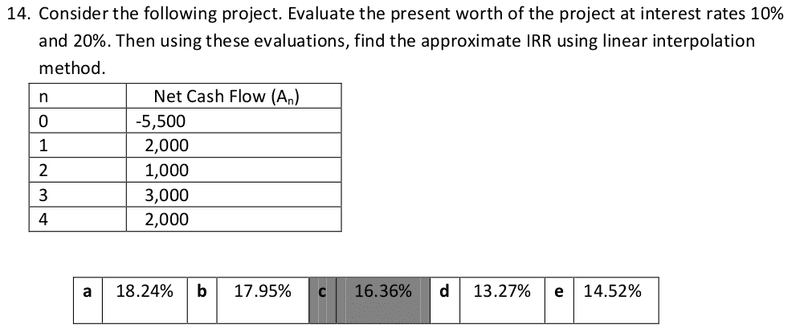
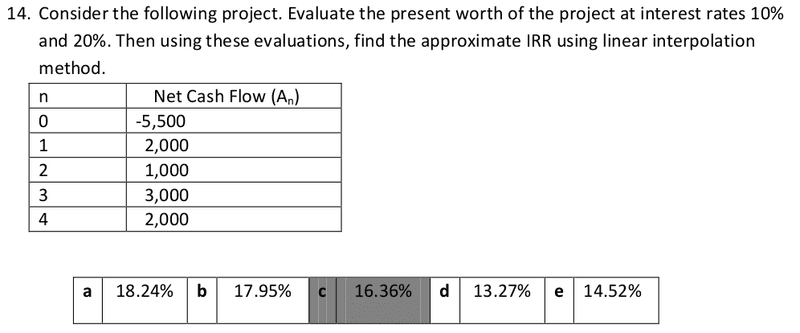
I understand how they calculated NPW but how did they use the linear interpolation method?
 
Physics news on Phys.org
ainster31 said:

Homework Statement


F96Lk18.png


Homework Equations


The Attempt at a Solution



tpXoSpS.png


I understand how they calculated NPW but how did they use the linear interpolation method?

I have never before seen their version of the linear interpolation method, but it does work. In linear interpolation we fit a linear function ##f = a + bx## through two points ##(x_1,f_1)## and ##(x_2,f_2)##:
[tex]f(x) = f_1 + \frac{f_2-f_1}{x_2-x_1} (x-x_1)[/tex]
This gives us the value of ##x_0##, the root of ##f(x) = 0,## as follows:
[tex]x_0 = \frac{f_2 x_1 - f_1 x_2}{f_2 - f_1}[/tex]
It follows (doing a lot of algebraic simplification) that
[tex]\frac{x_0 - x_1}{x_2-x_0} = -\frac{f_1}{f_2}[/tex]
In other words, we can find ##x_0## by solving the equation
[tex]\frac{x - x_1}{x_2-x} = -\frac{f_1}{f_2}[/tex]
The solution is ##x = x_0##. That is not how I would do it, but it is correct.
 
  • Like
Likes   Reactions: 1 person
Ray Vickson said:
That is not how I would do it, but it is correct.

How would you do it? Just set f(x)=0 and solve for x?
 
ainster31 said:
How would you do it? Just set f(x)=0 and solve for x?

I already gave you the formula I would use:
[tex]x_0 = \frac{f_2 x_1 - f_1 x_2}{f_2 - f_1}[/tex]
and I already explained how I got it.
 
Ray Vickson said:
I already gave you the formula I would use:
[tex]x_0 = \frac{f_2 x_1 - f_1 x_2}{f_2 - f_1}[/tex]
and I already explained how I got it.

You never explicitly said that you would use that formula so I didn't realize.

Thanks. I get it now.
 
ainster31 said:

Homework Statement


F96Lk18.png


Homework Equations


The Attempt at a Solution


tpXoSpS.png


I understand how they calculated NPW but how did they use the linear interpolation method?

Just so you know: there is a difference between using linear interpolation on ##r## directly, and using linear interpolation on ##x = 1/(1+r)##. The present value is a polynomial in ##x##, but not in ##r##. Linear interpolation on ##x## gives ##x_0 \approx .8609359558##, giving ##r_0 \approx .1615265843##, or about 16.15%. Which answer is closer? Well, the exact solution is ##r = .1594684085##, or about 15.95%. So, in this case at least, interpolation on ##x## produces slightly better results.