High School Using Small Examples to Solve Combinatorial Problems

  • Thread starter Thread starter sahilmm15
  • Start date Start date
  • Tags Tags
    Exponents
Click For Summary
The discussion focuses on using small examples to understand combinatorial problems, specifically the counting of factors in factorials. Participants highlight the method of dividing a number by powers of primes, such as 2 and 3, to determine the number of factors in factorials like 50!. The importance of starting with simpler cases, like 10!, is emphasized to build understanding before tackling larger problems. This approach not only clarifies the process but also provides a means to verify general formulas. Overall, breaking down complex problems into manageable examples is deemed an effective strategy for comprehension.
sahilmm15
Messages
100
Reaction score
27
In the below picture I understood the problem and also understood the solution. But I am not clear on why did they choose this particular method. So my question is why did they divided 50 with powers of 2 and 3, and what relation does ##50## have with ##50!## ( I am clear on the solution part but I am clueless how would have the author thought of the problem.) Thanks!
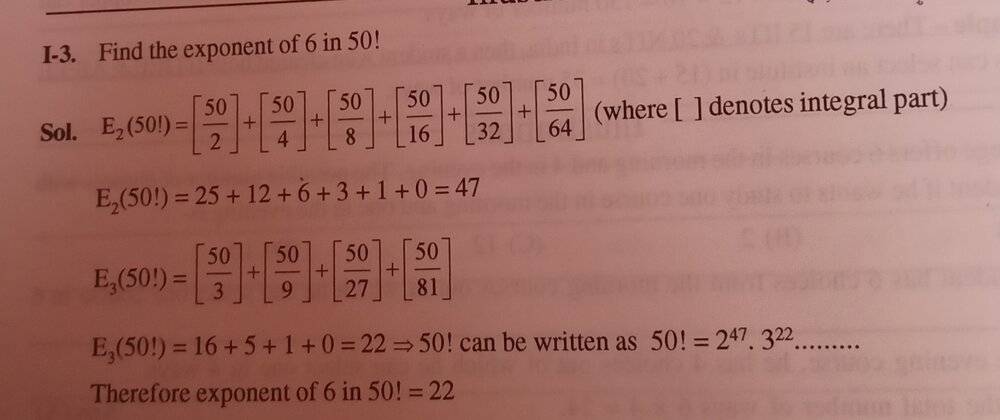
IMG_20201224_143619.jpg
 
Last edited by a moderator:
Physics news on Phys.org
It's just counting factors isn't it? It's not clear how much you understand.
 
PeroK said:
It's just counting factors isn't it? It's not clear how much you understand.
I think I overcomplicated it. Can you explain me from scratch.
 
sahilmm15 said:
I think I overcomplicated it. Can you explain me from scratch.
If you look at ##10!## say, then count the factors of ##2##. We have:

2, 4, 6, 8 and 10 all have a factor of 2 (that's five factors of 2)

4 and 8 have a second factor of 2 (that's two more factors of 2)

8 has a third factor of 2 (that's another one)

Altogether, therefore, ##10!## has eight factors of 2. And doing this for the other primes we see that: $$10! = 2^8 \times 3^4 \times 5^2 \times 7$$
 
  • Like
Likes sahilmm15
PeroK said:
If you look at ##10!## say, then count the factors of ##2##. We have:

2, 4, 6, 8 and 10 all have a factor of 2 (that's five factors of 2)

4 and 8 have a second factor of 2 (that's two more factors of 2)

8 has a third factor of 2 (that's another one)

Altogether, therefore, ##10!## has eight factors of 2. And doing this for the other primes we see that: $$10! = 2^8 \times 3^4 \times 5^2 \times 7$$
This was so simple. Thanks!
 
PeroK said:
If you look at ##10!## say, then count the factors of ##2##. We have:

2, 4, 6, 8 and 10 all have a factor of 2 (that's five factors of 2)

4 and 8 have a second factor of 2 (that's two more factors of 2)

8 has a third factor of 2 (that's another one)

Altogether, therefore, ##10!## has eight factors of 2. And doing this for the other primes we see that: $$10! = 2^8 \times 3^4 \times 5^2 \times 7$$
What I learned from this example is if you cannot comprehend a bigger problem take a smaller example and relate to the steps. I saw you doing this from past 2 answers and it worked beautifully.
 
  • Like
Likes PeroK
sahilmm15 said:
What I learned from this example is if you cannot comprehend a bigger problem take a smaller example and relate to the steps. I saw you doing this from past 2 answers and it worked beautifully.
Especially for these combinatorial problems. If in doubt, count for a low-value example. Often that's how you see what's going.

And, it gives you an answer to check against any general formula you come up with.
 
  • Informative
Likes sahilmm15

Similar threads

Replies
3
Views
2K
  • · Replies 1 ·
Replies
1
Views
2K
  • · Replies 11 ·
Replies
11
Views
3K
  • · Replies 29 ·
Replies
29
Views
4K
  • · Replies 6 ·
Replies
6
Views
3K
  • · Replies 2 ·
Replies
2
Views
2K
  • · Replies 4 ·
Replies
4
Views
4K
  • · Replies 6 ·
Replies
6
Views
3K
Replies
7
Views
2K
  • · Replies 9 ·
Replies
9
Views
1K