Using the principle of conservation of energy

Click For Summary
SUMMARY

The discussion centers on the application of the conservation of energy principle in quantum mechanics, specifically using the Hamiltonian equation H = T + V, where T represents kinetic energy and V represents potential energy. The user attempts to derive an analogy between this equation and Newton's laws by applying the condition dH/dt = 0. Feedback from other forum members highlights a critical error in the user's work, specifically the incorrect use of the derivative dV(x)/dt instead of the correct dV(x)/dx, which is essential for proper dimensional analysis and understanding of the potential energy function.

PREREQUISITES
  • Understanding of Hamiltonian mechanics
  • Familiarity with quantum mechanics concepts
  • Knowledge of Newton's laws of motion
  • Basic calculus, particularly differentiation
NEXT STEPS
  • Study Hamiltonian mechanics in detail
  • Learn about the relationship between potential energy and force
  • Explore the principles of quantum mechanics related to energy conservation
  • Review calculus concepts, focusing on differentiation of functions
USEFUL FOR

Students of physics, particularly those studying quantum mechanics and classical mechanics, as well as educators looking to clarify the relationship between energy conservation and motion laws.

Just_some_guy
Messages
16
Reaction score
0
Hi all,

I'm not 100% sure this belongs in this topic but it was a problem I was given in a quantum mechanics lecture so here goes, sorry if I am wrong.Anyway I was given a hamiltonian H= T+VWhere T is kinetic energy and av is potential, and asked to use

dH/dt= 0

to find an analogy between it and Newtons laws, now my work is far to long to post using the usual method so I have attached a photograph of all my work I hope it is clear what I have done, I just want to know if this is the correct approach or I have somehow magically confused myself into what seems to be a reasonable answer :)
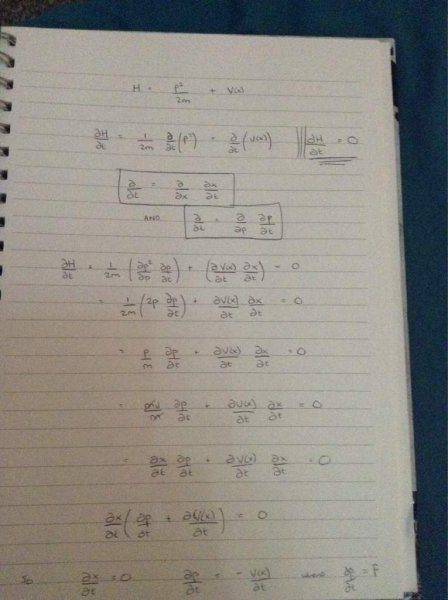
ImageUploadedByPhysics Forums1412978714.668321.jpg


Thanks for any help
 
Physics news on Phys.org
Just_some_guy said:
now my work is far to long to post using the usual method so I have attached a photograph of all my work
Let's be honest. It's not too long; you're just too lazy to type it in.
 
Ok fair enough! I'm using u phone so I find it much better to post photographs
 
V = V(x) so ##{\partial V\over \partial t} = 0##. However, that's not what you have in your relevant equation. From that (and from any first-grader dimensional analysis) you want ##{\partial V\over \partial x}## there. Coming close to Newton already ?
 
So potential between that a and 0 is not 0?
 
I'm not sure I follow what you are saying?
 
He's saying there's a mistake in the fifth line of your work.
 
Ah I see it! I have dV(x)/dt

Rather than what I should have which is

dV(x)/dx
 

Similar threads

  • · Replies 8 ·
Replies
8
Views
5K
Replies
6
Views
3K
Replies
5
Views
3K
  • · Replies 12 ·
Replies
12
Views
4K
  • · Replies 21 ·
Replies
21
Views
2K
Replies
7
Views
2K
Replies
3
Views
2K
  • · Replies 3 ·
Replies
3
Views
2K
  • · Replies 21 ·
Replies
21
Views
3K
  • · Replies 3 ·
Replies
3
Views
1K