Value that gives more than one stationary point

  • Thread starter Thread starter maxim07
  • Start date Start date
  • Tags Tags
    Point Value
Click For Summary
SUMMARY

The discussion centers on the behavior of quadratic equations, specifically regarding stationary points. It is established that a quadratic equation can have two stationary points unless the discriminant is zero, resulting in a single stationary point, or negative, leading to no stationary points. The equation discussed is f(x) = 2x³ - 12x² + zx + 30, with the condition that z must be less than 24 for two stationary points to exist. If z equals 24, there is one stationary point, and if z is greater than 24, there are no stationary points.

PREREQUISITES
  • Understanding of quadratic equations and their properties
  • Familiarity with the quadratic formula
  • Knowledge of stationary points and derivatives
  • Basic concepts of real and complex numbers
NEXT STEPS
  • Study the quadratic formula and its applications in finding roots
  • Learn about the discriminant and its role in determining the nature of roots
  • Explore the concept of stationary points in calculus
  • Investigate the implications of complex solutions in quadratic equations
USEFUL FOR

Students studying calculus, mathematicians analyzing quadratic functions, and educators teaching the properties of polynomials.

maxim07
Messages
53
Reaction score
8
Homework Statement
What value of z makes the curve have more than one stationary point
Relevant Equations
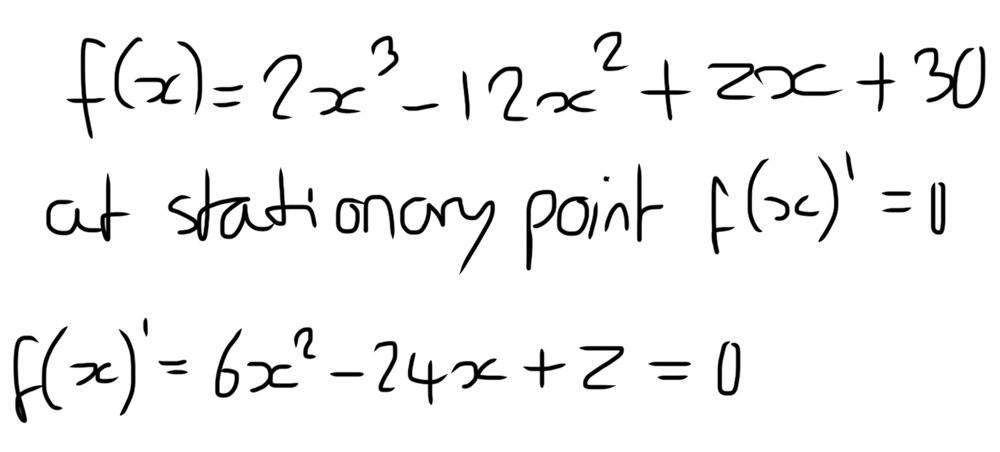
f(x) = 2x^3 -12x^2 + zx + 30
Here is my attempt at a solution
A252BB1F-99CE-4BA1-A73F-D77423075407.jpeg


I don’t know where to go from here, as the equation is a quadratic it will have two solutions which means there will be two stationary points, but I don’t know how to solve for z.
 
  • Like
Likes   Reactions: Delta2
Physics news on Phys.org
maxim07 said:
I don’t know where to go from here, as the equation is a quadratic it will have two solutions
Does a quadratic always have two solutions?
 
  • Like
Likes   Reactions: Delta2
Not if both brackets are the same
 
maxim07 said:
Not if both brackets are the same
I have no idea what you mean by that. What brackets?
 
  • Love
  • Haha
Likes   Reactions: docnet and Delta2
maxim07 said:
I don’t know where to go from here, as the equation is a quadratic it will have two solutions which means there will be two stationary points
That is only guaranteed if you allow complex solutions. When the problem expects only real solutions, the quadratic formula must have non-negative numbers inside the square root. That should allow you to get the restrictions on z.
 
  • Like
Likes   Reactions: Delta2
maxim07 said:
Not if both brackets are the same
I mean sometimes if you factor a quadratic the two bracketed terms you end up with are the same so you only have one solution
 
  • Like
Likes   Reactions: Delta2
maxim07 said:
I mean sometimes if you factor a quadratic the two bracketed terms you end up with are the same so you only have one solution
Can you always factorise a quadratic? What about ##x^2 + 1##?
 
maxim07 said:
I mean sometimes if you factor a quadratic the two bracketed terms you end up with are the same so you only have one solution
You need to use the quadratic formula. That will give you the factors, whether they are real, complex, integer, irrational, etc.
 
92E789C7-7147-4C2F-8701-56F2B124B030.jpeg

using the fact that the term under the square root can not be negative, this is what I get
 
  • Like
Likes   Reactions: FactChecker and Delta2
  • #10
So to summarize, there will be two stationary points if z < 24.

What happens if z = 24? Or if z > 24?

Comment - the usual way of writing the derivative of f at a value x is f'(x), not f(x)'. IOW, the "prime" symbol (an apostrophe) goes immediately after the function name.
 
  • #11
If z = 24 you get sqrt(0) , if z>24 you get a negative in the square root, neither of which are possible
 
  • #12
maxim07 said:
If z = 24 you get sqrt(0) , if z>24 you get a negative in the square root, neither of which are possible
No, both these cases are possible. If z = 24, there is only one stationary point. If z > 24, there are no stationary points. In the latter case, this means that the graph of ##f(x) = 2x^3 - 12x^2 + zx + 30## is always increasing; i.e., has no points at which the tangent line is horizontal.
 
  • Like
Likes   Reactions: docnet and FactChecker
  • #13
So if z =24 we get √0 so there is only one x solution and so one stationary point, if z > 24 we get √- so there are no solutions and no stationary points
 
  • #14
maxim07 said:
So if z =24 we get √0 so there is only one x solution and so one stationary point, if z > 24 we get √- so there are no solutions and no stationary points
Yes, on the real line. When you start to talk about complex numbers, there are complex solutions for the square root of negative numbers, but that is another subject.
 

Similar threads

  • · Replies 4 ·
Replies
4
Views
1K
Replies
2
Views
1K
Replies
2
Views
1K
  • · Replies 8 ·
Replies
8
Views
2K
  • · Replies 4 ·
Replies
4
Views
1K
  • · Replies 2 ·
Replies
2
Views
2K
Replies
2
Views
977
Replies
3
Views
2K
  • · Replies 11 ·
Replies
11
Views
2K
  • · Replies 5 ·
Replies
5
Views
2K