Undergrad Variations in the speed of sound in a star

Click For Summary
SUMMARY

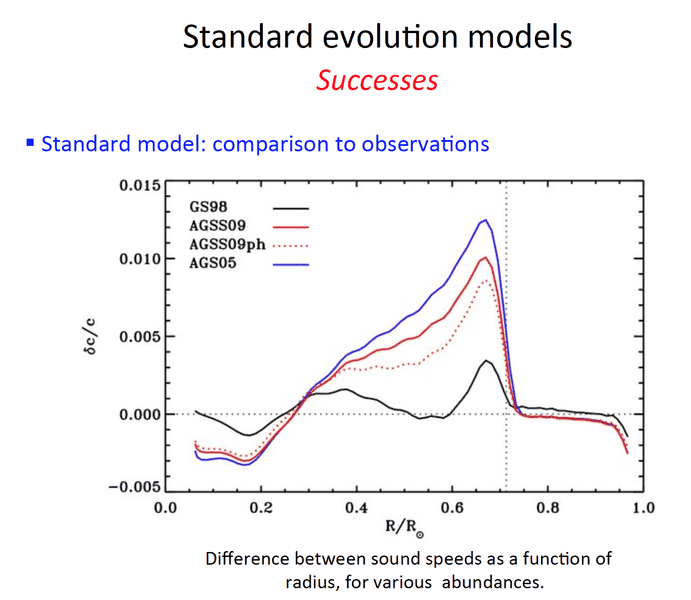
The discussion centers on the interpretation of the y-axis variable ##\delta c/c## in relation to the speed of sound variations within a star, specifically addressing whether it indicates relative error between theoretical and experimental values or fluctuations in sound speed. The participants highlight a significant discrepancy in current models within the radius range of 0.4 to 0.65 R/R0, questioning whether this region is characterized by radiative or convective zones. The need for clarity on these concepts is emphasized, particularly for those with a background in stellar physics.

PREREQUISITES
  • Understanding of stellar structure and zones (radiative and convective)
  • Familiarity with the concept of speed of sound in astrophysics
  • Knowledge of theoretical vs. experimental data analysis
  • Basic grasp of graphical data interpretation in scientific presentations
NEXT STEPS
  • Research the properties of radiative and convective zones in stars
  • Study the mathematical formulation of speed of sound in stellar environments
  • Explore methods for analyzing discrepancies between theoretical and experimental astrophysical models
  • Investigate graphical representation techniques for scientific data
USEFUL FOR

Astronomers, astrophysicists, and students studying stellar physics who seek to deepen their understanding of sound speed variations and model discrepancies in stellar environments.

fab13
Messages
300
Reaction score
7
I try to understand the following graphics with x-axis being the radius of a typical star :
oqCnR.png


I would like to knwo if ##\delta c/c## (y-axis) represents the relative error between theoretical and experimental values or if it represents the fluctuations of speed of sound inside. If these are fluctuations, one could get the mean speed all over radii or standard deviation.

I am not sure what it is exactly.

Any help is welcome
 

Attachments

  • oqCnR.png
    oqCnR.png
    44.5 KB · Views: 1,001
Last edited by a moderator:
Astronomy news on Phys.org
Can you give the source link? Even when using the Upload feature to attach a figure to your post, it is a good practice to post the source link. It also helps to avoid copyright issues. Thanks.
 
lecture is available on this link

Thanks in advance
 
fab13 said:
I would like to knwo if δc/c\delta c/c (y-axis) represents the relative error between theoretical and experimental values...
That's it. As explained in the graph on the previous page of the presentation you linked.
 
So the main discrepancy in current models is in the zone 0.4 - 0.65 R/R0 : can anyone could explain what's the origin of this issue ?

at R = 0.4 - 0.65 R0, are we in radiative or convective zone ?

Regards
 
Could anyone help me on this current discrepancy ? or if someone had stellar physics knowledge ... thanks
 
https://en.wikipedia.org/wiki/MoM-z14 Any photon with energy above 24.6 eV is going to ionize any atom. K, L X-rays would certainly ionize atoms. https://www.scientificamerican.com/article/whats-the-most-distant-galaxy/ The James Webb Space Telescope has found the most distant galaxy ever seen, at the dawn of the cosmos. Again. https://www.skyatnightmagazine.com/news/webb-mom-z14 A Cosmic Miracle: A Remarkably Luminous Galaxy at zspec = 14.44 Confirmed with JWST...

Similar threads

  • · Replies 48 ·
2
Replies
48
Views
6K
  • · Replies 1 ·
Replies
1
Views
3K
  • · Replies 3 ·
Replies
3
Views
1K
  • · Replies 2 ·
Replies
2
Views
2K
  • · Replies 9 ·
Replies
9
Views
2K
  • · Replies 75 ·
3
Replies
75
Views
9K
  • · Replies 19 ·
Replies
19
Views
5K
  • · Replies 48 ·
2
Replies
48
Views
6K
  • · Replies 23 ·
Replies
23
Views
6K
  • · Replies 9 ·
Replies
9
Views
4K